NACA member governments are: Australia, Bangladesh, Cambodia, China, Hong Kong SAR, India, Indonesia, I.R. Iran, Kingdom of Saudi Arabia, Korea (DPR), Lao PDR, Malaysia, Maldives, Myanmar, Nepal, Pakistan, Philippines, Sri Lanka, Thailand and Vietnam.
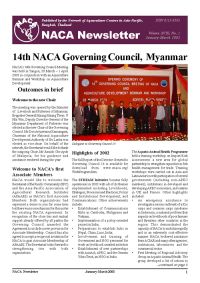
14th NACA Governing Council, Myanmar. Welcome to NACA's first Associate Member. NACA Alumni notes - U Minn Thame. Australian Youth Ambassador. Assisting in the Development of Recirculating Shrimp Farm Technologies. Nepal to join STREAM Initiative. NACA Joins Thai IT for Agriculture Forum. Indigenous Australian aquaculture group visits Thailand. Bangladesh Fisheries Training and Extension Project tour. Ugandan farmers train on catfish breeding and culture.
The Asia Regional Advisory Group on Aquatic Animal Health meets annually to discuss regional health issues including emerging disease threats. This report includes a review of regional disease status circa 2002, global and regional disease reporting arrangements, global issues and standards, progress in implementation of the Regional Technical Guidelines on Health management for the Responsible Movement of Live Aquatic Animals, identification and designation of regional aquatic animal health resources and regional and international cooperation.
This report, the eighteenth in the series, contains information about the aquatic animal health status of fifteen states in the Asia-Pacific region. The foreword discusses changes to the list of diseases covered in the report by the Asia Regional Advisory Group on Aquatic Animal Health.
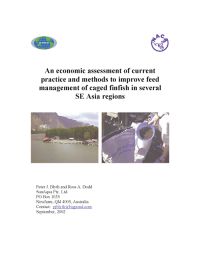
1 September 2002 | Peter J. Blyth and Ross A. Dodd | 2284 Downloads | .pdf | 882.45 KB
This paper examines farming practices in marine fish cage aquaculture in southeast Asia with reference to feed and feeding. It proposes a range of reforms to improve the economic performance of the sector, including selective breeding, use of hatchery-reared fingerings, modernisation of cage systems, improved feed management and use of dry pelleted feeds, relocation of cages to better quality sites and a greater degree of government and private sector co-operation in research and development.
This report, the seventeenth in the series, contains information about the aquatic animal health status of thirteen states in the Asia-Pacific region. The foreword discusses outcomes of the first meeting of the Asia Regional Advisory Group on Aquatic Animal Health.
The aim of this workshop was to formulate an approach which would enable participants to start detailed work on a process monitoring system, building on current activities and using already existing skills in Cambodia, Nepal, Philippines, Thailand and Vietnam. Objectives were to familiarise participants with recent developments in process monitoring and significant change, and to develop an action plan for each country and a set of guiding principles for a monitoring system to underpin work in all countries.
This is the report of the First Regional STREAM Regional Conference, held 19-21 June 2002 in Bangkok, Thailand. The conference was the first opportunity for participants in the STREAM Initiative, launched on 1 December 2001, to come together to discuss the programme. The conference discussed the main activities of STREAM, ways of working, communications strategies, feedback from participating countries and issues to follow up.
1 May 2002 | Sih Yang Sim | 1949 Downloads | .pdf | 2.7 MB
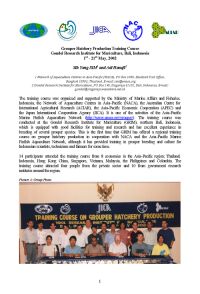
This report documents a training course that was held at the Research Institute for Mariculture, Bali, Indonesia in May 2003. The course covered both theoretical aspects of grouper husbandry via lectures and practical hands-on work in a grouper hatchery, including broodstock management, tank preparation egg collection, live feed production, health management, harvesting and transport and visits to commmercial grouper and milkfish hatcheries, grow-out facilities, markets and exporters.
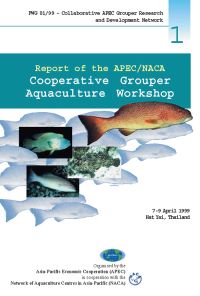
These are the proceedings of a workshop hosted by APEC and NACA under the project 'Collaborative APEC-NACA Grouper Aquaculture Network' (APEC Project FWG 01/99). The objectives of the workshop included the establishment of a regional research network to facilitate development of a sustainable grouper aquaculture industry; reduction of reliance on wild fingerlings for coastal grouper aquaculture, facilitate development of new aquaculture industries.
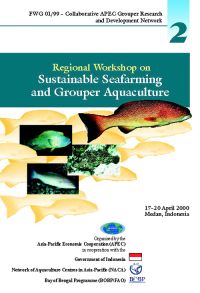
These are the proceedings of a workshop focussed on grouper culture, but also explored management strategies required to support the sustainable development of seafarming in the Asian region. The emphasis was on technology transfer and management strategies for the benefit of farmers and coastal communities. The workshop included special sessions on diversification of seafarming systems and culture species, the role of seafarming in the livelihoods of coastal communities.
Governing Council 13 / AFBiS Seminar. US Consultation sets work agenda for the WB-NACA-WWF-FAO. Consortium on Shrimp Farming and the Environment. Conclusions and Recommendations of the Joint meeting of AFBiS 2002 and the 13th NACA Governing Council. FAO/NACA Expert Consultation Focusing on Aquaculture and Small-scale Aquatic Resource Management for Poverty Alleviation. Myanmar Fishery and Livestock Fair 2002 a huge success. Nepal develops national strategy on aquatic animal health management. Shrimp Farming & the Environment Case Studies now available on the web. NACA implements APEC project on Import Risk Analysis. MOU on project to prevent disease losses on prawn farms. Andhra Pradesh Fisheries Minister studies Thai & Malaysian aquaculture systems. Vietnamese mission evaluates new high value Chinese species.
STREAM is a regional initiative that will support capacity building among local government institutions, NGOs, and community groups involved in aquatic resources management. It will support community-based learning initiatives, develop a regional communications and learning strategy and support on-going policy and institutional changes in the region to enable aquatic resources users to participate more effectively in policy-making processes, and encouraging the development of more responsive government institutions.
This document provides the report of a joint APEC/FAO/NACA/SEMARNAP expert workshop held in Mexico, July 2000. The workshop aimed to review existing knowledge on the impacts of trans-boundary aquatic animal pathogen movement, review management strategies to control impacts, to identify potential future managemment interventions at national and international levels, to review existing knowlege on standardisation or diagnostic techniques and to develop a follow up programme for standardisation of aquaculture health management measures.