NACA frequently organises technical workshops and consultations on aspects of aquaculture. The proceedings of such meetings are made available for free download. Audio and video recordings of technical presentations are also available for some meetings (please see the podcast section).
NACA publishes a wide range of aquaculture publications including technical manuals, workshop proceedings, better practice guidelines and several serials including Aquaculture Asia Magazine, the NACA Newsletter and the Quarterly Aquatic Animal Disease Report. To keep up to date with developments you could consider subscribing to our RSS feed.
Annual consumption of Artemia is now estimated at 3,500 – 4,000 tonnes, underpinning the production of over 900 billion crustacean post larvae and fish fry. With approximately 90 percent of the current Artemia production harvested from inland salt lakes, the future of the hatchery industry could be at risk and requires urgent attention. The purpose of the workshop was to explore needs and opportunities for a new international initiative to guarantee a more sustainable provision of Artemia, both from natural sources and from controlled extractive Artemia farming integrated with salt production and other fish/crustacean aquaculture.
16 June 2020 | Rishi K. Tyagi, D.H.N. Munasinghe, K.H.M. Ashoka Deepananda, Frank Niranjan and Ravi K. Khetarpal | 5884 Downloads | .pdf | 4.79 MB
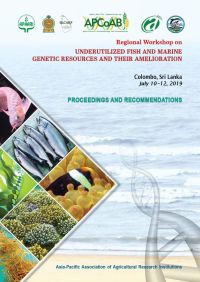
The workshop was held from 10-12 July 2019, Colombo, Sri Lanka. The objectives of the workshop were to i) assess the current status of underutilised aquatic genetic resources at the regional level and to assess R&D status of priority species with potential for use in food and agriculture; ii) discuss knowledge gaps and regional priorities concerning underutilised genetic resources and create awareness on their role and value for diversification of food supplies and livelihoods; and iii) formulate strategies for strengthening the institutional framework for management and conservation of genetic resources at the regional level.
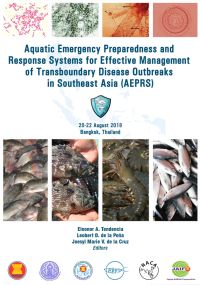
The ASEAN Regional Technical Consultation on Aquatic Emergency Preparedness and Response Systems for Effective Management of Transboundary Disease Outbreaks in Southeast Asia was held from 20-22 August 2018 in Bangkok, Thailand. The consultation discussed the status of and/or need for aquatic emergency preparedness and response systems for effective management of transboundary disease outbreaks in Southeast Asia. Issues were addressed through country reports, technical presentations and a workshop.
3 April 2019 | Johanna Johnson, Cassandra De Young, Tarub Bahri, Doris Soto and Cherdsak Virapat (eds.) | 5211 Downloads | .pdf | 3.81 MB
Climate variability and change are affecting hydro-meteorological cycles and altering aquatic ecosystems, driving shifts in physical and chemical processes, ecological communities and the distribution and abundance of species. These changes have implications for fisheries management, food security and the livelihoods of more than 600 million people worldwide. The FishAdapt conference was held in Bangkok from 8 to 10 August, 2016. It provided a forum to share practical experiences in understanding the vulnerabilities associated with climate change and ocean acidification and the development of risk management and adaptation strategies.
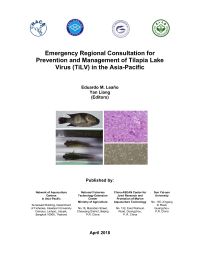
Since 2009, tilapia aquaculture has been threatened by mass die-offs in Israel and Ecuador, caused by a novel Orthomyxo-like (RNA) virus named Tilapia lake virus. An Emergency Regional Consultation for Prevention and Management of Tilapia Lake Virus in the Asia-Pacific was undertaken in September 2017, China, to discuss and plan actions on the overall prevention and management of the disease, and to prevent its further spread. These are the technical proceedings of the workshop.
1 September 2017 | Neeraj Sood, P.K. Pradhan, Gaurav Rathore, T.R. Swaminathan, Charan Ravi, Reeta Chaturvedi, Subhash Chandra, Ravi Kumar and Kuldeep K. Lal | 3954 Downloads | .pdf | 40.72 MB
These are the proceedings of a symposium convened by the ICAR National Bureau of Fish Genetic Resources, Lucknow, India, from 20-21 April 2017. The symposium included presentations from national and international experts on aquatic animal epidemiology and related disciplines to address a range of risk factors that catalyse horizontal spread of disease, spread of transboundary pathogens and increased disease susceptibility, thereby contributing to strengthening of surveillance efforts, especially in the Indian context.
19 January 2017 | Cherdsak Virapat, Simon Wilkinson and Doris Soto | 4282 Downloads | .pdf | 1.68 MB
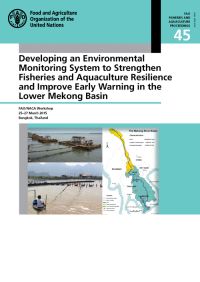
These are the proceedings of a consultation on the existence and effectiveness of environmental monitoring systems for fisheries and aquaculture in the Lower Mekong basin. The document provides a baseline assessment of environmental monitoring systems in Cambodia, Thailand and Vietnam and the report of a workshop to discuss the assessments findings and future steps towards an improved environmental monitoring and early warning system that will contribute to climate change adaptation in fisheries and aquaculture in the area.
The main objective of this symposium is to provide a venue for information sharing on extension of small-scale aquaculture, specifically targeted to those individuals and relevant organizations involved in various aquaculture development projects. The symposium will also assess and present the effectiveness of “farmer-to-farmer extension” approach in the implementation of relevant aquaculture development projects in the region. The symposium was organised for stakeholders in JICA-assisted projects in SE Asia and Africa.
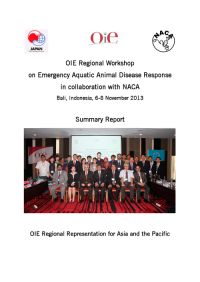
The workshop was held in Bali, Indonesia from 6 to 8 November 2013. The programme included reports on current aquatic animal disease situations in selected countries and presentations on the national aquatic animal health programmes of China, Japan and Korea. In addition, case studies on the molluscan diseases, shrimp diseases and finfish diseases were presented to facilitate the subsequent discussion on emergency response of those diseases in the national and regional level.
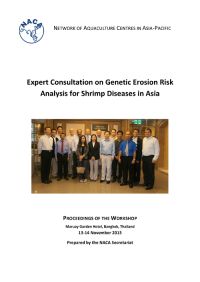
Shrimp aquaculture in tropical regions is facing a disease-induced catastrophe of lost production. There is reason to believe that current (poor) broodstock management practices may induce genetic erosion that increases susceptibility to disease and vulnerability to epizootics. The basic tenet for this consultation is that an important aggravating factor in the disease crisis is an agro-economic system that locks shrimp breeders, hatcheries and farmers into behaviour that induces high levels of inbreeding.
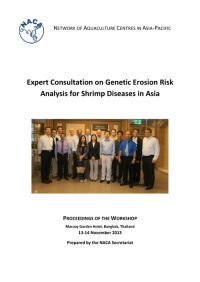
Shrimp aquaculture in tropical regions is facing a disease-induced catastrophe of lost production. There is reason to believe that current broodstock management practices may induce genetic erosion that increases susceptibility to disease and vulnerability to epizootics. The basic tenet for this Expert Consultation is that an important aggravating factor in the disease crisis is an agro-economic system that locks shrimp breeders, hatcheries and farmers into behaviour that induces high levels of inbreeding.
This report is the proceedings of a workshop held under the FAO technical cooperation project Emergency assistance to control the spread of an unknown disease affecting shrimps held in Hanoi, Viet Nam from 25 to 27 June 2013. The workshop reviewed recent investigations into the cause of acute hepatopancreatic necrosis syndrome, believed to related to a strain of Vibrio parahaemolyticus and drew a number of recommendations on specific and generic actions and measures for reducing the risk of AHPND.
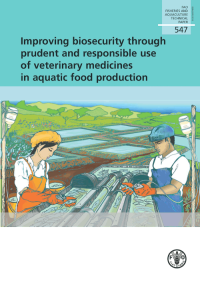
These are the proceedings of the FAO/AAHRI Expert Workshop on Improving Biosecurity through Prudent and Responsible Use of Veterinary Medicines in Aquatic Food Production, held in Bangkok, Thailand, from 15 to 18 December 2009. The workshop discussed the current status of antimicrobial usage in aquaculture and the impacts of their irresponsible use on human health, the aquatic environment and trade. The outcomes are relevant to the development of guiding principles on the responsible use of antimicrobials in aquaculture.
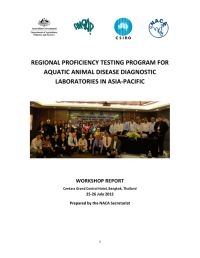
This is the report of the first workshop of the Regional proficiency testing program for aquatic animal disease diagnostic laboratories in Asia-Pacific, held from 25-26 July 2012 in Bangkok, Thailand. The objectives of the programme were to strengthen Asia’s regional capability to diagnose important aquatic animal diseases that impact on trade, train participating laboratory personnel in diagnostic standards and proficiency testing procedures, and to provide technical assistance to improve laboratory performance.
27 May 2012 | Rohana P. Subasinghe, J. Richard Arthur, Devin M. Bartley, Sena S. De Silva, Matthias Halwart, Nathanael Hishamunda, C.V. Mohan and Patrick Sorgeloos (Eds.) | 3802 Downloads | .pdf | 12 MB
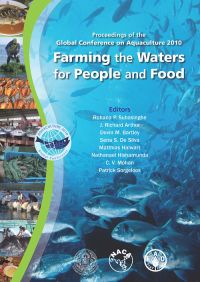
The Global Conference on Aquaculture 2010 reviewed the present status and trends in aquaculture development, addressed emerging issues relevant to aquaculture development, assessed opportunities and challenges for future aquaculture development and built consensus on advancing aquaculture as a global, sustainable and competitive food production sector. This volume provides information on how aquaculture could be mobilized to alleviate global poverty and improve food and nutrition security in the coming decades.
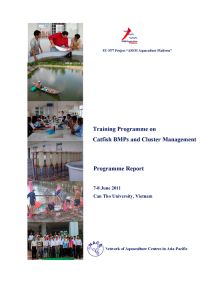
This is the report of a training programme on better management practices (BMPs) for catfish aquaculture and cluster-based management, which was held at the Faculty of Fisheries and Aquaculture, Can Tho University, Vietnam, 7-8 June 2011. The purpose of the training programme was to build capacity and awareness of selected cluster leaders, lead farmers and provincial extension officers on catfish BMPs, implementation of BMPs, group formation and operation.
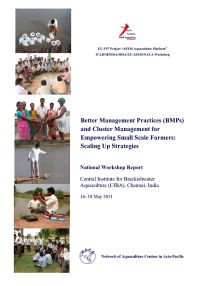
The workshop was held in Chennai, India from 16-18 May 2011, at the Central Institute for Brackishwater Aquaculture. It was convened as an activity of the ASEM Aquaculture Platform, funded by the European Commission’s 7th Framework Programme. The main purpose of the national workshop was to develop practical scaling up strategies at the national level and build consensus for an implementation plan for wider adoption of shrimp BMPs through a cluster management approach.
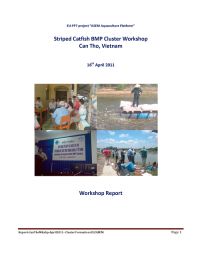
The purpose of the workshop, held in Can Tho Vietnam on 16 April 2011, was to build capacity and awareness of prospective cluster farmers and their leaders on the adoption of better management practices through cluster based management. The workshop shared experiences in cluster formation from other Asian countries and developed a join work programme for implementation of the project.
4 February 2011 | Miao Weimin, Sena De Silva and Brian Davy (eds.) | 6370 Downloads | .pdf | 1.16 MB
This regional review study is an effort to promote improved inland fisheries management under the Code of Conduct for Responsible Fisheries. It covers ten Asian countries with significant inland capture fisheries, namely Bangladesh, China, India, Indonesia, the Republic of Korea, Myanmar, Nepal, Sri Lanka, Thailand and Viet Nam. The papers were presented and discussed at a regional workshop held from 8-11 February 2010 in Pattaya, Thailand. Audio recordings of the presentations are also available for download.
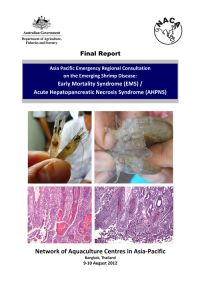
On 9-10 August 2012, an emergency regional consultation on Early Mortality Syndrome of shrimp and associated pathology described as acute hepatopancreatic necrosis syndrome was held in Bangkok, Thailand. The consultation shared information on this emerging disease, its occurrence, pathology and diagnosis, and to develop a coordinated regional response to the issue. Audio recordings of 19 technical presentations made at the regional Consultation meeting are available on NACA website, and the presentation slides are also available.