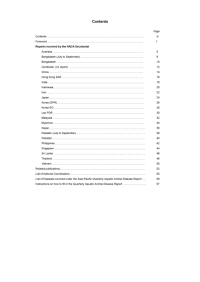
NACA member governments are: Australia, Bangladesh, Cambodia, China, Hong Kong SAR, India, Indonesia, I.R. Iran, Kingdom of Saudi Arabia, Korea (DPR), Lao PDR, Malaysia, Maldives, Myanmar, Nepal, Pakistan, Philippines, Sri Lanka, Thailand and Vietnam.
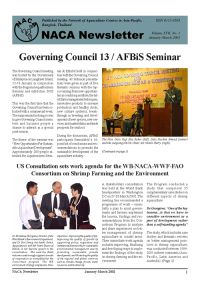
Governing Council 13 / AFBiS Seminar. US Consultation sets work agenda for the WB-NACA-WWF-FAO. Consortium on Shrimp Farming and the Environment. Conclusions and Recommendations of the Joint meeting of AFBiS 2002 and the 13th NACA Governing Council. FAO/NACA Expert Consultation Focusing on Aquaculture and Small-scale Aquatic Resource Management for Poverty Alleviation. Myanmar Fishery and Livestock Fair 2002 a huge success. Nepal develops national strategy on aquatic animal health management. Shrimp Farming & the Environment Case Studies now available on the web. NACA implements APEC project on Import Risk Analysis. MOU on project to prevent disease losses on prawn farms. Andhra Pradesh Fisheries Minister studies Thai & Malaysian aquaculture systems. Vietnamese mission evaluates new high value Chinese species.
STREAM is a regional initiative that will support capacity building among local government institutions, NGOs, and community groups involved in aquatic resources management. It will support community-based learning initiatives, develop a regional communications and learning strategy and support on-going policy and institutional changes in the region to enable aquatic resources users to participate more effectively in policy-making processes, and encouraging the development of more responsive government institutions.
This document provides the report of a joint APEC/FAO/NACA/SEMARNAP expert workshop held in Mexico, July 2000. The workshop aimed to review existing knowledge on the impacts of trans-boundary aquatic animal pathogen movement, review management strategies to control impacts, to identify potential future managemment interventions at national and international levels, to review existing knowlege on standardisation or diagnostic techniques and to develop a follow up programme for standardisation of aquaculture health management measures.
This report, the eighth in the series, contains information about the aquatic animal health status of sixteen states in the Asia-Pacific region. The foreword discusses capacity building initiatives to improve disease surveillance in the region.
This report, the sixth in the series, contains information about the aquatic animal health status of twenty states in the Asia-Pacific region. The foreword discusses capacity building initiatives to improve disease surveillance in the region.
This report, the fifth in the series, contains information about the aquatic animal health status of eighteen states in the Asia-Pacific region. The foreword discusses improvements in the quality of reporting.
This report, the third in the series, contains information about the aquatic animal health status of seventeen states in the Asia-Pacific region. The foreword discusses improvements in the quality of reporting.
This report, the second in the series, contains information about the aquatic animal health status of fourteen states in the Asia-Pacific region. The foreword discusses the establishment of the regional disease reporting system.
1 December 1985 | Mali Boonyaratpalin, E.W. McCoy and Tanaporn Chittapalapong | 2405 Downloads | .pdf | 194.65 KB
This publication describes the culture practices and socio-economic aspects of snakehead farming in Thailand circa 1985. It covers snakehead biology, culture systems, site selection, stocking and rearing, feeding and health aspects. The paper also describes economic profile of snakehead farmers, seed procurement, feed costs and feeding issues, fixed, variable and opportunitic costs of production. It also investigates the relationship between farmer experience, farm size, and profitability of snakehead farming.
Ths paper enumerates different carp integrated farming systems being prevalent in Asia along with successful case studies indicating potential and constraints of such systems. It recommends to integrate carp farming with agriculture and irrigation, livestock farming, sewage utilisation and water pollution control not only to increase the productivity of land and water and improve the economic conditions of poor farmers but also to maintain health and hygiene of the rural poor and city dwellers alike.
1 September 1983 | Mali Boonyaratpalin and Paiboon Vorasayan | 1611 Downloads | .pdf | 128.42 KB
The farming of the giant freshwater prawn has expanded rapidly in Thailand. Production has increased from less than 3 tons/year in 1976 to an estimated output of more than 1,200 tons in 1982. This rapid growth was largely stimulated by the Chachoengsao Fisheries Station established solely to promote culture of the prawn. Services of the station comprise the production and free distribution of post-larvae from 1976-1978, along with training and extension programmes.