Thailand charts a course for the future of its aquaculture
23 July 2026 | 701 views
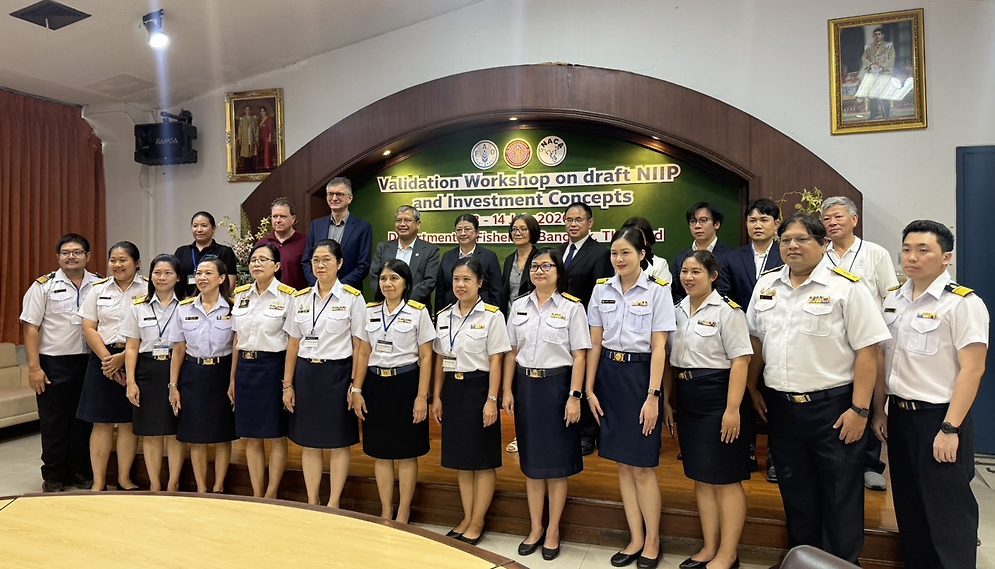
Thailand's aquaculture industry is one of the country's great success stories, but a changing world of climate pressure, disease risk, tougher export markets, and cheaper competitors is spurring the sector to innvate and adapt. On 13 July 2026, stakeholders from across the sector gathered at the Department of Fisheries in Bangkok to shape that response, meeting to review and validate a draft National Innovation and Investment Plan for aquaculture - part of a wider regional FAO Technical Cooperation Programme, implemented by NACA, that is assisting Thailand, India, and the Philippines to transform their industries.
The workshop brought together diverse interests including government, researchers, exporters, feed and farming companies, industry associations, and aquaculture standards bodies, reflecting the plan's premise that transformation cannot be delivered by government alone. Opening the workshop, Dr Thitiporn Laoprasert, Director General of the Department of Fisheries, called the plan a significant milestone for the sector, and set the tone with invitation to critically evaluate the draft plan and improve it.
At the heart of the plan is a vision for Thailand to become a global leader in innovative aquaculture by 2030, using data driven approaches, precision farming, and partnerships to deliver production that is competitive, environmentally responsible, and socially inclusive. The message running through the workshop was that the country's future lies not in ever-greater volume but in improved quality, innovation, and value. That ambition is anchored by three connected ideas: a national innovation and investment "Aqua Hub" to help bring promising research and start-ups to market; a premium branding effort to help Thai producers stand out and command higher prices; and a "next generation" programme to draw new talent, skills, and entrepreneurship into the industry.
Working in groups, participants endorsed the overall vision and contributed a wealth of practical ideas to strengthen the alignment and implementation. Among the suggestions was a focus on how progress could best be measured, with participants offering to help refine the plan's indicators into a clear, workable set that stakeholders can readily track and rally around.
Participants also enriched the plan with valuable additional perspectives: the opportunity to invest in skilled workers alongside young entrepreneurs; the potential to build stronger brands for local species such as tilapia and catfish; and ways to strengthen traceability across supply chains by engaging every actor, including the brokers and middlemen who play a key role. Contributions like these added real depth to an already ambitious plan.
The afternoon turned to a set of investment concepts designed to put the ideas into practice. Participants worked through each one in turn, discussing how it could be strengthened and taken forward, with a shared determination to translate the concepts into real, workable projects that deliver on the ground.
By the close, the day was judged a productive validation of both the plan and the ideas behind it, and the Department of Fisheries signalled its commitment to begin work on the selected projectst. The technical team will now fold the workshop's contributions into a revised draft and develop the investment concepts further, with volunteers from each group helping carry the ideas forward. There is also a sense that the three flagship ideas could come together as a single, coordinated programme, linked to a wider regional "AquaHub Asia" initiative that would connect Thailand's efforts with those of its neighbours.
The next milestone is a regional meeting in Bangkok in late November, where Thailand, India, and the Philippines will compare notes and share progress. Perhaps the most important conclusion, though, was also the simplest, voiced as the workshop ended: the plan belongs to Thailand's stakeholders, with FAO and NACA there to support and facilitate.
Creative Commons Attribution.
Related
Aquaculture transformation: Innovation and investment for sustainable intensification and expansion of aquaculture in Asia and the Pacific region
24 March 2025 | FAO, NACA | 13782 views | .pdf | 4.76 MB