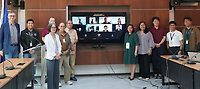
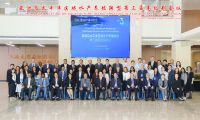
The Philippines is preparing a five-year National Innovation and Investment Plan to modernise its aquaculture sector. In September 2026, BFAR, NACA and FAO met with researchers and industry representatives in Quezon City to review the draft.
The plan covers the country's five priority commodities: seaweed, milkfish, tilapia, shrimp and shellfish. It aims to accelerate and build on extend existing government targets for industry development.
Proposals include better-quality certified seed, stronger disease diagnosis and biosecurity support, and a clear path for farms to move up the levels of good aquaculture practices certification to reach better-paying markets. The plan also looks at solar power and smart equipment to cut farm energy costs.
Other proposals include digital tools for certification and traceability, and closer links between farmers and buyers. It also targets higher exports of seaweed, milkfish and shrimp. The final plan is due to commence implementation in early 2027 and will help attract investment into the sector.
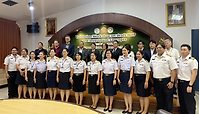
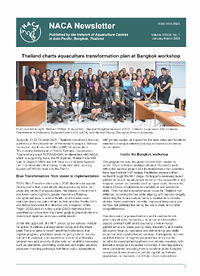
Thailand's aquaculture industry is one of the country's great success stories, but climate pressure, disease risk, tougher export markets, and cheaper competitors are spurring the sector to innovate and adapt. On 13 July 2026, stakeholders from government, research, industry, and the export and standards communities gathered at the Department of Fisheries in Bangkok to review and validate a draft National Innovation and Investment Plan for aquaculture, developed under a regional FAO Technical Cooperation Programme implemented by NACA that is also assisting India and the Philippines.
At its heart is a bold vision: for Thailand to become a global leader in innovative aquaculture by 2030, competing on quality, innovation, and value rather than volume, anchored by three connected ideas spanning innovation, premium branding, and the next generation of aquaculture talent.
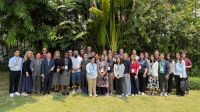
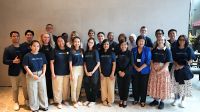
AquaInnovate 2 brought together 12 startups, scientists, and industry leaders in Bangkok from 23-27 March 2026, continuing the momentum to accelerate nature-based solutions and climate innovation across the Asia-Pacific, with financial from Canada's International Development Research Centre.
The week blended intensive learning with practical experience. Entrepreneurs pitched breakthrough ideas in biotechnology, community enterprise, and regional scaling, then refined their business models through expert coaching circles. Field visits to innovative Thai aquaculture sites connected theory with real-world practice, while a high-stakes "Shark Tank" session challenged innovators to defend their ideas before experienced investors and business leaders. A culinary showcase highlighted the importance of engaging buyers and chefs as essential partners in market success - not just scientists and farmers.
The week concluded with the unveiling of the AquaHub Vision, a roadmap for a permanent digital platform to sustain and grow the pan-regional network of aquaculture innovators into 2026 and beyond.
Videos of workshop presentations will be available on this page and NACA's YouTube channel shortly.
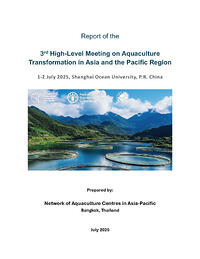
The third High-Level Meeting on Aquaculture Transformation assessed progress towards 2030 transformation goals and identified priority actions for the Asia-Pacific region. The meeting report, covering discussions held 1-2 July 2025 in Shanghai, documents findings from representatives of NACA member governments, FAO and regional organisations.
Participants identified multiple barriers to sustainable intensification: farmer scepticism about unfamiliar technologies, limited access to expertise, and misaligned incentives that prioritise profit over environmental responsibility. Investment remains concentrated at higher levels rather than reaching small-scale producers. The discussions emphasised collaborative approaches, knowledge-based farming systems, and the need to document aquaculture's positive social impacts.
NACA and FAO will continue supporting National Innovation and Investment Plans in India, the Philippines, Thailand and Vietnam. Future work includes establishing an Aquaculture Innovation and Investment Hub and developing monitoring systems to track transformation progress across the region.
Bangkok, 7 October - NACA convened a one-day, in-person working group to shape the vision, mission and strategy for the AquaHub, a startup incubator and support network for innovators in the aquaculture space. The workshop focused on establishing the AquaHub’s vision, mission, values and partnership principles to define how it will operate, and the immediate steps required to mobilise partners and resources across the Asia–Pacific.
Participants began by clarifying the problems AquaHub should address and why a dedicated hub is the right vehicle. Small group exercises produced draft vision and mission statements looking to 2035, which were then refined through rapid peer feedback. This work was grounded in a brief review of AquaHub’s current status and the wider innovation landscape to ensure complementarity with existing efforts.
6 October 2025 | Arun Konduri, Raveendar Banothu, Shyam Prasad. M, Potluri Sai Kishore, Kalithkar Bheemeswararao | 9895 Downloads | .pdf | 329.47 KB
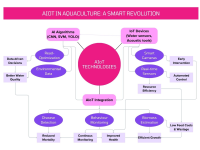
Aquaculture is changing as farms add artificial intelligence (AI) and the Internet of Things (IoT). Sensors and cameras watch water quality and animal behaviour, while software analyses the data to guide feeding, detect disease early, and plan harvests. This “AIoT” approach helps farmers act faster and with more accuracy.
This article reviews the main uses now in play such as automatic counting of postlarvae, biomass estimation, smart feeding, water-quality monitoring, behaviour tracking, and health diagnostics. The benefits include higher productivity, lower costs, and better fish welfare. Barriers to adoption are also summarised such as equipment cost, connectivity, and training needs.
AquaInnovate was an immersive AquaHub networking and coaching event for aquaculture entrepreneurs and startups was held in Bangkok from 12-19 May. AQUAINNOVATE brought together promising startups to pitch their ideas, network, and participate in expert coaching circles.
Convened by NACA and FutureFish with funding support from Canada's International Development Research Centre, the programme included sessions on business fundamentals, investing for impact, nature and community based business innovations, and interactions with experts from the the National Innovation Agency, Center of Excellence for Shrimp Molecular Biology and Biotechnology, the National Center for Genetic Engineering and Biotechnology, and Mahidol University.
The programme included visits to local farms that are driving innovation and leading the industry, panel discussions on the aquaculture startup ecosystem and nature-based seafood markets and creative partnerships.
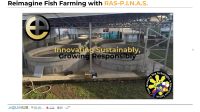
Elisa Claire Sy of E-Primate presents RAS-P.I.N.A.S, a closed-loop, water-efficient system for land-based fish farming. The technology integrates biofiltration, aeration, and mechanical treatment to support high-density production while conserving water and land and reducing disease risk. RAS-P.I.N.A.S also offers flexibility in farm siting, with trade-offs in energy use and infrastructure costs. Recirculating aquaculture systems are gaining traction as a key innovation in Asia’s sustainable aquaculture future.
20 August 2025 | Wanalida Rungrassamee | 2464 views
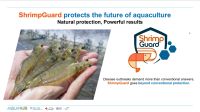
ShrimpGuard, developed by BIOTEC, NSTDA, and Kasetsart University in Thailand, is a phage-based innovation for managing shrimp health. It targets Vibrio infections using bacteriophages combined with immune-boosting agents, reducing antimicrobial use while improving farm productivity and sustainability across ASEAN. The project also engages farmers directly through training, outreach, and field trials to ensure practical application and lasting benefits for coastal communities and the wider aquaculture sector. This pitch was presented by Wanilada Rungrassamee of BIOTEC.
Circular nutrition in aquaculture focuses on reducing waste and closing nutrient loops by transforming fish byproducts into sustainable aquafeed. Simon Das from the Tropical Aquafeed Innovations Lab at James Cook University presents how this model can cut reliance on wild-caught forage fish while supporting cost-effective, nutritionally balanced diets. The lab’s work includes developing weaning protocols for pellet-ready fingerlings, training farmers in advanced feeding practices and economics, and promoting gender and youth inclusion. Circular nutrition highlights how rethinking resource use can make aquaculture both more efficient and more sustainable.
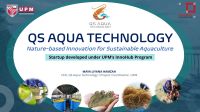
QS Aqua Technology, a startup from the InnoHub Program of Universiti Putra Malaysia, develops nature-based probiotic solutions for sustainable aquaculture. Their approach combines beneficial bacteria that support gut health and maintain balanced pond ecosystems with quorum sensing inhibition compounds from microalgae. These compounds block harmful bacteria from communicating, preventing disease outbreaks and reducing dependence on antibiotics. By improving pond health and resilience through microbial and algal innovations, QS Aqua Technology offers farmers safer, more sustainable tools to manage aquaculture production. This pitch was presented by Maya Liyana Hamzah of QS Aqua Technology.
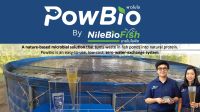
PowBio is a microbial inoculant developed by NileBioFish (NINEBIO GROUP Co., Ltd.) in Thailand to support sustainable biofloc aquaculture systems. Co-developed with Maejo University’s Faculty of Fisheries and Aquatic Resources and supported by the Thailand National Innovation Agency, PowBio uses high-efficiency microorganisms to turn fish pond waste into natural protein. By reducing ammonia and nitrite levels, improving water quality, and recycling nutrients within ponds, PowBio helps farmers cut feed costs, lower water exchange needs, and reduce chemical inputs. The result is healthier harvests without muddy off-flavors—delivered through a practical, low-cost, and easy-to-use solution for more productive and resilient aquaculture. This pitch was presented by Nissara Kitcharoen of NileBiofish.
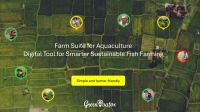
Farm Suite by Greenovator is a digital farm management tool tailored for aquaculture in Myanmar. The platform helps farms and agribusinesses streamline planning and daily operations by tracking activities, inputs, and yields through a real-time, business-grade dashboard. Recognised as a top-3 innovation in the Grow Asia Challenge, Farm Suite provides an affordable, professional alternative to manual record-keeping. With its mobile app interface, it delivers actionable insights that empower aquaculture managers to boost productivity and sustainability. This pitch was presented by Yin Yin Phyu.
20 August 2025 | Mariska Bottema and Rebecca McMillan | 2478 views
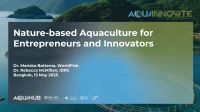
Mariska Bottema (WorldFish) and Rebecca McMillan (IDRC) discuss the concept of nature-based aquaculture, why it matters for innovation and entrepreneurship, and how it can support ecosystems, communities, and profitability. Topics include: Defining nature-based aquaculture and its connection to nature-based solutions; criteria such as climate resilience, ecosystem health, reduced antimicrobial use, and inclusivity; global examples: mangrove–shrimp integration, women-led seaweed farming, integrated multi-trophic systems, and rice–fish farming; supportive technologies including IoT, renewable energy, and life cycle assessment; and opportunities for entrepreneurs: resilient farms, reduced risks, lower costs, premium markets, funding, and partnerships.
The 3rd High‑Level Meeting on Aquaculture Transformation in Asia and the Pacific, held 1–2 July in Shanghai, brought together governments, industry leaders and development partners to drive innovation, investment and sustainability in the region’s aquaculture sector. Discussions focused on scaling low‑cost fish production, making technology adoption easier for small farmers, improving access to finance, and strengthening regional cooperation. The meeting set clear priorities for accelerating transformation by 2030, with resources and key presentations now available online. Videos of the presentations are available for viewing on YouTube.
This video by Mike Phillips, CEO of FutureFish, explores the current state of aquaculture innovation and investment across the Asia-Pacific region. Technology innovation is advancing, especially for higher-value species, but challenges remain in scaling inclusive value chains and building climate resilience. Despite growth in private investment, significant financing gaps persist—particularly for SMEs and smallholders, who make up 90% of the sector. National policies, governance, and regulatory environments strongly influence the adoption and scaling of innovations.
The presentation highlights the importance of partnerships, innovation hubs, and better alignment between financing and transformation priorities to achieve sustainable and inclusive aquaculture development.
31 July 2025 | Tipparat Pongthanapanich | 2573 views
This video by Tipparat Pongthanapanich, FAO, provides an overview of the development of National Innovation and Investment Plans (NIIPs) and the regional Aquaculture Transformation Monitoring, Evaluation and Learning System (ATMS). NIIPs aim to guide each country's strategic priorities for innovation and investment in aquaculture through 2030, aligned with the regional transformation vision. ATMS will support regional progress tracking and knowledge sharing.
An FAO-led technical cooperation project project is supporting the pilot development of NIIPs and ATMS in four countries - India, Thailand, Viet Nam, and the Philippines - with a view to wider regional application. Key components include strategic visioning, policy alignment, project formulation, and robust monitoring systems to drive inclusive, sustainable aquaculture development.