The Gender Programme was established to ensure that NACA implements the action plans on gender mainstreaming within its activities. With a continued interest in embracing gender integration among relevant agencies, NACA aims to build up capacity of members in gender mainstreaming in all its undertakings, and motivate support and action globally.
Insufficient capacity for gender research and application among stakeholders is a hindrance to effectively implement programs integrating the gender dimensions in development. Adding a gender dimension in aquaculture value chains will give assurance to consumers that seafood has been produced sustainably.
Key activities
Key activities of the programme are:
Women, Youth and Aquaculture Development Programme.
Organising and supporting symposia on Gender in Aquaculture and Fisheries.
Capacity building on gender integration and mainstreaming.
Curriculum development on gender in aquaculture and fisheries education.
In-country gender assessment reports for policy, action and research.
Publication of case studies and success stories on gender in aquaculture value chains.
Coordinating the Regional Gender Practitioners’ Network and mentoring programmes.
Campaigns and policy advocacy for gender integration in aquaculture.
30 January 2004 | Ashish Kumar, B.K. Sahay, K.P. Singh, S.D. Tripathi, Gautam Dutta, Jhinuk Ray, Graham Haylor and William Savage | 2377 Downloads | .pdf | 588.45 KB
The six case studies published here grew in concept and content throughout the Project period. To follow the progress of the Case Studies, excerpts have been taken from previous Project documents, and adapted for the purpose of showing how they changed from an initial idea to the form in which they appear here and were presented finally at the Policy Review Workshop in Noida, Delhi, in April 2003. Each of the studies is different in focus and format.
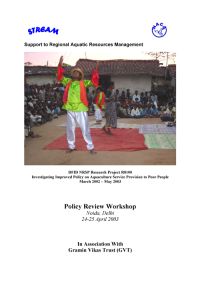
30 January 2004 | Graham Haylor, William Savage and S.D. Tripathi | 1388 Downloads | .pdf | 494.22 KB
The aim of the Policy Review Workshop, as with all project activities, was “contributing to ‘giving people a voice’ in policy-making processes that have an impact on their livelihoods”. The workshop objectives included: Through six case studies, stakeholder statements and a street-play, understand the experiences of rural aquaculture services provision from the perspectives of recipients and providers; review the process for transacting policy change and lessons learnt; and make recommendations for policy change based on project outcomes.
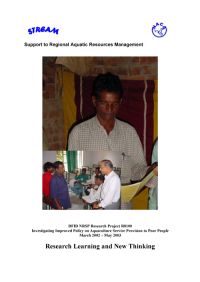
30 January 2004 | Graham Haylor and William Savage | 1547 Downloads | .pdf | 447.15 KB
This report, at the request of NRSP, highlights “research learning and new thinking” arising from project R8100. It considers the project’s process from a strategic viewpoint, which is summarised in a conceptual matrix. The main features of the process’s overall strategy considered in more detail are a strategy for bringing through the voices of poor people – described as facilitated advocacy, with the role played by the project being one of “making it easier for people to speak for themselves”.
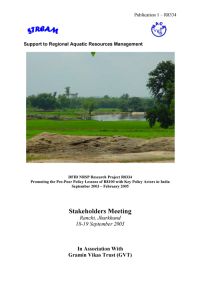
30 January 2004 | Graham Haylor, William Savage and S.D. Tripathi | 1402 Downloads | .pdf | 399.6 KB
The meetings and this document discuss the lessons learnt by project R8100 and consider how the follow on project might take these forward. This document combines the minutes of the Delhi meetings and the Stakeholder meeting in Ranchi, and captures as stories the summary of project R8100 and the visit to Jabarrah. The objectives of R8334 are presented, with comments on these recorded, and the project flow chart and proposed revisions to it are included.
30 January 2004 | Graham Haylor, William Savage and S.D. Tripathi | 1760 Downloads | .pdf | 267.98 KB
Three consecutive State-level Communications Strategy Workshops were held in the capitals of Jharkhand, Orissa and West Bengal states. The aim of the workshops, as with all project activities, was to “contribute to ‘giving people a voice’ in policy-making processes that have an impact on their livelihoods.” The specific objectives were to review and orient participants to the project’s four outputs and to draft a state-level communications strategy, including ideas for a monitoring and evaluation process.
30 January 2004 | Paul Bulcock, Graham Haylor and William Savage | 1655 Downloads | .pdf | 516.56 KB
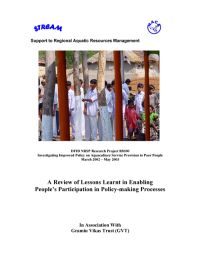
Development approaches are constantly evolving, acting on and utilising lessons learnt from past experiences. As a result, “good governance” approaches are currently topical, an intrinsic component of which is how rural poor people can participate in policy-making processes. By reviewing lessons learnt, and considering these with examples from within and outside India, an indication can be given of the most appropriate ways to begin to affect policy, although a specific blueprint will not be suggested.
This Learning Workshop on Livelihoods Analysis was held in Long An Province, Vietnam from 19-20 November 2002. It was part of an ongoing series of activities that will inform the implementation of the Ministry of Fisheries Strategy on Sustainable Aquaculture for Poverty Alleviation under the Vietnamese Government’s Hunger Eradication and Poverty Reduction (HEPR) Program. The recruitment in October of Nguyen Song Ha, STREAM Vietnam Communications Hub Manager, improved preparations within the Vietnamese national context.
A scoping Meeting on “Sustainable Aquaculture for Poverty Alleviation” was held in Hanoi , 23-25 May 2000. The meeting was held to review the role of aquaculture development (freshwater, brackish water and marine environments) in poverty alleviation and hunger eradication in Vietnam, to identify strategies for the more effective application of aquaculture and aquatic resources management to poverty alleviation, to review a draft framework for a programme on sustainable aquaculture for poverty alleviation and to prepare an appropriate action plan.
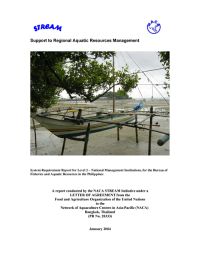
This System Requirement Report describes national level requirements for data collection and sharing mechanisms for fisheries co-management in the Philippines. It also provides a broad picture of the following for the national fisheries management level in the Philippines.
This report presents an overview of the state of aquatic resources in the Philippines, its performance and importance in the Philippine economy, and explores the situation of poverty in the "aquatic resources sector." The report describes the policy environment that guides the action of key actors in the sector. A general analysis of some trends in relation to factors that keep the poor from participating and benefiting from aquatic resource management is also provided.
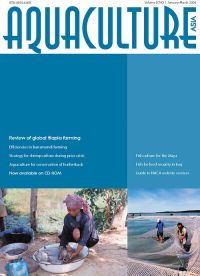
Aquaculture and food security in Iraq. Natural breeding in captivity - conservation of the threatened freshwater featherback Notopterus notopterus. Culture of Penaeus japonicus. Enzymes for sustainable aquaculture. Review of global tilapia farming practices. Fish culture in Yucatan, Mexico. Shrimp farm project planning, preparation and implementation. Coping with low shrimp prices. Efficiencies in barramundi culture. The innovative contributions of women in aquaculture. Marine finfish section. What's new on the web. Aquaculture calendar.
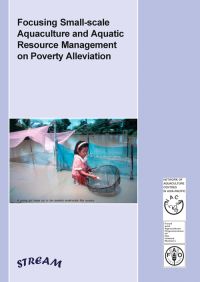
This report provides a background to the issues of focusing aquaculture on poverty alleviation based on the conclusions of an FAO/NACA Expert Consultation, which was organised in order to provide field-level professionals in Asia with a unique opportunity to come together to share experience on working in the field of poverty alleviation and aquaculture, and to prepare a platform for future networking.
In this issue: An experience with group formation in Jabarrah, West Bengal. Aquaculture self-help groups in rural West Bengal. Lessons learned for Fulwar Toli from an exposure visit to Jabarrah. Livelihood intervention by Fish Farmers Development Agency - a success story from Mayurbhanj, Orissa. Understanding of assets-based livelihoods through participatory rural appraisal to eliminate hunger. Poverty ranking tools in PRA - experiences of EIRFP in addressing vulnerability. This edition is also available in Vietnamese, Khmer, Ilonggo and Oriya.
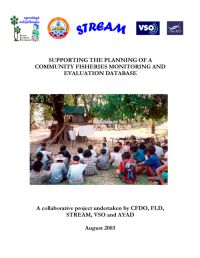
Knowledge of community fisheries and their capacity is a pre-requisite for co-management. This report illustrates the development of a pilot data collection, sharing and interrogation mechanisms for key information in support of co-management, identifying information requirements and procedures for the transmission and sharing of information between relevant stakeholders. A combination of focus group interviews with the community committee and village leaders, and participatory rural appraisal was used as a means of information compilation.
In this issue: Livelihood improvements through fisheries in the Pode community in Pokhara, Nepal. Women's participation in coastal resources management and livelihoods in Khanh Hoa Province, Vietnam. Supporting people's efforts and interactions in coastal resources management in Indonesia. Planning for a community fisheries M&E system. Identifying needs and recommendations for efficient stakeholder communications through an information access survey. IEC Seminar-Workshop in Support of Fisheries Ordinance Implementation in Roxas City, Philippines. About the STREAM Journal. About STREAM.
The Second STREAM Regional Conference was held in Tagaytay City, Philippines, from 8-10 June 2003 with the participation of 23 people from Australia, Cambodia, India, Nepal, Philippines, Thailand, Vietnam and Yunnan Province of China. Following a regional overview of STREAM’s themes, country partners, donors and funding, and activities, participants visited four “stations” on the themes of livelihoods, institutions, policy development, and communications, working in groups representing National Coordinators, Communications Hub Managers, and Partners. STREAM operations were discussed.
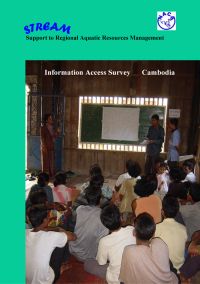
The aim of this report is to identify and recommend methods of communication that are appropriate to aquatic resources management stakeholders, focusing in particular on poor rural communities in Cambodia. As the Cambodian government begins to work more closely with local aquatic resources managers from poor rural communities, increased attention is being paid to the use of communication strategies and tools, in particular by the newly established Community Fisheries Development Office of the Department of Fisheries.
In this issue: Learning insights from the Fisheries Resource Management Project. An orientation on the SIAD approach and participatory local development planning. Group-building, production success and the struggle to prevent capture of the resource. Urban agriculture, water reuse and local economies: Case study of coastal riverine settlements of Ondo State, Nigeria. Livelihoods analysis: Actual experience from using PRA. A sustainable livelihoods approach to fisheries development for poverty alleviation in southeastern Vietnam. About the STREAM Journal. About STREAM.
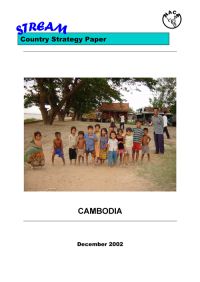
Cambodia is one of the poorest countries in the world; much of its population live in rural areas and many live below the local poverty line. The management of common property aquatic resources is of over-riding importance to food security and sustainable rural development in Cambodia. The key groups of poor people who use aquatic resources as part of their diverse livelihoods portfolios are subsistence fishers, small-scale aquaculture practitioners and aquatic resources collectors.
In this issue: Hon Mun MPA Pilot Project on Community-based Natural Resources Management. An experience with participatory research in Tam Giang Lagoon, Thua Thien-Hue. Experiences and benefits of livelihoods analysis. Lessons learnt in implementing PRA in livelihoods analysis. Lessons learnt from livelihoods analysis and PRA in the Trao Reef Marine Reserve. Using the findings from a participatory poverty assessment in Tra Vinh Province. About the STREAM Journal. About STREAM. This edition is also available in Ilonggo, Khmer, Nepali and Vietnamese.