We invite you to join us for the 10th Symposium on Diseases in Asian Aquaculture (DAA10), the popular triennial event of the Fish Health Section of the Asian Fisheries Society (FHS-AFS), to be held from 28 August to 1 September 2017 at the Anvaya Beach Resort, Kuta, Bali, Indonesia.
With the chosen theme of “Enhancing Aquatic Animal Health Research and Services through Public-Private Sector Partnerships” we anticipate to cover topics from classic parasitic, bacterial and viral diseases to emerging trends and cutting-edge research in aquatic animal health.
Three satellite workshops: FAO’s Inter-regional Workshop, NACA’s Meeting of the Asia Regional Advisory Group on Aquatic Animal Health, and a Bioinformatics Workshop are being organised back-to-back with DAA10.
19 January 2017Cherdsak Virapat, Simon Wilkinson and Doris Soto | 4285 Downloads | .pdf | 1.68 MB
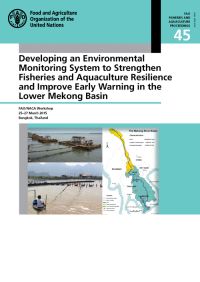
These are the proceedings of a consultation on the existence and effectiveness of environmental monitoring systems for fisheries and aquaculture in the Lower Mekong basin. The document provides a baseline assessment of environmental monitoring systems in Cambodia, Thailand and Vietnam and the report of a workshop to discuss the assessments findings and future steps towards an improved environmental monitoring and early warning system that will contribute to climate change adaptation in fisheries and aquaculture in the area.
The 15th meeting was held from 21-23 November 2016, in Bangkok, Thailand. A special session was held on addressing the use of anti-microbial substances in aquaculture and the development of anti-microbial resistance. This is an issue of global concern for both human and animal health, and it had been addressed by a resolution at FAO’s Thirty-ninth Conference in June 2015. The meeting reviewed in detail the status of aquatic animal disease in the region.
On behalf of the network, the NACA Secretariat would like to express our profound condolences to the people of Thailand regarding the passing of His Majesty King Bhumibol Adulyadej, the world's longest serving monarch. His Majesty was reknowned for his personal involvement in and commitment to development for the people of Thailand and the region, establishing his first rural development project in Huai Mongkol village of Hua Hin in 1952.
NACA's Director General Dr Cherdsak Virapat was interviewed on the "Around the World" radio programme of Saranrom (AM 1575 kHz), concerning the mission and role of NACA in regional food security. Please note the interview is in Thai language.