NACA frequently organises technical workshops and consultations on aspects of aquaculture. The proceedings of such meetings are made available for free download. Audio and video recordings of technical presentations are also available for some meetings (please see the podcast section).
NACA publishes a wide range of aquaculture publications including technical manuals, workshop proceedings, better practice guidelines and several serials including Aquaculture Asia Magazine, the NACA Newsletter and the Quarterly Aquatic Animal Disease Report. To keep up to date with developments you could consider subscribing to our RSS feed.
Mahajal – The Big Fishing Net was written by Mr Rakesh Raman, a playwright from Ranchi, Jharkhand, and performed by his theatre troupe. The play was written as an interpretation of the outcomes of the project case studies carried out in Jharkhand, Orissa and West Bengal. Act One sets the scene of fisherfolk’s livelihoods and the difficulties they face in a tribal village. Act Two places the project’s policy change recommendations within the context of their lives and aspirations.
The workshop Indigenous Participation in Aquaculture – the Pacific Experience was held as a day-and-a-half session in the Australasian Aquaculture 2004, Sydney,27–28 September 2004. The workshop promoted exchange of information and experiences between researchers, government representatives and industry involved in aquaculture development in the Pacific. The workshop recognised the increasing interest in aquaculture as an industry that can provide benefits for indigenous communities in Australia as well as the Pacific Islands.
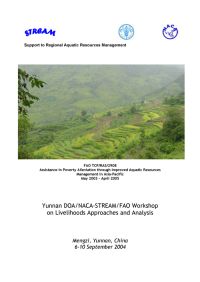
This is the report of the “Yunnan DOA/NACA-STREAM/FAO Workshop on Livelihoods Approaches and Analysis” that was conducted in Mengzi, Yunnan from 6-10 September 2004. The purpose of the workshop was to develop and document mechanisms for training in livelihoods approaches and analysis, and to build national capacity to conduct livelihoods analysis. The workshop in Yunnan was the first STREAM event in China, with colleagues coming to participate from throughout the province.
Established in early 2002, STREAM Vietnam has so far attained a number of good experiences and lessons in using participatory approaches for its work. The Country Office has been able to link to a wide range of stakeholders, and is working hard to build close relationships amongst them, so that institutional entities can better support the livelihoods of poor aquatic resources users, and support disadvantaged groups of people to improve their living standards by themselves.
8 September 2004 | Graham Haylor | 1243 Downloads | .pdf | 176.2 KB
This paper advocates strategies, processes and practices that enable: livelihoods approaches rather than resource-based approaches, ‘direct’ institutional and policy development, rather than ‘project demonstrations’, and support for regional, national and local communications. It was presented at the Symposium on Participatory approaches in reservoir fisheries management: Issues, challenges and policy, October 4-6th 2004 at the Culture Club Resort, Dambulla, Sri Lanka hosted by the National Aquaculture Development Authority in collaboration with FAO..
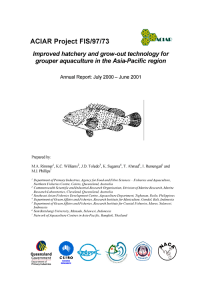
26 July 2004 | M.A. Rimmer, K.C. Williams, J.D. Toledo, K. Sugama, T. Ahmad, I. Rumengan and M.J. Phillips | 1345 Downloads | .pdf | 396.92 KB
This is the annual report 2000-2001 of the ACIAR Project FIS/97/73 Improved hatchery and grow-out technolgy for grouper aquaculture in the Asia-Pacific region. The report describes progress by research partners in development of larval rearing, grow-out diet development, and collaboration via the Asia-Pacific Marine Finfish Aquaculture Network. It also provides an indicative research workplan for the year ahead and future plans for the network.
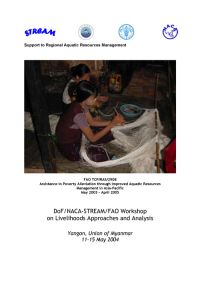
The purpose of the workshop was to develop and document mechanisms for training in livelihoods approaches and analysis, and to build national capacity to conduct livelihoods studies. The workshop in Yangon was the fourth in a series, the first of which was held in Iloilo City, Philippines, in November 2003, the second in Ranchi, India, in February 2004, and the third in Vientiane, Lao PDR in March 2004. A subsequent workshop will take place in Yunnan, China.
24 May 2004 | M.G. Bondad-Reantaso, J. Humphrey, S. Kanchanakhan and S. Chinabut | 3323 Downloads | .pdf | 2.2 MB
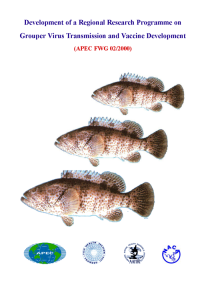
These are the proceedings of a workshop, funded by the APEC Fisheries Working Group Project 02/2000. The project developed a framework with nine major research components: Health and production at hatcheries, regional collaborative disease resource centers, regional disease monitoring and surveillance, improving regional diagnostic capabilities, responsible trans-boundary movement, farm health management, vaccines and vaccination, funding mechanisms and establishment of an ad-hoc working group.
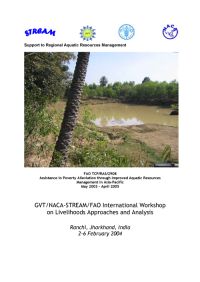
The purpose of the workshop was to develop and document mechanisms for training in livelihoods approaches and analysis, and to build national capacity to conduct livelihoods analysis. The workshop in Ranchi was a joint India-Nepal event. A central element of the workshop was a visit to the Jabarrah community, where participants learnt about the community’s livelihoods. In addition to gaining information about the Jabarrah community itself, participants also had important insights into how best to conduct livelihoods analyses.
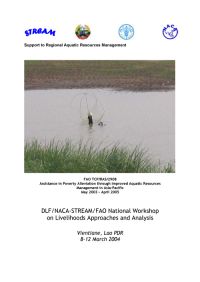
This is the report of the “DLF/NACA-STREAM/FAO National Workshop on Livelihoods Approaches and Analysis” that was conducted in Vientiane, Lao PDR from 8-12 March 2004. The purpose of the workshop was to develop and document mechanisms for training in livelihoods approaches and analysis, and to build national capacity to conduct livelihoods analysis. The workshop in Vientiane was the first STREAM event in Lao PDR.
The recommendations are derived from discussions at the consultation and three expert working groups and were adopted during the final plenary session of the Expert Consultation. Together they represent a powerful set of recommendations in use of rapid diagnostic tools for better health management in shrimp aquaculture. They have been put together in this summary document for rapid dissemination to potential users, researchers and other interested parties, in India and elsewhere.
19 March 2004 | Department for International Development | 2157 Downloads | .pdf | 300.93 KB
In February 2002 the shrimp fry collection ban was placed into abeyance pending further review of how biodiversity could be conserved at the same time as protecting the livelihoods of 400,000 fry collectors. A Shrimp Action Plan for the period April - September 2002 was drawn up to identify trends impacting on distribution and growth in the shrimp sector, and to explore alternative models for the management of fry resource and to assess their social, institutional and economic implications.
This document was the result of the discussions, conclusions and recommendations reached during the Expert Consultation in consultation held in Bhubaneswar, India, 16-19 October 2001. It was based on country reviews (Bangladesh, Bhutan, India, Myanmar, Pakistan, Nepal, and Sri Lanka), a synthesis paper (India), a technical guideline paper (Chinese experience) and resource expert papers (diseases and health management, water use and environment, nutrition and feeding) made available or presented during the Expert Consultation.
This is the report of the “BFAR/NACA-STREAM/FAO Workshop on Livelihoods Approaches and Analysis” held in Iloilo City, Philippines from 24-28 November 2003. The main purpose of the workshop was to develop and document mechanisms for training in livelihoods approaches and analysis, and to build national capacity to conduct livelihoods analysis. The workshop in Iloilo was the first in a series which will take place in other countries in the region.
The Second SPARK-STREAM Workshop on Livelihoods and Languages took place in Tagaytay City, Philippines, from 12-14 June 2003. The outputs of the workshop included drafts of a language-specific “Guide to Learning and Communicating about Livelihoods”, drafts of articles for STREAM Journal and SPARK Newsletter, identification of priorities and practical follow-up for capacity-building in carrying out participatory livelihoods analysis and the development of follow-up plans.
The purpose of this workshop was to build shared understandings of participatory livelihoods concepts and approaches, with emphases on the approaches as ways of thinking and working, and on learning from concrete examples from the experiences of STREAM in Cambodia and Vietnam, and SPARK in the Philippines. One outcome from the first workshop, was that between the two workshops participants would carry out follow-up tasks appropriate to their context.
30 January 2004 | Graham Haylor, William Savage and S.D. Tripathi | 1247 Downloads | .pdf | 382.99 KB
The visit was to plan the proposed case studies, the State-level Workshops and the consensus-building process of the DFID NRSP Research Project R8100 entitled “Investigating Improved Policy on Aquaculture Service Provision to Poor People”. Meetings were held with GVT staff, jankars and farmers from communities in villages in Orissa, Jharkhand and West Bengal, and officials of Departments of Fisheries in Orissa, West Bengal and Jharkhand. Meetings were also held with GVT, ICAR and the Fisheries Commission.
30 January 2004 | S. Ayyappan, P. Bueno and G. Haylor | 1194 Downloads | .pdf | 97.9 KB
To organise, to form a union, to become an alliance, is a fundamental of human social behaviour. Farming is one of the earliest examples of sustained collective livelihood. This missive relates some early exciting experiences of associations of farmers that are emerging from amongst tribal communities, which constitute some of the most disadvantaged in India, and the work that these organisations and other partners have made towards poverty alleviation through support for aquaculture.
30 January 2004 | Graham Haylor, William Savage and | 1479 Downloads | .pdf | 320.32 KB
The three State-level Workshops were held in West Bengal, Jharkhand and Orissa in October 2002. The aim and objectives of the workshops were to contribute to “giving people a voice” in policy-making processes that have an impact on their livelihoods, to understand a process for transacting institutional and policy change, to provide feedback on case studies and to review emerging “indicators of change” and provide input into the subsequent Stakeholders Workshop.
30 January 2004 | Graham Haylor, William Savage and S.D. Tripathi | 1352 Downloads | .pdf | 405.61 KB
The workshop objectives were to understand a process for transacting institutional and policy change, provide feedback to “finalise” six case studies which document experiences of rural aquaculture services provision from the perspectives of representative recipient and provider groups, to review emerging “indicators of progress” to feed into a consensus-building process and to provide input into a subsequent Policy Review Workshop. It contributed to giving people a voice in policy-making processes that have an impact on their livelihoods.