From coast to pond: Integrating seaweed aquaculture with brackishwater farming systems
25 June 2026 | Aravind R., P. Nila Rekha, R. Jayakumar, J.A.J. Raymond, P.S. Shyne Anand, N.S. Sudheer, R. Saraswathy, S. Aravind Kumar, M. Jayanthi and Kuldeep K. Lal | 248 Downloads | .pdf | 5.38 MB
Seaweed farming in India is an emerging and sustainable aquaculture activity, supplying raw material for food, pharmaceuticals, nutraceuticals, cosmetics, biofertilisers, animal feed, and biofuel. Historically it has been restricted to open coastal waters, but recent research is opening opportunities to grow commercially important species in brackishwater systems, particularly when integrated with shrimp, mud crab, and finfish. This article from ICAR-Central Institute of Brackishwater Aquaculture sets out the case for this "Blue-Green Revolution" and the science behind it.
The most promising candidates are fast-growing species of Gracilaria and Ulva lactuca (sea lettuce), both well suited to brackishwater because they tolerate salinity swings and absorb dissolved nutrients efficiently. The article reviews cultivation methods - raft, long-line, tube-line, and pole-based systems - and the environmental factors that govern success: adequate sunlight, dissolved nutrients, and species-specific salinity ranges. A key advantage is the short culture cycle and minimal inputs, since most species need no external feed or fertiliser in nutrient-rich waters.
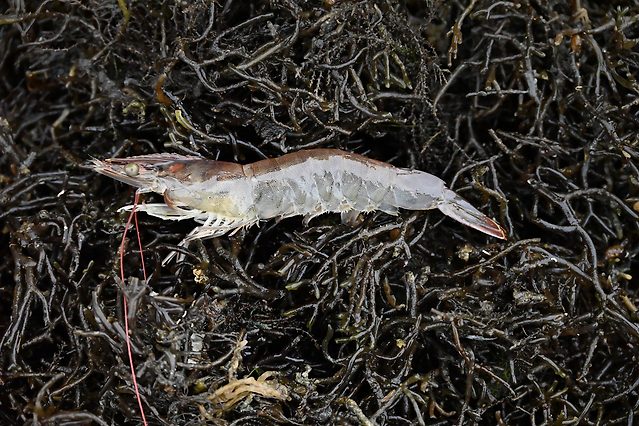
The core of the article examines integrated farming. In shrimp ponds, seaweed absorbs the nutrients released from uneaten feed and wastes, stabilising water quality while producing a second crop. ICAR-CIBA's standardised co-culture of G. salicornia with Penaeus vannamei achieved a more than three-fold increase in seaweed biomass, around 1.2 t from a 0.1 ha pond, and shrimp survival above 95%. With mud crab, seaweed provides shelter that reduces cannibalism, lifting survival to 60–80% from megalopa to instar stages. With finfish such as seabass, mullet, and milkfish, it acts as a nutrient sink and habitat. The article also describes how satellite and GIS technologies help map and manage seaweed resources.
It closes with an assessment of the constraints that must still be overcome: limited disease-free seed stock, reliance on wild-collected biomass, salinity fluctuations, emerging diseases, and the absence of quality-based pricing and certification, and the training and extension support needed to scale up this low-input, high-reward opportunity for coastal farmers.
1782400972_integrating-seaweed-aquaculture-with-brackishwater-farming-systems.pdf
Copyright, all rights reserved.