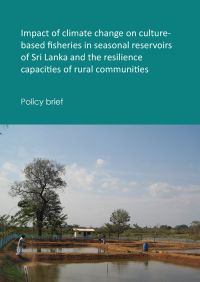
Culture-based fisheries (CBF) are stock enhancement practices to improve the productivity of water bodies that do not have enough natural recruitment to support a capture fishery. The stocked seed usually rely on the natural productivity of the water body as food supply.
CBF is usually conducted in small water bodies, which are often communally managed by local communities, and the where the seed is owned either individually or collectively. CBF practices are therefore a form of aquaculture.
This brief summarises the results from the interdisciplinary study conducted within the Aquaclimate project in Sri Lanka, which investigated the impacts of climate change on culture based fisheries. The brief further provides guidelines for adaptation and policy development to address the climate change impacts on culture based fisheries in Sri Lanka and how adaptation measures should be implemented.
27 May 2012 | Rohana P. Subasinghe, J. Richard Arthur, Devin M. Bartley, Sena S. De Silva, Matthias Halwart, Nathanael Hishamunda, C.V. Mohan and Patrick Sorgeloos (Eds.) | 3805 Downloads | .pdf | 12 MB
The Global Conference on Aquaculture 2010 reviewed the present status and trends in aquaculture development, addressed emerging issues relevant to aquaculture development, assessed opportunities and challenges for future aquaculture development and built consensus on advancing aquaculture as a global, sustainable and competitive food production sector. This volume provides information on how aquaculture could be mobilized to alleviate global poverty and improve food and nutrition security in the coming decades.
4 February 2011 | Miao Weimin, Sena De Silva and Brian Davy (eds.) | 6377 Downloads | .pdf | 1.16 MB
This regional review study is an effort to promote improved inland fisheries management under the Code of Conduct for Responsible Fisheries. It covers ten Asian countries with significant inland capture fisheries, namely Bangladesh, China, India, Indonesia, the Republic of Korea, Myanmar, Nepal, Sri Lanka, Thailand and Viet Nam. The papers were presented and discussed at a regional workshop held from 8-11 February 2010 in Pattaya, Thailand. Audio recordings of the presentations are also available for download.
The Phuket Consensus is a declaration on aquaculture development endorsed by participants of the Global Conference on Aquaculture 2010, held in Phuket, Thailand, 22-25 September. The consensus builds on the Bangkok Declaration, which was formulated at the International Conference on Aquaculture in the Third Millennium, held in Bangkok, 20-25 February 2000. The consensus and declaration provide strategic guidance on sustainable development of aquaculture considering social, environmental, technical and economic issues.
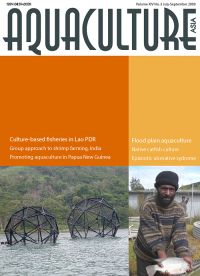
Community management and revenue sharing practices of culture-based fisheries in Lao PDR. Floodplain aquaculture in Bangladesh. Promoting small-scale inland aquaculture in Papua New Guinea. Group approaches to shrimp farming: The key to sustainability. Native catfish culture - a technology package for farmers. Influence of salinity in the growth of the black clam Villorita cyprinoides. EUS in Asia and Africa. Offshore opportunities for artisinal aquaculture. Grouper aquaculture in Brazil. NACA Newsletter.
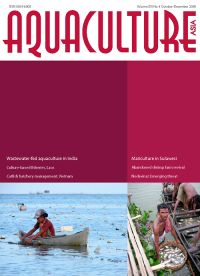
An increasingly secure future for wastewater-fed aquaculture in Kolkata, India? First culture-based fisheries growth cycle in Lao PDR is overhwelmingly encouraging. Revival of abandoned shrimp farms in Andhra Pradesh. Growth of industries linked with aquaculture in Kolleru Lake area, India. Applications of nutritional biotechnology in aquaculture. Technical and management aspects of catfish hatcheries in Vietnam. Asian seabass farming. Mariculture development opportunities in southeast Sulawesi, and much more.
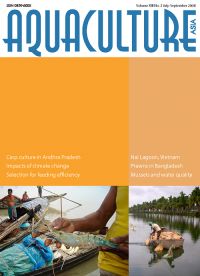
Possible improvements to carp culture in Andhra Pradesh. Aquaculture and environmental issues in the region of Nai Lagoon, Vietnam. Selection potential for feed efficiency in farmed salmonids. Freshwater prawn broodstock concern in Bangladhesh hatcheries. Production of Cirrhinus molitorella and Labeo chrysophekadion for culture-based fisheries in Lao PDR: Nursery and grow-out. Mussel farming: Alternate water monitoring practice. Use of poultry by-product meals in pelleted feed for humpback grouper Cromileptes altivelis.
26 May 2008 | Sena S. De Silva, Upali S. Amarasinghe and Thuy T. T. Nguyen (eds.) | 2404 Downloads | .pdf | 2.73 MB
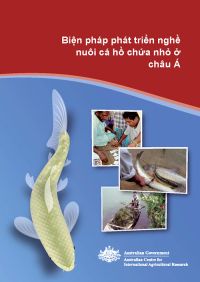
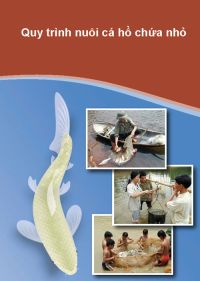
Chúng tôi xin trân trọng được giới thiệu với bạn đọc cuốn sách Biện pháp phát triển nghề nuôi cá hồ chứa nhỏ ở châu Á. Mục tiêu của cuốn sách không nhằm hướng dẫn thực hành như tài liệu khuyến ngư, mà thực sự là công trình tổng kết kinh nghiệm từ kết quả thực tế của nhiều địa phương, kết quả nghiên cứu khoa học, và những cơ sở lý thuyết liên quan đến lĩnh vực này.
From integrated carp polyculture to intensive monoculture in the Pearl River Delta, China. Better management practices for Vietnamese catfish. Ipomoea aquatica - an aquaculture friendly macrophyte. Status of fisheries and aquaculture development in Pakistan. The changing face of post-grad education in aquaculture: Contributing to soaring production and sustainable practices. Hatchery management in Bangladesh. Production of Cirrhinus molitorella and Labeo chrysophekadion for culture-based fisheries in Lao PDR and much more.
31 March 2008 | Sena S. De Silva, Upali S. Amarasinghe and Thuy T. T. Nguyen (eds.) | 1495 Downloads | .pdf | 2.04 MB
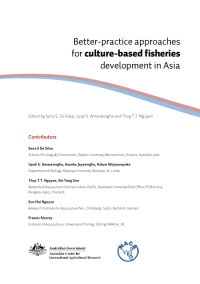
The primary objective of this manual is to provide guidelines for attaining better practices in culture-based fisheries, an emerging practice in rural areas in the Asian region. It deals will the principles of culture-based fishery practices, primarily based on relatively long-term experiences in Sri Lanka and Vietnam. It is not only targeted at researchers per se, but also at stakeholders at the grass root levels, as well as planners and policy developers.
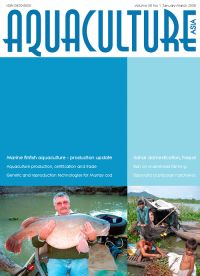
Developing guidelines for sustainable freshwater aquaculture planning in Vietnam. Aquaculture production, certification and trade for small-scale farmers. Backyard hatcheries for crustaceans in Thailand. Alternative carp species for diversification in India. Genetic and reproduction technologies for aquaculture and fisheries management of Murray cod. Status of sahar domestication in Nepal. Comparative advantage analysis of shrimp production in Asia. Strategies to improve the livelihoods of the rural poor, Vietnam, and more.
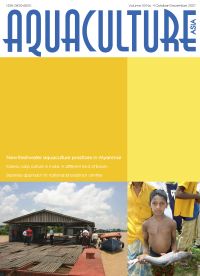
A different form of dumping: The need for a precautionary approach for yet another new species for shrimp farming in Asia. Sustainable livelihoods of pangus farming in Bangladesh. Business approach to national broodstock centres in Vietnam. Freshwater aquaculture in Myanmar. Traditional carp culture in Central Europe. Egg and larval quality in sand bass Psammoperca weigiensis. Effect of protein and lipid level of growth performance of tiger grouper Epinephelus fuscoguttatus.
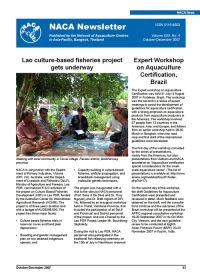
Lao culture-based fisheries project gets underway. Expert Workshop on Aquaculture Certification, Brazil. Strategies for Development of Asian Reservoir and Lake Fisheries Management. EUS identified as cause of fish kills in Africa. NACA seeks shrimp farm specialists for assignments in Indonesia. FDA detains five species of farm-raised seafood from China. 7th Symposium on Diseases in Asian Aquaculture. Aquafeed Horizons Asia 2008. Scientists join fight against frog diseases. Artificial propagation of snow trout Schizothorax zarudnyi by Iranian experts. NACA keynotes three international meetings. Culture, capture conflicts project review, Indonesia. Sign up to the coldwater aquaculture Yahoo! Tech Group. Website publishing and administration training, Vietnam. Aquatic Animal diseases Significant to Asia-Pacific: Identification Field Guide.
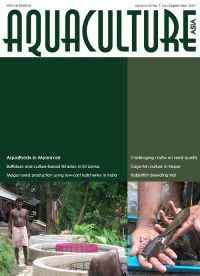
Buffaloes in favour of culture-based fisheries in Sri Lanka. Aquafeeds in Myanmar: A change from farm-made to factory-made feeds. Challenging myths about seed quality and potential benfits to the rural poor. Catfish Clarius batrachus production using low cost hatcheries. Cage fish culture and livelihoods in the mid-hill lakes of Pokhara, Nepal. Marine fish hatchery training. Rabbitfish Siganus guttatus breeding and larval rearing. Vietnamese extension manual on culture-based fisheries.
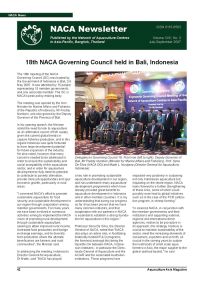
18th NACA Governing Council held in Bali, Indonesia. Strengthening aquatic animal health capacity and biosecurity in ASEAN - final workshop. Aquatic animal pathology master class. Vietnamese extension manual on culture-based fisheries. New project: Culture-based fisheries development in Lao PDR. Guidelines on digital publishing: a practical approach for small organizations with limited resources. Workshop on understanding and applying risk analysis in aquaculture. GISFish: Remote sensing and mapping for aquaculture and inland fisheries. Online encyclopeadia to list 1.8 m known species. DELTA 2007. NACA/FAO partnership working to establish guidelines for certification of farmed fish. Asia-Pacific Aquaculture 2007, 5-8 August 2007, Vietnam. Skretting sponsorship & scholarships for the Marine Finfish Aquaculture Network. The eleventh regular session on genetic resources for food and agriculture.
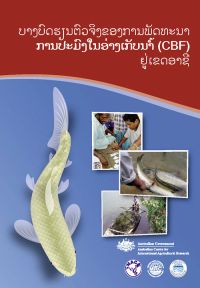
Mục tiêu của cuốn sách nhằm cung cấp những chỉ dẫn cơ bản của CBF, một hình thức nuôi cá hiệu quả, đang được quan tâm nhiều ở các vùng nông thôn miền núi châu.
9 March 2007 | Thuy Nguyen, David Hurwood, Peter Mather, Uthairat Na-Nakorn, Wongpathom Kamonrat and Devin Bartley | 8029 views | .zip | 3.09 MB
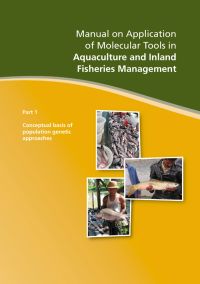
This manual provides a comprehensive practical tool for the generation and analysis of genetic data for subsequent application in aquatic resources management in relation to genetic stock identification in inland fisheries and aquaculture. The material only covers general background on genetics in relation to aquaculture and fisheries resource management, the techniques and relevant methods of data analysis that are commonly used to address questions relating to genetic resource characterisation and population genetic analyses.
This manual provides guidelines for attaining better practices in culture-based fisheries, an emerging practice in rural areas in the Asian region. It deals with the principles of culture-based fishery practices, primarily based on relatively long-term experiences in Sri Lanka and Vietnam. It deals with the gross factors that are applicable to improving fish yields and therefore revenue; and sustaining culture based fisheries as a development activity in the long-term.
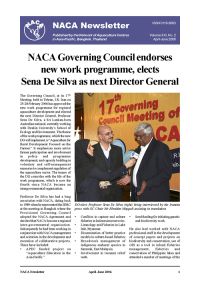
NACA Governing Council endorses new work programme, elects Sena De Silva as next Director General. RapiDot Kit - Farmer friendly kit for WSSV detection. Regional mariculture program strengthened. Economics and marketing analysis of the live reef fish food trade in the Asia-Pacific. Workshop on molecular techniques in aquaculture and seafood safety, Mangalore, India. Better-practice approaches for culture-based fisheries development in Asia. High-level Bahrain fisheries deletation visits Iran. First monthly meeting of fish farmers at One-stop Aqua Shop in Punjab Pakistan. Fish breeding training program for farmers of OAS, Kaipara. Provincial workshops on National Fisheries Policy and Strategy Framework held in Punjab and Sindh, Pakistan. Monitoring and evaluating the impacts of aquaculture on the agency and well-being of women. STREAM welcomes AYAD volunteer. Workshop to strengthen aquatic animal health capacity and biosecurity in ASEAN. Asian Federation for Information Technology in Agriculture (AFITA) 2006 in Bangalore. Aquaculture rehabilitation project launched by Indonesian Minister of Marine Affairs and Fisheries.
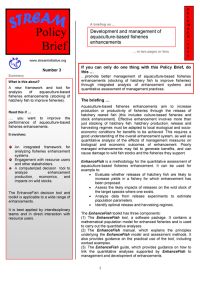
This policy brief aims to promote better management of aquaculture-based fisheries enhancements (stocking of hatchery fish to improve fisheries) through integrated analysis of enhancement systems and quantitative assessment of management practices through use of the EnhanceFish decision tool.