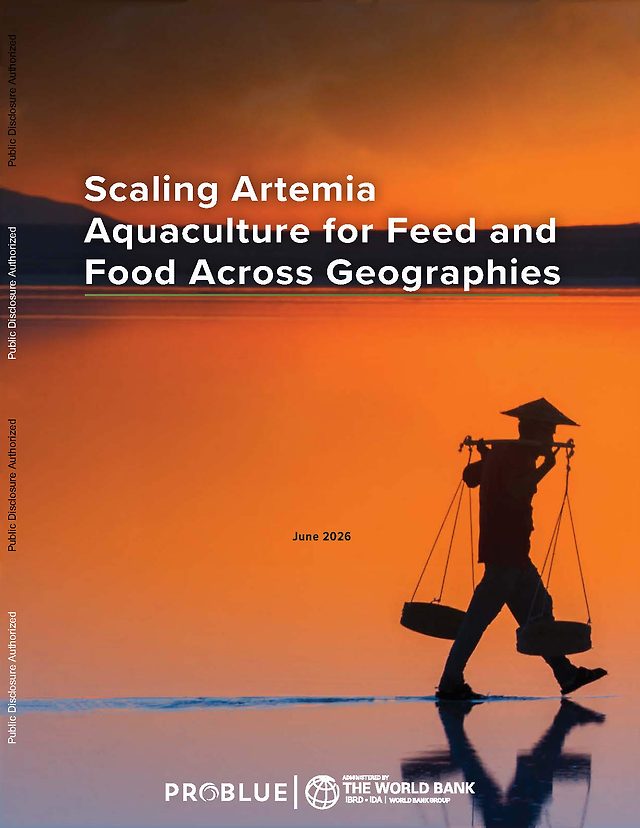
Scaling Artemia Aquaculture for Feed and Food Across Geographies
31 July 2026 | World Bank | 149 Downloads | .pdf | 3.48 MB
Artemia, commonly known as brine shrimp, is a critical live feed ingredient in aquaculture, particularly for shrimp and marine finfish hatcheries. The global Artemia industry is experiencing increasing demand driven by expanding aquaculture production. This report provides an in-depth analysis of Artemia in five key countries where Artemia aquaculture is established or in early stages of development — Viet Nam, China, Thailand, Bangladesh, and Kenya. The studies highlight Artemia value chains and associated production systems, market potential, and investment needs.
The findings confirm that Artemia can be successfully, profitably, and sustainably produced through aquaculture as cyst or biomass products in hypersaline environments, across diverse systems, providing important and critical products for aquaculture, with potential for wider application and product development as aquafeed and human food.
The productivity and profitability of Artemia compares positively with traditional salt production, providing new income and livelihood opportunities for people living in hypersaline and salt-affected coastal and inland regions. A key factor for success is access to markets. Case studies identify important opportunities for investment that include working capital and infrastructure for farm and storage improvements, training and extension activities, product diversification, and post-harvest and market product development, including investing in Artemia and novel aquafeed ingredients and human food applications.
The case studies also provide examples of four systems or business cases with potential for wider application and scaling, including (a) Integrated Artemia-Shrimp Farming (Viet Nam Model); (b) Solar Saltworks-Artemia Integration (China Model); (c) Artemia Biomass for Aquafeed & Livestock Feed (Thailand Model); and (d) Smallholder Artemia Pond Culture (Bangladesh Model). The potential scalability of these models is assessed by countries in Africa, Latin America, Asia, and the Middle East. The assessment shows significant opportunities for scaling the models in Africa and more globally in hypersaline ecosystems, provided the market, regulatory, and research environment is in place.
In Africa, the assessments reveal widespread opportunity, with country-by-country assessments provided for Madagascar, Mozambique, Federal Republic of Somalia, Namibia, Botswana, Zambia, Tanzania, Kenya Uganda, Rwanda, Ghana, Nigeria, Tunisia, the Arab Republic of Egypt, Senegal and Ethiopia. The studies provide guidance on potential; the follow up actions would involve more detailed country level assessments and the development of country specific investments strategies for the public and private sector. A coordinated approach for public investment (in research, policy, and investment environment) and private investment (in Artemia production businesses, processing, and product marketing) is required.
The next steps will involve feedback on this draft case study report and the preparation of a comprehensive investment synthesis and strategy to progress the priorities and opportunities for Artemia.
1785489501_scaling-artemia-aquaculture-for-feed-and-food-across-geographies.pdf
Copyright, all rights reserved.
Related
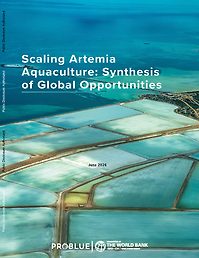
Scaling Artemia Aquaculture: Synthesis of Global Opportunities
31 July 2026 | World Bank | 1634 views | .pdf | 4.53 MB