Scaling Artemia Aquaculture: Synthesis of Global Opportunities
31 July 2026 | World Bank | 1632 views | .pdf | 4.53 MB
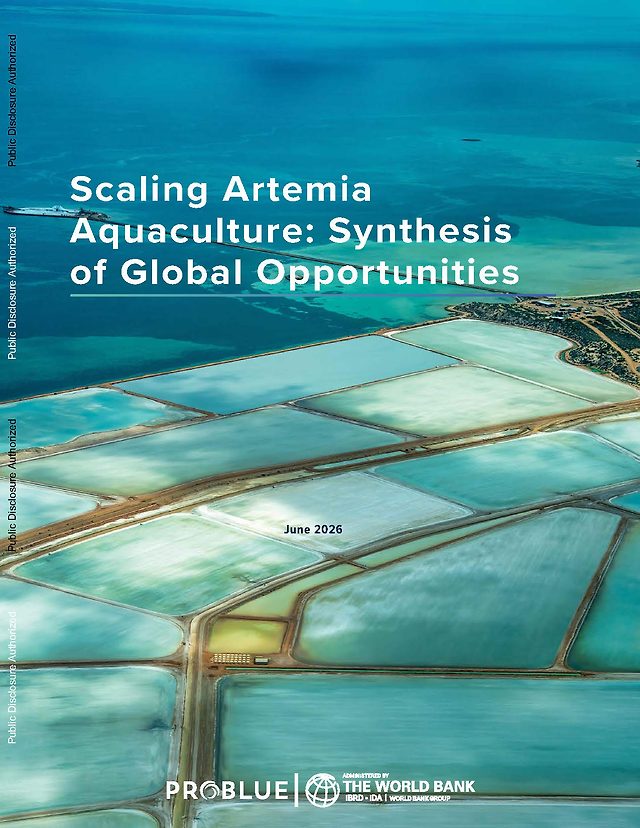
This synthesis report consolidates over half a year’s worth of technical research, market analysis, and country level value chain assessments to present a comprehensive investment overview of the brine shrimp- Artemia - aquabusiness. Developed as part of the World Bank’s PROBLUE initiative on sustainable aquaculture and blue economy development, the report draws together the findings of six assessments, covering Artemia production systems, governance frameworks, markets and trade, emerging use cases, inventories of innovators, and in-depth country value chain studies.
Artemia, or brine shrimp, is a cornerstone input in hatchery-based aquaculture - used in the early life stages of shrimp, marine fish, and increasingly, ornamental species. However, over 90 percent of the global Artemia cyst supply is still derived from wild sources, primarily from hypersaline lakes in the United States and Central Asia. This dependence exposes the Artemia aquabusiness to supply shocks, price volatility, and environmental risks. Meanwhile, demand for Artemia is rising rapidly in response to global aquaculture growth and the search for sustainable, climate-smart solutions for animal feed and human food.
The purpose of this synthesis report is to:
- Provide an integrated overview of the current state and future potential of farmed Artemia systems.
- Present investor-ready intelligence on country contexts, production models, and enabling conditions.
- Guide strategic decision-making across public, private, and donor stakeholders through a concise but data-driven road map for investment and scale.
The report builds on field-level insights and technical models drawn from in-depth value-chain analyses in five countries—Bangladesh, Viet Nam, Thailand, China, and Kenya—and a broader investment readiness scan across 27 additional countries identified as high-potential scaling candidates. Using structured criteria around market demand, resource availability, governance, inclusion, and scalability, the synthesis distills lessons into four scalable Artemia business models and presents regional investment road maps for Asia, Africa, Latin America, and the Middle East.
1785489892_scaling-artemia-aquaculture-synthesis-global-opportunities-2026.pdf
Copyright, all rights reserved.
In this collection
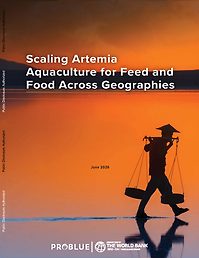
Scaling Artemia Aquaculture for Feed and Food Across Geographies
31 July 2026 | World Bank | 148 Downloads | .pdf | 3.48 MB
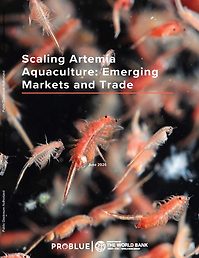
Scaling Artemia Aquaculture: Emerging Markets and Trade
31 July 2026 | World Bank | 164 Downloads | .pdf | 1.34 MB