Hatchery and nursery

Information related to hatchery management, larval rearing and seed production in aquaculture.

Creative Commons Attribution.

Related

Subject tags

A collection of subject tags relating to technical matters.

In this collection

Coral trout Plectropomus leopardus aquaculture research and fingerling production in Indonesia

Coral trout Plectropomus leopardus is an emerging exported grouper commodity in Indonesia. The demand for coral trout fingerlings has been increasing and the value of this species is the highest among groupers. However, the rearing of coral trout larvae is notoriously more ‘difficult’ than other groupers. This article describes research on coral trout larval rearing protocols conducted by the Institute for Mariculture Research and Fisheries Extension, which has achieved a survival rate of 12%.

Fish pituitary gland collection and supply as a vocation in West Bengal, India

In retail fish markets in Kolkata city proper, suburbs and neighbouring districts, pituitary glands are collected as a profession from the heads of mature fish. The preserved glands are used to induce breeding via hypophysation in carp hatcheries throughout West Bengal, playing an important role in the availability of carp seed to support aquaculture operations. This article describes the livelihoods of pituitary gland collectors and traders in West Bengal, India.

Scenario of captive production of Clarias magur in India

Clarias magur, locally known as magur, is a well-preferred medium sized catfish among Indian consumers. Difficulties such as shortages of effective inducing agents and the erratic response to induced breeding, low survival in different life stages, slow growth, and lack of effective feeds have been a bottleneck for the wider adoption of this fish by farmers. There has been considerable research to simplify the technology and disseminate it among farmers over the last decade. This article summarises these attempts and describes the present level of its technology practiced in India.

Aquaculture Asia Magazine, October-December 2020

In this issue:

Framework for participatory linkage of marine ornamentals germplasm conservation to livelihoods: Is community aquaculture an inclusive option? Induced breeding of farm-bred and pond-raised critically endangered peninsular carp, Hypselobarbus pulchellus; A way forward for utilisation of aquatic genetic resources in Asia-Pacific: Synthesis from deliberations during the Regional Workshop on Underutilized Fish and Marine Genetic Resources and their Amelioration 2019; Cast nets: The dominant active fishing gear in the Kashmir Valley; Moyna model of major carp farming in Purba Medinipur District, West Bengal, India; NACA Newsletter.

Induced breeding of farm-bred and pond-raised critically endangered peninsular carp, Hypselobarbus pulchellus

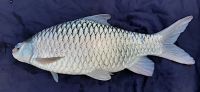
Hypselobarbus pulchellus is endemic to the peninsular rivers of India, mainly the Krishna, Godavari, Tungabhadra, Sita and Tunga. It once formed a major fishery of the Tungabhadra reservoir but has declined to the status of a critically endangered species. H. pulchellus is a bentho-pelagic species which inhabits the deeper part of large streams and rivers along the base of ghats. It is the only indigenous fish that consumes aquatic weeds and submerged grasses, and could play a role in controlling aquatic vegetation in reservoirs, tanks and irrigation canals. Capable of attaining 8 kg, H. pulchellus would make a welcome addition to pond culture practices of India, especially for composite fish culture. This article gives an overview of the breeding and seed production technologies developed by ICAR-CIFA for farm-bred and pond-raised H. pulchelllus.

Free online Training on Mariculture Technologies for the Asia-Pacific Region

The Yellow Sea Fisheries Research Institute, Chinese Academy of Fisheries Sciences and NACA are organising a free online training course on mariculture technologies, to be held from 21-25 September 2020. The programme will cover breeding, disease control and prevention, nutrition and feed research, breeding model construction, farm technology development, engineering, quality, safety and inspection technology for aquatic products. The course is open to government officials, researchers, enterprise managers and technicians from developing countries. The deadline for applications is 19 September 2020.
Aquaculture Asia Magazine, July-September 2020

In this issue:

Hatchery techniques for the seed production of short-necked clams (Paphia undulata) in Nha Trang, Vietnam; Lovesome chum of the aquarium are wreaking havoc in East Kolkata Wetlands, India; Concept of indigenous recirculatory aquaculture system executed in West Bengal, India and other places; Homestead modular hatchery technology of brackishwater catfish, Mystus gulio: A potential alternate livelihood option for small and marginal farmers of Sunderban; NACA Newsletter.

Homestead modular hatchery technology of brackishwater catfish, Mystus gulio: A potential alternate livelihood option for small and marginal farmers of Sunderban

The catfish Mystus gulio is a small indigenous euryhaline fish found in fresh and brackishwater environments of the Sunderban delta of Bangladesh and India. A fast-growing species with high nutritional value, market demand and hardy nature, M. gulio is a desirable candidate for aquaculture in Asia. It is co-cultured with other brackishwater species in paddy fields, but expansion of culture in pond systems has been held back because of a shortage of seed. This article reports on induced breeding techniques and the development of a farmer-friendly modular hatchery and farming system suitable for use at the homestead level or by small-scale operators.

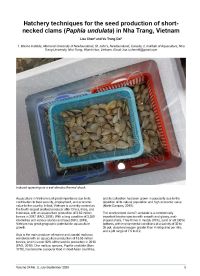
Hatchery Techniques for the Seed Production of Short-Necked Clams (Paphia undulata) in Nha Trang, Vietnam

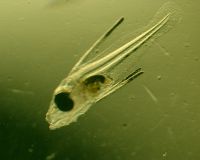
Aquaculture of short-necked clam Paphia undulata in Vietnam started approximately ten years ago, but production has been very small due to the lack of seed supply from hatcheries. The Institute of Aquaculture at Nha Trang University, is the first to conduct artificial seed production research on P. undulata and the first hatchery in Khanh Hoa province to produce seed of this species. This article describes techniques to induce spawning in P. undulata using wet and dry thermal shock stimuli. It also describes broodstock preparation, larval rearing, transportation techniques and the market value of this species.

Aquaculture Asia Magazine, April-June 2020

In this issue:

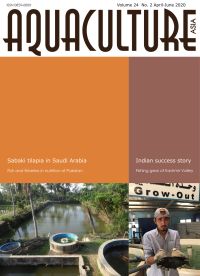
Potential new species in the Kingdom of Saudi Arabia: Sabaki tilapia (Oreochromis spilurus); Role of fish & fisheries in national nutrition of Pakistan; Success story of first fish farmer in India to be awarded ‘Padma Shri’; Insights into the fishing gear and ichthyofauna of major lentic water bodies of Kashmir Valley; NACA Newsletter.

NACA Newsletter, Vol. XXXV No. 2, April-June 2020

In this issue:

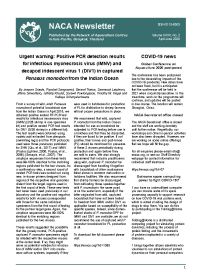
Urgent warning: Positive PCR detection results for infectious myonecrosis virus (IMNV) and decapod iridescent virus 1 (DIV1) in captured Penaeus monodon from the Indian Ocean; COVID-19 news; Urgent announcement on usefulness of the lymphoid organ (LO) as an additional prime target for diagnosis of decapod iridescent virus 1 (DIV1) in diseased P. vannamei; Fresh or frozen seafood?; Report of the Eighteenth Meeting of the Asia Regional Advisory Group on Aquatic Animal Health; COVID-19 fallout could push half a billion people into poverty in developing countries; Simple techniques double crablet production.

Simple techniques double crablet production

Crab farmers will be happier, and the environment hopefully better, with recent improvements at the mangrove crab hatchery of SEAFDEC/AQD in Iloilo, Philippines. Crablets used in the farming of the prized mangrove crabs, Scylla serrata, are usually collected from the wild and increasing demand has threatened their natural population. However, Huervana recently revealed that simple tweaks in protocols at the SEAFDEC/AQD hatchery have led to a significant boost in their crablet production, with survival increasing twofold.

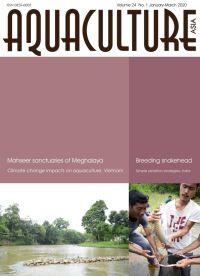
Aquaculture Asia Magazine, January-March 2020

In this issue:

Mahseer sanctuaries of Meghalaya: A conservation and recreational perspective; Impacts of climate change on aquaculture in Vietnam: A review of local knowledge; Simple means of water aeration adopted by progressive fish breeders in West Bengal, India; Breeding striped snakehead (Channa striata) using the concrete tank method in the Cangkringan Area, Special Region of Yogyakarta; NACA Newsletter.

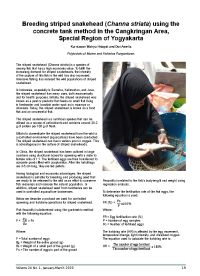
Breeding striped snakehead (Channa striata) using the concrete tank method in the Cangkringan Area, Special Region of Yogyakarta

The striped snakehead (Channa striata) is a species of swamp fish that has a high economic value. Intensive fishing has reduced the wild populations. Hatchery production of this species has the potential for both commercial aquaculture supportive breeding programmes to conserve fish resources and increase the natural population. Below we describe a protocol we used for controlled spawning and hatchery operations for striped snakehead.

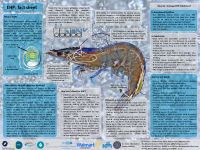
Fact sheet on Enterocytozoon hepatopenaei, a microsporidian parasite of shrimp

EHP or Enterocytozoon hepatopenaei is a fungal microsporidian parasite that infects the hepatopancreas (hp) of tiger shrimp (Penaeus monodon) and whiteleg shrimp (P. vannamei) in Thailand and results in slow growth and, in chronic infections, mortalities. EHP is also known from Brunei, China, India, Indonesia, Malaysia, Philippines, Venezuela and Vietnam. This fact sheet provides information on the EHP life cycle, signs of infection, diagnosis and management in both hatcheries and growout, as well technical contacts for further information.

NACA Newsletter, Vol. XXXIV No. 4, October-December 2019

In this issue:

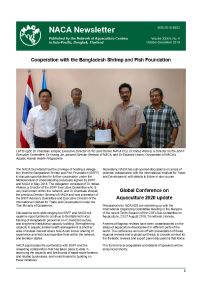
Cooperation with the Bangladesh Shrimp and Fish Foundation; Global Conference on Aquaculture 2020 update; Quarterly Aquatic Animal Disease Report, January-March 2019; A fresh look at inland fisheries and their role in food security and livelihoods; Tuskfish 2 Beta: Testers wanted; APAARI Regional Workshop on Underutilized Fish and Marine Genetic Resources and Their Amelioration; Joint Research Project on Utilization of Thailand Local Genetic Resources to Develop Novel Farmed Fish for Global Market; Impacts of climate change on fisheries and aquaculture.

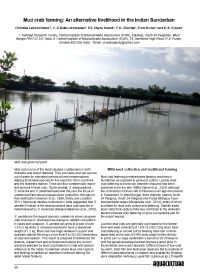
Mud crab farming: An alternative livelihood in the Indian Sundarban

Mud crab is one of the most valuable crustaeceans in both domestic and export markets. They are hardy and can survive out of water for extended periods at lower temperatures, making them idea for live export. Mud crab fattening predominates farming practices in Sundarban as opposed to grow-out culture. This report describes current practces adopted by mud crab farmers in India with special reference to the Indian Sundarban, where mud crab capture and farming are an important livelihood for small holder farmers.

Aquaculture Asia Magazine, April-June 2019

In this issue:

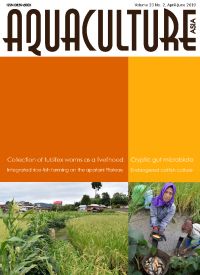
Collection of tubifex worms from the Adi Ganga canal, West Bengal as means of livelihood; Some facts for the grow-out culture of an endangered catfish, Clarias magur; The cryptic domain of gut microbiota in composite culture of Indian major carps; Integrated rice-fish farming in hilly terraces of the Apatani Plateau, Arunachal Pradesh.

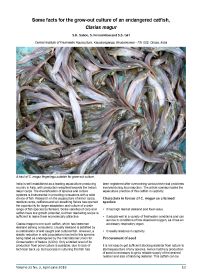
Some facts for the grow-out culture of an endangered catfish, Clarias magur

Although relatively slow growing, market demand for Clarias magur is sufficient to make it economically attractive for aquaculture. Supply of this species is through a combination of wild caught and cultured fish. However, a drastic reduction in wild populations has led to C. magur being listed as endangered by the International Union for Conservation of Nature. Only limited quantities of cultured fish are available. The article communicates the aquaculture practices of C. magur including hatchery, nursery and grow out.

Fattening of mud crab Scylla serrata in estuarine region of south-eastern West Bengal, India

Live mud crab has a high export value and good overseas demand. Over the past fifteen years exports from India have increased, with the introduction of crab fattening practices. Wild-caught seed are held in pens constructed of bamboo screens for several weeks and fed to increase their body weight and hence value. Fattened crabs are onsold to traders exporters, who may air lift them to Singapore and other regional markets for the live restaurant trade.