Health and Biosecurity

The Health and Biosecurity Programme assists members to reduce the risks of aquatic animal disease impacting the livelihoods of farmers, national economies, trade, environment and human health by:

  • Improving regional cooperation in aquatic animal health and welfare.
  • Developing and implementing national strategies on aquatic animal health.
  • Improving surveillance, reporting and response to disease emergencies.
  • Promoting harmonisation of diagnostic procedures and risk assessment.
  • Widespread promotion of better aquatic animal health management practices at the farm level.

Key activities

Key activities of the programme include:

  • Convening the annual meeting of the Asia Regional Advisory Group on Aquatic Animal Health, coordinating the Quarterly Aquatic Animal Disease Report and bringing regional issues to the attention of global standard setting bodies such as the Office International des Epizooties.
  • Establishment and expansion of a three-tier shared resource in aquatic animal health.
  • Development of farm-level health management tools for key aquaculture commodities.
  • Supporting regional disease surveillance and reporting.
  • Strengthening aquatic animal health and biosecurity in the region.
  • Facilitating harmonisation in disease diagnostic techniques.
  • Developing resource material in support of diagnosis and surveillance.

Contacts

Creative Commons Attribution.
Related

Subject tags

A collection of subject tags relating to technical matters.

In this collection

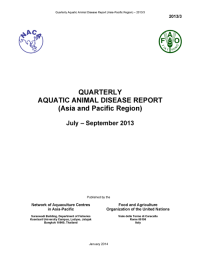
Quarterly Aquatic Animal Disease Report, July-September 2013

This report, the 61st in the series, contains information about the aquatic animal health status of fifteen states in the Asia-Pacific region. The foreword discusses the OIE tool for evaluation of performance of aquatic veterinary services.

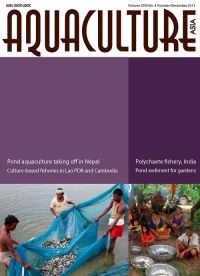
Aquaculture Asia Magazine, October-December 2013

In this issue:

Special session on regional cooperation for improved biosecurity. Pond aquaculture taking off in Nepal. Introduction of culture-based fishery practices in small water bodies in Cambodia: Issues and strategies. A case study on polychaete fishery by the Irular tribal fishing community on the Tamil Nadu coast. Use of pangasius pond sediment for rooftop bag gardening: Potential for rural-urban integrated agriculture-horticulture. Culture-based fisheries exchanges between Lao PDR and Cambodia.

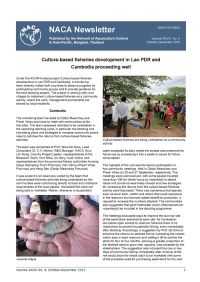
NACA Newsletter, Volume XXVIII, No. 4, October-December 2013

In this issue:

Culture-based fisheries development in Lao PDR and Cambodia proceeding well. National aquatic animal disease surveillance programme launched in India. Report on early mortality syndrome / acute hepatopancreatic necrosis syndrome of shrimp. International Symposium on Small-scale Freshwater Aquaculture Extension, 2-5 December, Bangkok. 'Perfect' food for 'perfect' prawns. Aquaculture without Frontiers Special Session. We asked CSIRO: Gold Coast Tiger Prawns. Understanding the sex of salmon. Overcoming smallholder challenges with biotechnology. Coordinated efforts in aquaculture needed to meet global demand. FAO e-book collection for tablets and e-readers.

FAO / MARD Technical Workshop on Early Mortality Syndrome or Acute Hepatopancreatic Necrosis Syndrome of Cultured Shrimp

This report is the proceedings of a workshop held under the FAO technical cooperation project Emergency assistance to control the spread of an unknown disease affecting shrimps held in Hanoi, Viet Nam from 25 to 27 June 2013. The workshop reviewed recent investigations into the cause of acute hepatopancreatic necrosis syndrome, believed to related to a strain of Vibrio parahaemolyticus and drew a number of recommendations on specific and generic actions and measures for reducing the risk of AHPND.

Report on early mortality syndrome / acute hepatopancreatic necrosis syndrome of shrimp

A new FAO Fisheries and Aquaculture Report, Early Mortality Syndrome (EMS) or Acute Hepatopancreatic Necrosis Syndrome (AHPNS) of Cultured Shrimp, focuses on this emerging disease that has devastated the shrimp industry of China, Malaysia, Thailand and Viet Nam over the last three years.

National aquatic animal disease surveillance programme launched in India

The Department of Animal Husbandry Dairying and Fisheries, Ministry of Agriculture, Government of India has approved a national project on aquatic animal disease surveillance for five years and funding of INR 320 million (about US$ 6 million) has been allocated through the National Fisheries Development Board (NFDB). A national consultation on aquatic animal disease surveillance held last April 2012, attended by NACA, made a strong recommendation for the need for a national program on surveillance.

Presentations from the final technical consultation on EMS/AHPNS

Under the FAO technical cooperation project (TCP/VIE/3304 (E)) Emergency assistance to control the spread of an unknown disease affecting shrimp, this final technical consultation on “Early Mortality Syndrome (EMS) or Acute Hepatopancreatic Necrosis Syndrome (APHNS) of Cultured Shrimp” was jointly organised by FAO and Vietnam’s Ministry of Agriculture and Rural Development from 25-27 June 2013, Prestige Hotel, Hanoi, Viet Nam.

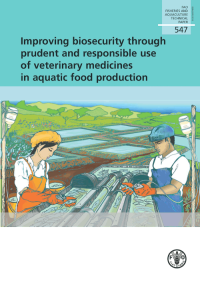
Improving biosecurity through prudent and responsible use of veterinary medicines in aquatic food production

These are the proceedings of the FAO/AAHRI Expert Workshop on Improving Biosecurity through Prudent and Responsible Use of Veterinary Medicines in Aquatic Food Production, held in Bangkok, Thailand, from 15 to 18 December 2009. The workshop discussed the current status of antimicrobial usage in aquaculture and the impacts of their irresponsible use on human health, the aquatic environment and trade. The outcomes are relevant to the development of guiding principles on the responsible use of antimicrobials in aquaculture.

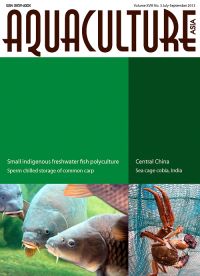
Aquaculture Asia Magazine, July-September 2013

In this issue:

A second trip to Hubei Province, central China. Sea cage growout of cobia Rachycentron canadum in the Gulf of Mannar. Culture of small indigenous fish species in polyculture with Indian major carps and high value crops along pond dykes. Study on sperm chilled storage of common carp Cyprinus carpio in Vietnam. Culture-based fisheries exchanges between Lao PDR and Cambodia. Culprit behind massive shrimp die-offs in Asia unmasked.

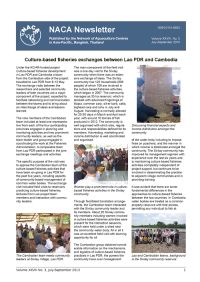
NACA Newsletter, Volume XXVIII, No. 3, July-September 2013

In this issue:

Culture-based fisheries exchanges between Lao PDR and Cambodia. Culprit behind massive shrimp die-offs in Asia unmasked. Presentations from the final technical consultation on EMS/AHPNS of shrimp available for download. Aquaculture certification workshop held in Viet Nam. Aquaculture in a genetic plunge towards extinction? NACA implements World Bank training program on Good Aquaculture Practices. Study tour on aquaculture and wetland management for delegation from Assam, India. Koh Yao Noi Tree Bank and mangrove replanting continues. Consistent fish names key to consumer confidence. We are hiring! Request for contributions: Global Advances in Ecology and Management of Golden Apple Snails (2nd edition).

Artisinal tropical aquaculture in a genetic plunge towards extinction

Artisanal shrimp aquaculture is in a disease-induced crisis of lost production. The immediate cause is biological: rising levels of inbreeding and a strong, positive relationship between inbreeding and disease. The root cause is social: a nexus of human behavior in which breeders protect their intellectual property by generating inbreeding, local hatcheries sell copied, inbred shrimp, and farmers suffer the consequences.

Cause of "shrimp early mortality syndrome" (acute hepatopancreatic necrosis syndrome) identified

In a major breakthrough, researchers at the University of Arizona have identified the causative agent behind "shrimp early mortality syndrome" or EMS, more accurately known as acute hepatopancreatic necrosis syndrome. The causative agent is a strain of a bacteria commonly found in brackish water, Vibrio parahemolyticus, with possible involvement of a phage. Very encouraging news. Congratulations to Dr Lightner's team and all that have assisted with the search for the culprit - Ed.

Quarterly Aquatic Animal Disease Report, April-June 2013

This report, the 60th in the series, contains information about the aquatic animal health status of fifteen states in the Asia-Pacific region. The foreword discusses response to aquatic animal disease emergencies.

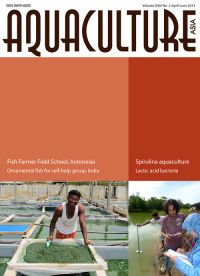
Aquaculture Asia Magazine, April-June 2013

In this issue:

Workshop on mainstreaming gender in NACA. Fish Farmer Field School: Towards healthier milkfish / shrimp polyculture and fish farmer empowerment in South Sulawesi. A success story of Maa Tarini Self Help Group Ornamental Fish Unity, India. Use of lactic acid bacteria in fish farming. AFSPAN field surveys underway. Anti-viral treatment for healthier black tiger prawns. Jungle perch on the comeback trail. Nursery management of grouper manual. Hatchery management of tiger group manual.

NACA Newsletter, Volume XXVIII, No. 2, April-June 2013

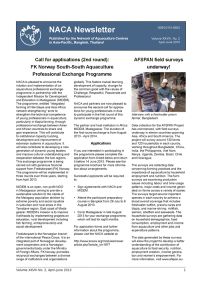
In this issue:

Call for applications (2nd round): FK Norway South-South Aquaculture Professional Exchange Programme. AFSPAN field surveys underway! 4th Global Symposium on Gender in Aquaculture and Fisheries. An anti-viral treatment for healthier black tiger prawns. Jungle perch on the comeback trail. Nursery management of grouper: A best-practice manual (Indonesian translation). Hatchery management of tiger grouper (Epinephelus fuscoguttatus): A best-practice manual (Indonesian translation). Priority adaptations to climate change for Pacific fisheries and aquaculture: Reducing risks and capitalising on opportunities. Improving biosecurity through prudent and responsible use of veterinary medicines in aquatic food production.

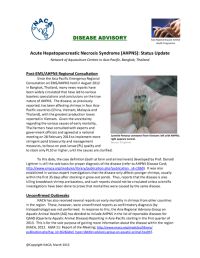
Acute Hepatopancreatic Necrosis Syndrome (AHPNS): Status Update

Since the Asia Pacific Emergency Regional Consultation on EMS/AHPNS held in August 2012 in Bangkok, Thailand, many news reports have been widely circulated that have led to various baseless speculations and conclusions on the true nature of AHPNS. This disease update/advisory has been issued to address the many circulating false and baseless speculations on the effects and spread of AHPNS in the region.

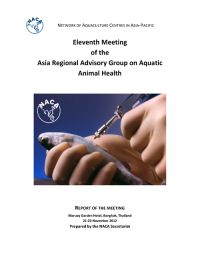
Report of the eleventh meeting of the Asia Regional Advisory Group on Aquatic Animal Health, 21-23 November 2012

The Asia Regional Advisory Group on Aquatic Animal Health meets annually to discuss regional health issues including emerging disease threats. This report includes a review of regional disease status circa 2012, global and regional disease reporting arrangements, global issues and standards, progress in implementation of the the Regional Technical Guidelines on Health management for the Responsible Movement of Live Aquatic Animals, identification and designation of regional aquatic animal health resources and regional and international cooperation.

Quarterly Aquatic Animal Disease Report, January-March 2013

This report, the 59th in the series, contains information about the aquatic animal health status of sixteen states in the Asia-Pacific region. The foreword contains an update on acute hepatopancreatic necrosis syndrome (AHPNS) of cultured shrimp.

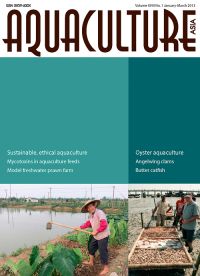
Aquaculture Asia Magazine, January-March 2013

In this issue:

Health issues are not going away. Sustainable and Ethical Aquaculture Trade project in China. Oyster aquaculture for coastal defense and food production in Bangladesh. Importance of mycotoxins in aquaculture feeds. A model modular farm for size grading and monosex culture of freshwater prawn. Angelwing clam (Pholas orientalis) future assured after Thai DOF's breeding success. Ompok bimaculatus, an emerging species for diversification of aquaculture in Tripura, North-eastern India.

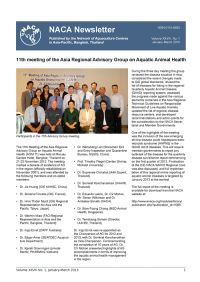
NACA Newsletter, Volume XXVIII, No. 1, January-March 2013

In this issue:

11th meeting of the Asia Regional Advisory Group on Aquatic Animal Health. Aquaculture community mourns Prof. M.C. Nandeesha. Got a story for Aquaculture Asia Magazine? AusAID funded project on Institutional Support for Development of Mariculture in South East Sulawesi commences. Regional training course on broodstock management in aquaculture, Vietnam 27 May - 1 June 2013. Video recordings from workshop on sustainable intensification of aquaculture released!