Health and Biosecurity

The Health and Biosecurity Programme assists members to reduce the risks of aquatic animal disease impacting the livelihoods of farmers, national economies, trade, environment and human health by:

  • Improving regional cooperation in aquatic animal health and welfare.
  • Developing and implementing national strategies on aquatic animal health.
  • Improving surveillance, reporting and response to disease emergencies.
  • Promoting harmonisation of diagnostic procedures and risk assessment.
  • Widespread promotion of better aquatic animal health management practices at the farm level.

Key activities

Key activities of the programme include:

  • Convening the annual meeting of the Asia Regional Advisory Group on Aquatic Animal Health, coordinating the Quarterly Aquatic Animal Disease Report and bringing regional issues to the attention of global standard setting bodies such as the Office International des Epizooties.
  • Establishment and expansion of a three-tier shared resource in aquatic animal health.
  • Development of farm-level health management tools for key aquaculture commodities.
  • Supporting regional disease surveillance and reporting.
  • Strengthening aquatic animal health and biosecurity in the region.
  • Facilitating harmonisation in disease diagnostic techniques.
  • Developing resource material in support of diagnosis and surveillance.

Contacts

Creative Commons Attribution.
Related

Subject tags

A collection of subject tags relating to technical matters.

In this collection

Aquaculture Asia Magazine, October-December 2009

In this issue:

Mussel farming initiatives in North Kerala, India. Selective study on availability of indigenous fish with ornamental value in West Bengal. Aquaculture livelihoods centre in Aceh, Indonesia. e-Sagu Aqua - an innovative information and communication technology model for transfer of technology for aquaculture. Freshwater pearl crop: An emerging enterprise in the Indian subcontinent. Preliminary risk assessment of Pacific white shrimp (P. vannamei) introduced to Thailand for aquaculture. Black gill disease of lobster and more.

Quarterly Aquatic Animal Disease Report, July-September 2009

This report, the 45th in the series, contains information about the aquatic animal health status of sixteen states in the Asia-Pacific region. The foreword discusses the Sanitary and Phytosanitary (SPS) Agreement and its relationship to the OIE Aquatic Animal Health Standards.

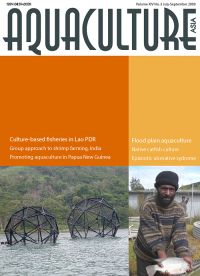
Aquaculture Asia Magazine, July-September 2009

In this issue:

Community management and revenue sharing practices of culture-based fisheries in Lao PDR. Floodplain aquaculture in Bangladesh. Promoting small-scale inland aquaculture in Papua New Guinea. Group approaches to shrimp farming: The key to sustainability. Native catfish culture - a technology package for farmers. Influence of salinity in the growth of the black clam Villorita cyprinoides. EUS in Asia and Africa. Offshore opportunities for artisinal aquaculture. Grouper aquaculture in Brazil. NACA Newsletter.

Quarterly Aquatic Animal Disease Report, April-June 2009

This report, the 44th in the series, contains information about the aquatic animal health status of fifteen states in the Asia-Pacific region. The foreword discusses national aquatic animal health strategies.

NACA Newsletter Volume XXIV, No. 2, April-June 2009

In this issue:

NORAD funded project on climate change initiated. Sign up for our free email newsletter service! Market chains and biosecurity of 'low value' aquaculture commodities. Global conference on aquaculture 2010. Extending information and technical services to aquaculture farmer groups in Aceh. Giant Prawn 2011, Quindao, China. Alien species in aquaculture and biodiversity: A paradox in food production. Aquatic ecosystems and development: Comparative Asian perspectives. Macrobrachium: The culture of freshwater prawns.

Report of the seventh meeting of the Asia Regional Advisory Group on Aquatic Animal Health, 15-17 December 2008

The Asia Regional Advisory Group on Aquatic Animal Health meets annually to discuss regional health issues including emerging disease threats. This report includes a review of regional disease status circa 2008, global and regional disease reporting arrangements, global issues and standards, progress in implementation of the the Regional Technical Guidelines on Health management for the Responsible Movement of Live Aquatic Animals, identification and designation of regional aquatic animal health resources and regional and international cooperation.

Quarterly Aquatic Animal Disease Report, January-March 2009

This report, the 43rd in the series, contains information about the aquatic animal health status of fifteen states in the Asia-Pacific region. The foreword discusses emerging amphibian diseases in the region.

Aquaculture Asia Magazine, January-March 2009

In this issue:

Myanmar revisited. Harvesting, traditional preservation and marketing of fishes of Chalan Beel, Bangladesh. Role of community in production and supply of larger, quality fingerlings. Can rice-fish farming provide food security in Bangladesh? Nutritional and food security for rural poor through multi-commodity production from a lake of eastern Uttar Pradesh. Emerging boost in Sri Lankan reservoir fish production. Farming the freshwater prawn Macrobrachium malcolmnsonii. Breeding and seed production of catfish Ompok pabda.

NACA Newsletter Volume XXIV, No. 1, January-March 2009

In this issue:

9th Technical Advisory Committee meeting and 30th anniversary of FFRC. Training Workshop on the Use of Molecular Genetics in Conservation held at USM, Malaysia. Japan International Award for NACA Staff. Consortium on freshwater finfish genetics and breeding. Shrimp Farming eNews. Seventh Meeting of the Asia Regional Advisory Group on Aquatic Animal Health. Sri Lankans learn pisciculture at CIFA. India's Central Institute for Freshwater Aquaculture observes 33rd Foundation day.

Acute viral necrosis in scallops: Disease card

Acute viral necrosis in scallops was included in the list of Qquarterly Aquatic Animal Disease (QAAD) reporting list for the year 2008. The disease card developed by regional resource experts from China in support of QAAD reporting system in Asia-Pacific provides information on pathogen, hosts, and confirmatory diagnostic methods. This is an emerging disease in the region and has caused significant losses to scallop culture industry in China.

Monodon slow growth syndrome and Laem-Singh virus retinopathy: Disease card

During 2002, slow growth of farmed Penaeus monodon was reported throughout shrimp growing areas of Thailand and figures indicated that annual production volume was reduced by approximately 36%. The cause of this slow growth was not determined but laboratory trails suggested that a filterable infectious agent was involved. Injected extracts affected P. monodon but not P. vannamei. The slow growth condition was referred to as monodon slow growth syndrome or MSGS. This disease card provides an overview.

Specific pathogen free (SPF) organism information sheet

This information sheet provides an explanation and background information on Specific Pathogen Free organisms. Key points include that SPF animals are designated to be free from specified pathogens, only. The SPF status simply provides an assurance to the buyer that the stock is not infected with the specified pathogens at the time of purchase. The SPF status is lost when animals are removed from biosecure facilities.

Quarterly Aquatic Animal Disease Report, October-December 2008

This report, the 42nd in the series, contains information about the aquatic animal health status of fifteen states in the Asia-Pacific region. The foreword discusses import requirements for live aquatic animals and their products for the European Union.

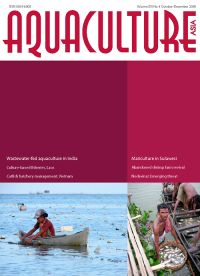
Aquaculture Asia Magazine, October-December 2008

In this issue:

An increasingly secure future for wastewater-fed aquaculture in Kolkata, India? First culture-based fisheries growth cycle in Lao PDR is overhwelmingly encouraging. Revival of abandoned shrimp farms in Andhra Pradesh. Growth of industries linked with aquaculture in Kolleru Lake area, India. Applications of nutritional biotechnology in aquaculture. Technical and management aspects of catfish hatcheries in Vietnam. Asian seabass farming. Mariculture development opportunities in southeast Sulawesi, and much more.

Quarterly Aquatic Animal Disease Report, July-September 2008

This report, the 41st in the series, contains information about the aquatic animal health status of sixteen states in the Asia-Pacific region. The foreword discusses emerging crustacean diseases.

NACA Newsletter Volume XXIII, No. 2, April-June 2008

In this issue:

19th Governing Council meeting held in Kathmandu, Nepal. OIE/NACA Regional Workshop on Aquatic Animal Health. Vietnam catfish BMP project kicks off. Planning meeting, Regional Project on Reservoir Fisheries Development and Management. NACA to document 'Aquaculture Success Stories'. 6th Regional Grouper Hatchery Training Course 5-25 May 2008. Establishing a Working Party on Aquaculture Statistics. Implementing the ASEAN Roadmap for Integration of Fisheries Sector. London Expert Workshop on Aquaculture Certification.

Report of the sixth meeting of the Asia Regional Advisory Group on Aquatic Animal Health, 12-14 December 2007

The Asia Regional Advisory Group on Aquatic Animal Health meets annually to discuss regional health issues including emerging disease threats. This report includes a review of regional disease status circa 2007, global and regional disease reporting arrangements, global issues and standards, progress in implementation of the the Regional Technical Guidelines on Health management for the Responsible Movement of Live Aquatic Animals, identification and designation of regional aquatic animal health resources and regional and international cooperation.

Quarterly Aquatic Animal Disease Report, January-March 2008

This report, the 39th in the series, contains information about the aquatic animal health status of fifteen states in the Asia-Pacific region. The foreword discusses the 7th Symposium on Diseases in Asian Aquaculture.

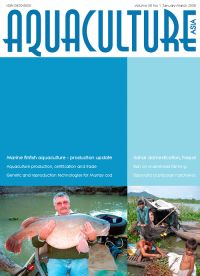
Aquaculture Asia Magazine, January-March 2008

In this issue:

Developing guidelines for sustainable freshwater aquaculture planning in Vietnam. Aquaculture production, certification and trade for small-scale farmers. Backyard hatcheries for crustaceans in Thailand. Alternative carp species for diversification in India. Genetic and reproduction technologies for aquaculture and fisheries management of Murray cod. Status of sahar domestication in Nepal. Comparative advantage analysis of shrimp production in Asia. Strategies to improve the livelihoods of the rural poor, Vietnam, and more.

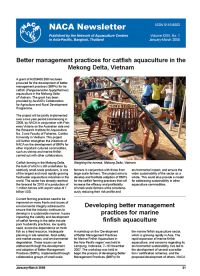
NACA Newsletter Volume XXIII, No. 1, January-March 2008

In this issue:

Better management practices for catfish aquaculture in the Mekong Delta, Vietnam. Developing better management practices for marine finfish aquaculture. Workshop on modelling carrying capacity for tropical finfish cage culture: Towards a consensus view. First comprehensive genetic management plan for Asian fish species: Mahseer. NACA and World Fisheries Trust sign agreement on collaboration. Fish Health Master Class. Second Workshop on Application of Molecular Genetic Techniques in Inland Fisheries and Aquaculture Management. Two new species of spiny eels described from Myanmar. Importance of species identification in conservation. Koh Yao Noi mangrove replanting in celebration of 80th birthday of His Majesty the King of Thailand. Responsible movement of live food finfish within ASEAN: Implementation workshop. Consultation on aquaculture certification guidelines. Strengthening regional mechanisms to maximise benefits to small-holder shrimp farmer groups adopting better management practices.