Nutrition and feeding

Information relating to nutrition and feeding in aquaculture.

Creative Commons Attribution.

Related

Subject tags

A collection of subject tags relating to technical matters.

In this collection

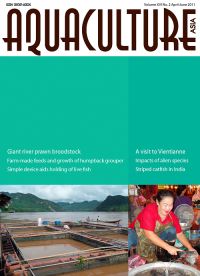
Aquaculture Asia Magazine, April-June 2011

In this issue:

A visit to Vientianne, Lao PDR. Development of captive broodstock of giant river prawn Macrobrachium rosenbergii. Alien introduction and its impact on native fisheries and aquatic bioiversity of West Bengal, India. Ecological impacts of exotic fish species in India. Farm-made feeds support good growth and survivial of the humpback grouper. An easy way to hold live fish. Litopenaeus vannamei introduction: Sound management or expediency? Newsletter and more.

Global Conference on Aquaculture 2010

The conference was organised by FAO, the Thai Department of Fisheries and NACA and held in the Mövenpick Resort and Spa, Phuket, Thailand, 22-25 September. The conference was the third in a series of aquaculture development conferences, following on from the Conference on Aquaculture in the Third Millennium held in Bangkok 2000, and the FAO Technical Conference on Aquaculture, held in Kyoto 1976.

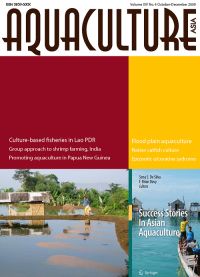
Aquaculture Asia Magazine, October-December 2010

In this issue:

Rapidly changing aquaculture scene in the Red River Delta, Vietnam. Current situation and challenges for the farming of snakeheads in the Mekong Delta. Is there a business case for small-holders in Vietnamese pangasius? Small scale prawn culture practices towards sustainable development in Chittagong region, Bangladesh. Gloating hapa technology for the mass production of tilapia Oreochromis niloticus in Bangladesh. Management in seed production of golden mahseer Tor putitora in hatchery condictions.

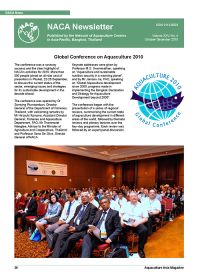
NACA Newsletter, Volume XXV, No. 4, October-December 2010

In this issue:

Global Conference on Aquaculture 2010. Reducing the dependence on trash fish as feed for marine finfish. 21st NACA Governing Council & 10th Technical Advisory Committee. Training course on application of business management principles in small-scale aquaculture. Sri Lanka Journal of Aquatic Sciences goes open access. Now we're on Facebook too.

Keynote: Aquaculture and Sustainable Nutrition Security in a Warming Planet

Fisheries and aquaculture contribute significantly to food and nutrition security. About 20 percent per capita intake of animal protein for more than 2.8 billion people is from fish and for over 400 million people fish meets 50% of the requirement for animal protein and minerals. Malnutrition is still the number one killer compared to other diseases. Climate change is likely to increase the frequency and intensity of climate processes.

Providing high quality feeds for aquaculture and getting out of the fish meal trap: opportunities and challenges

If the aquaculture sector is to maintain its current average growth rate of 8 to 10 percent per year to 2025, the supply of nutrient and feed inputs will have to grow at a similar rate. Feed-fed aquaculture production is largely dependent upon capture fisheries for dietary protein and lipid. Sustainability of the aquaculture sector is likely to be linked with the supply of animal and plant proteins, oils and carbohydrate sources for aquafeeds.

The potential of aquaculture to improve human nutrition and health

Fish makes a vital contribution to the survival and health of a significant portion of the world’s population. In some of Asia’s poorest countries, people derive as much as 75 percent of their daily protein from fish. Aquaculture can assist communities in developing countries to address the potential of fish as a ready provider of essential nutrients, a tradable commodity and as such, a contributor to development and social stability.

Enhancing the contribution of aquaculture to poverty alleviation, food security and rural development

We are passing through an era of increasing population, food shortages and unsustainable farming practices. We cannot think of food security unless issues connected with poverty and livelihoods are addressed. Since 75 percent of global aquaculture production comes from small-scale farms in developing countries we have to address a number of issues to ensure that the livelihoods and food security of all those involved in the sector are not threatened.

Thematic session 6 summary and conclusions: Enhancing the contribution of aquaculture to poverty alleviation, food security and rural development

Presentation of the summary, conclusions and recommendations of Thematic Session 6 (Enhancing the contribution of aquaculture to poverty alleviation, food security and rural development).

Phuket Consensus: A re-affirmation of commitment to the Bangkok Declaration

The Phuket Consensus is a declaration on aquaculture development endorsed by participants of the Global Conference on Aquaculture 2010, held in Phuket, Thailand, 22-25 September. The consensus builds on the Bangkok Declaration, which was formulated at the International Conference on Aquaculture in the Third Millennium, held in Bangkok, 20-25 February 2000. The consensus and declaration provide strategic guidance on sustainable development of aquaculture considering social, environmental, technical and economic issues.
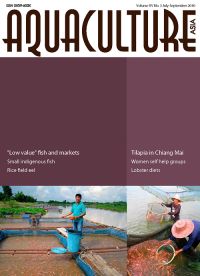
Aquaculture Asia Magazine, July-September 2010

In this issue:

Relative efficacies of lobsters Panulirus ornatus and P. homarus cultured using pellet feeds and trash fish, Vietnam. Tilapia in Chiang Mai, Thailand. Marketing low-value cultured fish in Bangladesh: An evaluation of value chain. Current practices of rice field eel Monopterus albus culture in Vietnam. Self-help group makes fisherwomen self-relian: A story of success. Small indigenous freshwater fish species of India: Significance, conservation and utilisation. 

NACA Newsletter, Volume XXV, No. 3, July-September 2010

In this issue:

Vietnamese catfish - better management practices update. Is this the perfect prawn? Fish Oil Replacement and Alternative Lipid Sources in Aquaculture Feeds. Multilingual CD-ROM of FAO cultured aquatic species fact sheets. Aquaclimate Annual Progress Report 2010. Training course on application of business management principles in small-scale aquaculture.

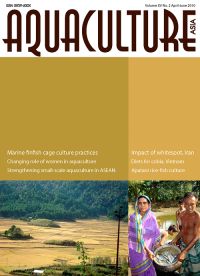
Aquaculture Asia Magazine, April-June 2010

In this issue:

The Dedanaw Project, Myanmar. The changing face of women for small-scale aquaculture in Bangladesh. Strengthening capacity of small holders in ASEAN. Carp seed production in Orissa, India. Sustainable mountain paddy-fish farming of the Apatani tribes. The economic impacts of whitespot virus on shrimp production in Iran. Current practices of marine finfish cage culture in China, Indonesia, Thailand and Vietnam. Effects of trash fish on growth and body composition of cobia.

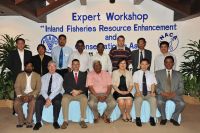
Expert Workshop on Inland Fisheries Resource Enhancement and Conservation in Asia

Over the past few decades inland fisheries resources have come under increasing pressure from water engineering projects, pollution and overfishing. FAO and NACA convened an expert workshop to review inland fisheries resource enhancement and conservation practices in Pattaya, Thailand, 8-11 February. Experts from 10 Asian countries attended the meeting to share experiences and lessons learned. Regional collaborative efforts are required to facilitate assessment of current inland fisheries resource enhancement and conservation practices.

Aquaculture Asia Magazine, October-December 2009

In this issue:

Mussel farming initiatives in North Kerala, India. Selective study on availability of indigenous fish with ornamental value in West Bengal. Aquaculture livelihoods centre in Aceh, Indonesia. e-Sagu Aqua - an innovative information and communication technology model for transfer of technology for aquaculture. Freshwater pearl crop: An emerging enterprise in the Indian subcontinent. Preliminary risk assessment of Pacific white shrimp (P. vannamei) introduced to Thailand for aquaculture. Black gill disease of lobster and more.

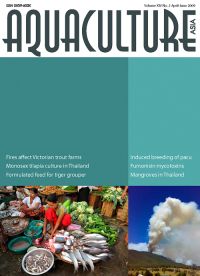
Aquaculture Asia Magazine, April-June 2009

In this issue:

GLOBALGAP standard in Thai shrimp farms: Mission (im)possible? The Victorian trout industry and the bushfires. Small-scale aquaculture in the Ayeyarwady Delta, Myanmar. The history, status and future prospects of monosex tilapia culture in Thailand. Mangroves of Nakhon Si Thammaarat Province in Souther Thailand. Induced breeding of pacu Piaractus brachypomus in captivity. Fumosins - mycotoxins of increasing importance in fish. Microsatellite DNA markers, a fisheries perspective. Formulated feed for tiger grouper grow out.

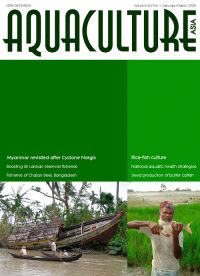
Aquaculture Asia Magazine, January-March 2009

In this issue:

Myanmar revisited. Harvesting, traditional preservation and marketing of fishes of Chalan Beel, Bangladesh. Role of community in production and supply of larger, quality fingerlings. Can rice-fish farming provide food security in Bangladesh? Nutritional and food security for rural poor through multi-commodity production from a lake of eastern Uttar Pradesh. Emerging boost in Sri Lankan reservoir fish production. Farming the freshwater prawn Macrobrachium malcolmnsonii. Breeding and seed production of catfish Ompok pabda.

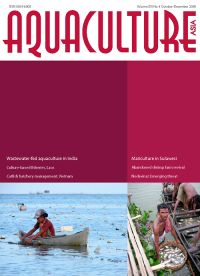
Aquaculture Asia Magazine, October-December 2008

In this issue:

An increasingly secure future for wastewater-fed aquaculture in Kolkata, India? First culture-based fisheries growth cycle in Lao PDR is overhwelmingly encouraging. Revival of abandoned shrimp farms in Andhra Pradesh. Growth of industries linked with aquaculture in Kolleru Lake area, India. Applications of nutritional biotechnology in aquaculture. Technical and management aspects of catfish hatcheries in Vietnam. Asian seabass farming. Mariculture development opportunities in southeast Sulawesi, and much more.

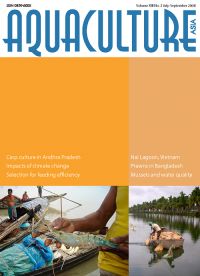
Aquaculture Asia Magazine, July-September 2008

In this issue:

Possible improvements to carp culture in Andhra Pradesh. Aquaculture and environmental issues in the region of Nai Lagoon, Vietnam. Selection potential for feed efficiency in farmed salmonids. Freshwater prawn broodstock concern in Bangladhesh hatcheries. Production of Cirrhinus molitorella and Labeo chrysophekadion for culture-based fisheries in Lao PDR: Nursery and grow-out. Mussel farming: Alternate water monitoring practice. Use of poultry by-product meals in pelleted feed for humpback grouper Cromileptes altivelis.

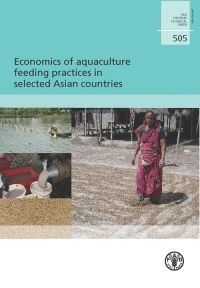
Economics of aquaculture feeding practices in selected Asian countries

This technical paper provides an analysis of the economic implications of, and the reasons for, adopting various feeding practices for different fish species and aquaculture systems in Asia. The systems studied include extensive/traditional, semi-intensive and intensive farms for a number of different species including sutchi and pangasiid catfishes (Bangladesh and Viet Nam), hybrid catfish (Thailand), carp polyculture (India and China), prawn and milkfish polyculture (the Philippines).