Nutrition and feeding

Information relating to nutrition and feeding in aquaculture.

Creative Commons Attribution.

Related

Subject tags

A collection of subject tags relating to technical matters.

In this collection

Status of aquaculture feed and feed ingredient production and utilisation in Philippines

It is estimated that around 1,061,173. tonnes of commercial aquaculture feeds were consumed on 2016. The aquaculture feed milling industry in the Philippines is presently  over capacity, based on the above-estimated feed requirement. The current primary law on animal feeds, which also covers aquaculture feeds, is under legislative review. Animal feeds ingredients standards are defined under administrative orders. Quality standards for finished aquaculture feeds are specified under the Philippine National Standards on Aquaculture Feeds (PNS/BAFPS 84: 2010).

Status of aquaculture feed and feed ingredient production and utilisation in Vietnam

This presentation gives an overview of aquaculture feed production and related issues in Vietnam.

Status of aquaculture feed and feed ingredient production and utilisation in Thailand

Approximately 90% of aquaculture produce in Thailand are fed with a complete commercial feed. The Department of Fisheries is responsible for the licensing and registration of feed to be sold for commercial purposes. High quality fishmeal is a priority for aquaculture feed production especially for shrimp and marine fish and this has significantly affected feed cost. Most agricultural by-products are already utilised for purposes such as livestock, pet foods, fertilisers and biofuels, so competition for alternative ingredients is high.

Status of aquaculture feed and feed ingredient production and utilisation in Korea

Olive flounder and Korean rockfish make up over 60% out of total finfish production. However, marine fish culture heavily relies on farm-made feed. Although the Korean government has made various attempts to promote sustainable aquaculture, most farmers still prefer to use raw fish-based frozen pellets to compounded feed. To secure the sustainable growth of domestic aquaculture and feed production, the Korean government needs to press on with policy enforcement andresearch and development to provide low-priced compounded feeds.

Status of aquaculture feed and feed ingredient production and utilisation in Pakistan

Aquaculture has become an important sector in terms of its potential for increasing domestic supply of quality protein in Pakistan. Promising prospects exist for further growth in carp production due to high profitability and because there are about 2 million hectares of freshwater bodies (lakes, reservoirs and rivers) suitable for aquaculture. Fish farming in Pakistan is operating on an extensive or limited semi-intensive level and use of artificial feeds is limited, only having been introduced as a practice recently.

Status of aquaculture feed and feed ingredient production and utilisation in Nepal

In mountain and hilly regions rainbow trout is the main fish species cultivated whereas carps, tilapia and pangasius are cultivated in the inner terai and terai region. Around 12,000 tonnes of pellet feed is used in aquaculture, of which about one third is imported from India. Around 60% of carps are fed with pellets or homemade feed. Around 40% of carp farmers, mainly small-scale, do not use any types of artificial feed but rely upon natural productivity of ponds.

Status of aquaculture feed and feed ingredient production and utilisation in Myanmar

Freshwater aquaculture in Myanmar is dominated by rohu, but other carps, tilapia and giant freshwater prawn are also cultured. At present around 25% of freshwater finish farmers in Myanmar are using commercial feeds from factory mills while the remaining 75% still use locally available rice bran only or rice bran and oil cakes. Soft shell mud crab and marine fish farming are thoroughly dependent on trash fish. A significant local feedmill industry exists, but many ingredients need to be imported.

Status of aquaculture feed and feed ingredient production and utilisation in Maldives

 Aquaculture production is relatively recent in the Maldives in comparison to the rest of the Asia-Pacific region, with only one hatchery facility currently operational. Small-scale grow out operations for hatchery produced groupers as well as the hatchery production of milkfish as an alternative live feed for the pole-and-line fishery is expected to kick-off in the near future. The availability of by-product from the local tuna fishery has potential to support feed manufacture.

Status of aquaculture feed and feed ingredient production and utilisation in Malaysia

More than 293,000 tonnes of aquaculture feed was produced locally or imported to Malaysia in 2015. By 2020, it is estimated that almost 1.1 million tonnes of aquaculture feed will need to be produced. Discussions have been held with industry to expand capacity. DOF Malaysia is supporting good feed management, forumlation and nutrition practices by providing training courses for stakeholders. Farms and feed mills are audited with regards to feed and feeding processes based on MyGAP and legislative requirements.

Status of aquaculture feed and feed ingredient production and utilisation in Lao PDR

Around 73% of total fisheries production originated from aquaculture including fish culture in ponds, community fish culture in oxbow lakes and irrigation weirs, rice-fish culture and cage culture. Commercial feed is typically only used in pond culture. In other production systems some supplementary feeding may be conducted using local materials. Integrated fish farming with livestock is also practiced using various species of carp, barbs, catfish, gourami and snakeheads. Existing local feed factories have considerable spare capacity.

Status of aquaculture feed and feed ingredient production and utilisation in Indonesia

As aquaculture production expands in Indonesia more feed is needed. It was estimated that in 2015 feed usage for main Indonesia’s cultured commodities reached 8.9 million tonnes, raising issues related to the availability of feed raw materials, many of which are imported. The Indonesian government has launched a “self-sufficient fish feed” programme, aimed at reducing the dependence on imported raw materials, especially fishmeal, by using locally available ingredients for feed. The availability of local feed ingredients is discussed.

Status of aquaculture feed and feed ingredient production and utilisation in India

About 0.75 million tonnes of shrimp feed was produced during 2016, with roughly equal quantities of freshwater fish feed produced. Although shrimp farming is fully dependent on formulated feeds, freshwater finfish farming is still transitioning to use of pelleted feeds. High value coastal carnivorous fin fish continues to be produced via a combination of trash fish and formulated feeds. Fishmeal inclusion in shrimp feed formulations has fallen substantially. The availability of feed ingredients in India is discussed.

Status of aquaculture feed and feed ingredient production and utilisation in China

The rapid development of the Chinese aquaculture has stimulated the development of a significant feed industry. Fishmeal imports have remained relatively static as formulations have improved and due to substantial culture of filter-feeding species. Representative species have been selected for systematic nutritional studies to determine their requirements and the efficiency of feed ingredients. These studies are being used to develop a database on nutritional requirements and bioavailability of feed ingredients to aid efficient feed formulation design.

Status of aquaculture feed and feed ingredient production and utilisation in Cambodia

Cambodians are among the largest consumers of fish in the world with per capita consumption of 63 kg/person/year. At present 90% of production is from freshwater systems. Low value "trash" fish from both freshwater and marine resources are used as an important feed input to the sector. Both imported pellets and on-farm feeds are of mixed quality, storage protocols inadequate and feeding strategies often wasteful. There is much scope to improve the efficiency of feed use.

Status of aquaculture feed and feed ingredient production and utilisation in Bangladesh

Aquaculture production in Bangladesh is growing rapidly, resulting in increasing demand for feeds. In response, the government has formulated the Fishfeed and Animal Feed Act, 2010 and Fishfeed Rules, 2011, to assure the quality of feed inputs. The legislation mandates licenses for the establishment and operation of feed factories, for import/export of feeds and ingredients, and for sale of feed. Minimum minimum standards for feeds have been established and officials are empowered to test feed samples for compliance.
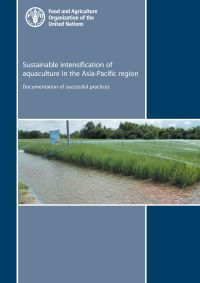
Sustainable intensification of aquaculture in the Asia-Pacific region: Documentation of successful practices

This publication is the major output of a regional programme jointly implemented by FAO and NACA in 2015 to document and disseminate successful practices that contribute to the sustainable intensification of aquaculture in the Asia-Pacific region. Twelve practices are described that contribute to at least one of the following: Improved production and resource use efficiency (land, water, feed, energy); improved environmental benefits; strengthened economic viability and farmers' resilience; and improved social acceptance and equity.

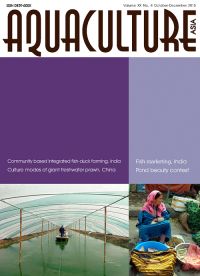
Aquaculture Asia Magazine, October-December 2015

In this issue:

Aquaculture feed supply chain attracting scrutiny. Pond beauty contest, Ram Kumar and social development. Culture modes of giant freshwater prawn in Yangtze River Delta for early harvest. Fish marketing in Kashmir, India - a case study of Srinagar. Community-based integrated fish-duck farming: A boon for rural development in agro-climatic conditions of Assam, India. Gastropod and bivalve fishery of Kakinada Bay, Andhra Pradesh, India: Management and conservation issues.

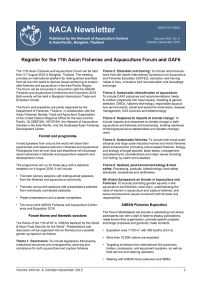
NACA Newsletter, Volume XXX, No. 4, October-December 2015

In this issue:

Register for the 11th Asian Fisheries and Aquaculture Forum and GAF6. 6th Global Symposium on Gender in Aquaculture and Fisheries. Global Conference on Climate Change Adaptation for Fisheries and Aquaculture. A Review of women's access to fish in small-scale fisheries. Aquaculture operations in floating HDPE cages: a field handbook. Aquaculture seed and feed production and management in Bangladesh: Status, issues and constraints.

12th Technical Advisory Committee held in Cha-am, Thailand

The twelfth meeting of NACA’s Technical Advisory Committee (TAC) was held in the coastal town of Cha-am, Thailand from 9-12 March. The TAC meets every two years to review NACA’s rolling work programme and propose amendments to realign it with the current needs of member governments and to account for new and emerging issues. In proposing changes, the TAC prioritises issues of common concern to member governments where there are prospects for regional collaboration.

AFSPAN Final Technical Report now available

The objectives of the Aquaculture for Food Security, Poverty Alleviation and Nutrition (AFSPAN) project were to strengthen the knowledge base and develop new and more rigorous methodologies of quantifying the contribution of aquaculture to combat hunger and poverty, thus providing the evidence upon which sound strategies, policies and research programs can be developed to support the sustainable expansion of aquaculture to maximise its impact on food and nutrition security and poverty alleviation.