Expert Workshop on Inland Fisheries Resource Enhancement and Conservation in Asia
11 February 2010 | 38077 views
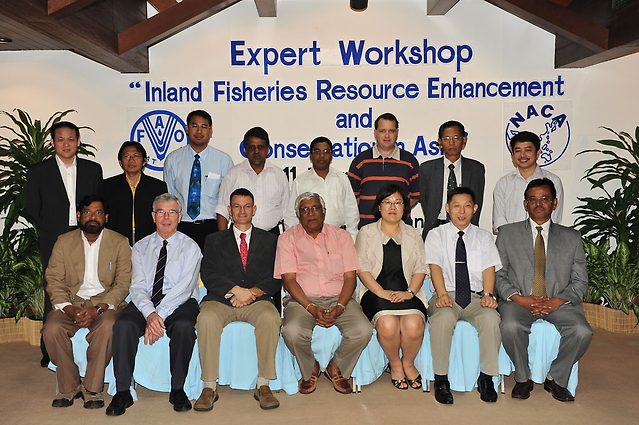
Participants in the Expert Workshop on Inland Fisheries Resource Enhancement and Conservation in Southeast Asia, Pattaya, 2010
FAO and NACA convened an expert workshop to review inland fisheries resource enhancement and conservation practices in Pattaya, Thailand, 8-11 February. Experts from 10 Asian countries attended the meeting to share experiences and lessons learned.
Over the past few decades inland fisheries resources have come under increasing pressure from water engineering projects, pollution and overfishing. This has lead to an alarming decline in the natural populations of many important inland fish species in Asian countries, with implications for the economic welfare and nutrition of millions of people that are dependant on these resources, for the environment, and also for the aquaculture industry that depends on the genetic resource base. Regional collaborative efforts are required to facilitate assessment of current inland fisheries resource enhancement and conservation practices, and there are transboundary coordination issues for countries that share rivers.
NACA publishes audio and video recordings of presentations from technical workshops and conferences. You may listen or view the presentations via the player within the website, or download them for later use. Our audio files are in mp3 format, while video files are in mp4.
Various measures for resource enhancement, conservation and management have been tried in Bangladesh in order to prevent the decline of fisheries resources. The needs of Bangladesh’s poor fisher community to eat what they catch and lack of a legal legislative framework means this situation can only worsen. Hope is offered by new conservation initiatives including habitat restoration, enhancement of depleting fish stocks, transferral of fishing rights and establishment of fish sanctuaries at strategic points.
India produces 4.6 million tonnes of fish annually from its inland water bodies, of which 1 million tonnes originates from enhancement and capture fisheries of open waters. Reservoirs of all categories together produce 94,000 tonnes of fish against a potential of nearly 1 million tonnes. Ownership of inland water bodies vests with the government and the fishing rights of reservoirs and beels are given to individuals, groups and communities according to norms that vary across the states.
Fisheries resources conservation development in Indonesia is based on the protection of endangered and vulnerable freshwater species and maintaining biodiversity integrity, and has been developed with community participation. In order to increase the population and diversification of fish species in inland waters stock enhancement has been carried out since the Dutch occupation when more than 17 species were stocked in inland waters in Indonesia.
Early attempts of fisheries enhancement in Sri Lankan freshwaters were aimed at establishing commercial fisheries. A fisheries enhancement strategy was introduced to village reservoirs of the country in 1980s on a trial basis. Presently, inland fisheries enhancement strategies in Sri Lanka are practiced in seasonal reservoirs and minor perennial reservoirs. The annual CBF production from these reservoirs is about 6 600 tonnes, accounting for about 17 percent of the inland fisheries production.
Inland aquatic ecosystems in China have been largely influenced by the large-scale economic activities and over-exploitation of aquatic resources. A wide range of fisheries resource enhancement and conservation activities have been carried out throughout China. This presentation reviews the history and practices and analyses the problems and insufficient in inland fisheries resource enhancement and conservation in China, and finally recommends some suggestions on technology and operation in order to sustain inland fisheries resources.
7 February 2010 | Jeung Sook Park | 4057 views | .mp3 | 5.17 MB
The beginning of inland fisheries resource stock enhancement in the Republic of Korea dates back to the early 1970’s, when fishing pressure was relatively low, and its development was closely related to the overall trends in the inland fisheries production. The release of hatchery reared juveniles of inland fisheries resources has become an increasingly common practice for stock enhancement and conservation over the last three decades.
7 February 2010 | U Aung Htay | 4016 views | .mp3 | 5.32 MB
Myanmar's inland water resources are still largely in a pristine condition. Fish, consumed in fresh and many processed forms is an important component of the protein intake of the population; consumption is estimated at 43 kg capita per year in 2008-2009. Stock enhancement of inland waters in Myanmar has been conducted since 1967, initiated through a seed replenishing program to the natural water, such rivers, lake, dams even rice fields.
The ecological and biophysical diversity existing in Nepal offers comparative advantages and opportunities to develop and restore inland fishery resources for livelihood enhancement and poverty alleviation of rural communities. Through good governance and proper legislative measures it is required to establish improved environmental protection. Efforts need to target beneficiaries such as disadvantaged and marginalized ethnic communities with training and awareness raising, appropriate legal instruments and infrastructure development needs proper mitigation in hydropower generation/irrigation projects.
7 February 2010 | Tuantong Jutagate and Achara Rattanachai | 4248 views | .mp3 | 6.73 MB
The production from inland capture fisheries in Thailand is about 1 million tonnes per annum. Engineering the environment and fish stocking are the two major practices adopted, and closed-season fishing as well as control of fishing gears are used for conservation purposes. Fish stocking programs date back to the 1950s have been continuously conducted. This presentation provides a historical perspective on stock enhancement practices in Thailand since the 1950s.
7 February 2010 | Bui The Anh and Phan Dinh Phuc | 3900 views | .mp3 | 7.22 MB
Inland fisheries resource enhancement has been considered a major component of reservoir fisheries management since 1962. Multipurpose reservoir construction commenced about the 1960s for irrigation, hydropower generation and flood control. Reservoir fisheries are always a secondary or tertiary activity and are given low priority; however stocking has been considered a major component of reservoir fisheries management. This presentation reviews the history of and changes to stock enhancement practices in Vietnamese reservoirs since the 1960s.