NACA member governments are: Australia, Bangladesh, Cambodia, China, Hong Kong SAR, India, Indonesia, I.R. Iran, Kingdom of Saudi Arabia, Korea (DPR), Lao PDR, Malaysia, Maldives, Myanmar, Nepal, Pakistan, Philippines, Sri Lanka, Thailand and Vietnam.
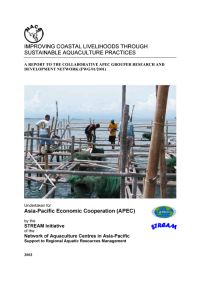
Wild-harvest fisheries for live reef fish are largely over-exploited or unsustainable. Sustainable aquaculture – such as that of groupers – is one option for meeting increasing demand for reef fish as well as potentially maintaining livelihoods of coastal communities. This report draws upon secondary literature, media sources and four diverse case studies from at-risk reef fisheries, to frame a strategy for encouraging sustainable aquaculture as an alternative to destructive fishing practices. It was commissioned by the APEC Secretariat.
Sulawesi has the largest coral reef area in Indonesia, at the epicenter of worldwide marine biodiversity, but is one of the areas most threatened in Southeast Asia by destructive fishing practices. This case study reviews the potential for aquaculture to provide alternative livelihoods for fishers within the context of an integrated, community-based coastal management plan with involvement of local communities empowered to control and steward their resources so that they can conserve and utilise them sustainably.
The Nature Conservancy has been working in Komodo National Park since 1995 to establish a marine reserve that 1) ensures long-term protection of the natural community structure, habitat and species and protects a portion of the exploited reef fish stock to enhance fisheries in the traditional use zones inside the Park and in the waters surrounding the Park. This case study illustrates mariculture activities that could contribute to conservation purposes and more sustainable use of natural resources.
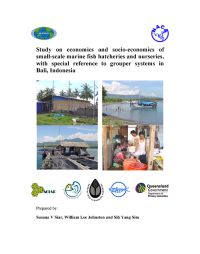
The main objectives of the study were to describe the development of the small-scale or back yard multispecies hatcheries and their economic structure and benefits to the farmers and local community in Bali, Indonesia. The social and economic impact of the back yard multi-species hatchery systems were analysed and details of the benefit of this system to the community described. The strengths and weaknesses of the back yard multi-species hatchery system are described.
This report, the 23rd in the series, contains information about the aquatic animal health status of twenty states in the Asia-Pacific region. The foreword discusses a project on Capacity and Awareness Building on Import Risk Analysis for Aquatic Animals, funded by the APEC Fisheries Working Group.
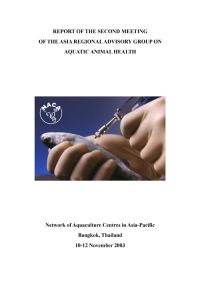
The Asia Regional Advisory Group on Aquatic Animal Health meets annually to discuss regional health issues including emerging disease threats. This report includes a review of regional disease status circa 2003, global and regional disease reporting arrangements, global issues and standards, progress in implementation of the the Regional Technical Guidelines on Health management for the Responsible Movement of Live Aquatic Animals, identification and designation of regional aquatic animal health resources and regional and international cooperation.
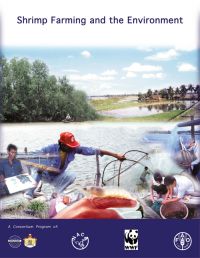
This collection of publications originates from the International Consortium Program on Shrimp Farming and the Environment, which was implemented by the World Bank, the Network of Aquaculture Centres in Asia-Pacific (NACA), the World Wildlife Fund (WWF), the Food and Agriculture Organization of the United Nations (FAO), and the United Nations Environment Programme (UNEP). The consortium supported 35 complementary case studies prepared by more than 100 researchers in more than 20 shrimp farming countries.
This disease card provides information on the epizootic of koi and common carp in Indonesia. The pattern of the recent epidemic in koi and common carp in Indonesia is consistent with that of an infectious disease, but there is as yet no definitive aetiological diagnosis. The Regional Aquatic Animal Health Advisory Group of NACA in its first meeting decided to list Koi mass mortality under Unknown diseases of serious nature in the Quarterly Aquatic Animal Disease report.
The Expert Consultation on Aquaculture Education in the Asia-Pacific was held in, Vietnam, 2000. The consultation was the final activity of APEC project FWG/02/99 “Collaborative Aquaculture Education Program”. This report gives the findings and papers presented to the Expert Consultation, including the follow-up recommendations for establishing an Aquaculture Educational Consortium, in the form of a network, comprising academic and training institutions in the Asia and Oceania regions.
This report, the 22nd in the series, contains information about the aquatic animal health status of seventeen states in the Asia-Pacific region. The foreword discusses the role of disease surveillance programmes and issues realted to the OIE Aquatic Animal Health Standards Commission.
In this issue: Livelihood improvements through fisheries in the Pode community in Pokhara, Nepal. Women's participation in coastal resources management and livelihoods in Khanh Hoa Province, Vietnam. Supporting people's efforts and interactions in coastal resources management in Indonesia. Planning for a community fisheries M&E system. Identifying needs and recommendations for efficient stakeholder communications through an information access survey. IEC Seminar-Workshop in Support of Fisheries Ordinance Implementation in Roxas City, Philippines. About the STREAM Journal. About STREAM.
This report, the 21st in the series, contains information about the aquatic animal health status of sixteen states in the Asia-Pacific region. The foreword discusses the outcomes of the second meeting of the Asia Regional Advisory Group on Aquatic Animal Health.
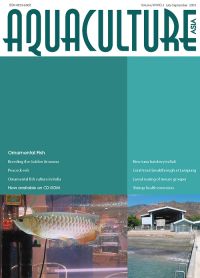
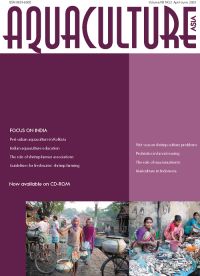
Ornamental fish farming in India. Tilapia for Indian aquaculture? Peri-urban food production in southeast Asia. Socio-economic consequences of shrimp farming in Andhra Pradesh. Breeding techniques for golden arowana Scleropages formosus. Captive breeding of peacock eel Macrognathus aculeatus. Substrate-based aquaculture systems. Extension in shrimp health management - experiences from India. Treatment of disease in freshwater shrimps and crabs in China. Larval rearing techniques for humpback grouper Cromileptes altivelis.
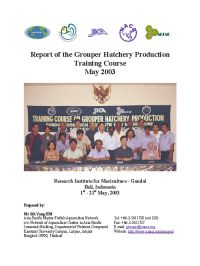
This report documents a training course that was held at the Research Institute for Mariculture, Bali, Indonesia in May 2003. The course covered both theoretical aspects of grouper husbandry via lectures and practical hands-on work in a grouper hatchery, including broodstock management, tank preparation egg collection, live feed production, health management, harvesting and transport and visits to commmercial grouper and milkfish hatcheries, grow-out facilities, markets and exporters.
In this issue: Livelihoods and languages - a SPARK-STREAM learning and communications process. Towards broader contextual understandings of livelihoods. Using tools to build shared understandings, using a sustainable livelihoods framework to learn. Learning about rattan as a livelihood. Meanings of "community-managed area". Lessons learnt about processes for learning and communicating. About the STREAM Journal. About STREAM. This edition is also available in Bahasa (Indonesia), Ilonggo, Vietnamese, Bengali and Oriya.
This report, the twentieth in the series, contains information about the aquatic animal health status of nineteen states in the Asia-Pacific region. The editorial discusses health risks associated with trans-boundary movement of live aquatic animals and the role of risk analyses.
Peri-urban aquaculture in Kolkata. Diffusion and adoption of shrimp farming technologies. Aquaculture education in India. Information system on fish germplasm resources in China. Freshwater crustacean aquaculture in China. The role of macronutrients. Innovations by Bengal farmers. Scientific guidelines for freshwater prawn farmers in India. Status of mariculture in Indonesia. Use of probiotics in larval rearing. Problems in shrimp culture during the wet season.
The Asia Regional Advisory Group on Aquatic Animal Health meets annually to discuss regional health issues including emerging disease threats. This report includes a review of regional disease status circa 2002, global and regional disease reporting arrangements, global issues and standards, progress in implementation of the Regional Technical Guidelines on Health management for the Responsible Movement of Live Aquatic Animals, identification and designation of regional aquatic animal health resources and regional and international cooperation.
This report, the eighteenth in the series, contains information about the aquatic animal health status of fifteen states in the Asia-Pacific region. The foreword discusses changes to the list of diseases covered in the report by the Asia Regional Advisory Group on Aquatic Animal Health.
This report, the seventeenth in the series, contains information about the aquatic animal health status of thirteen states in the Asia-Pacific region. The foreword discusses outcomes of the first meeting of the Asia Regional Advisory Group on Aquatic Animal Health.