NACA member governments are: Australia, Bangladesh, Cambodia, China, Hong Kong SAR, India, Indonesia, I.R. Iran, Kingdom of Saudi Arabia, Korea (DPR), Lao PDR, Malaysia, Maldives, Myanmar, Nepal, Pakistan, Philippines, Sri Lanka, Thailand and Vietnam.
The 74th edition of the Quarterly Aquatic Animal Disease Report contains information from 15 governments. The foreword describes an Emergency Regional Consultation for Prevention and Management of Tilapia Lake Virus (TiLV) in the Asia-Pacific region.
The 15th meeting was held from 21-23 November 2016, in Bangkok, Thailand. A special session was held on addressing the use of anti-microbial substances in aquaculture and the development of anti-microbial resistance. This is an issue of global concern for both human and animal health, and it had been addressed by a resolution at FAO’s Thirty-ninth Conference in June 2015. The meeting reviewed in detail the status of aquatic animal disease in the region.
The 71st edition of the Quarterly Aquatic Animal Disease Report contains information from 15 governments. The foreword provides information about the 10th Symposium on Diseases in Asian Aquaculture.
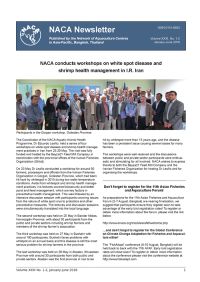
NACA conducts workshops on white spot disease and shrimp health management in I.R. Iran. Don’t forget to register for the 11th Asian Fisheries and Aquaculture Forum! NACA pays tribute to Professor H.P.C. Shetty – Patron of the Pillay Aquaculture Foundation. EHP: Shrimp industry survey. 3rd International Conference on Fisheries and Aquaculture, 24-25 August, Negombo, Sri Lanka. Special Session on the Status of Aquatic Genetic Resources for Food and Agriculture. Second International Technical Workshop on Acute Hepatopancreatic Necrosis Disease (AHPND). Guidebook on Farmer-to-Farmer Extension Approach for Small-Scale Freshwater Aquaculture. Sustainable intensification of aquaculture in the Asia-Pacific region.
A Regional Proficiency Testing Program for Aquatic Animal Disease Diagnostic Laboratories in Asia-Pacific was developed to strengthen diagnostic capability across Asia. This capability was identified as a requirement to facilitate the sanitary safety of trade in aquatic animal products. The program provided 41 laboratories across the Asia-Pacific with the opportunity to assess their diagnostic performance for 10 regionally significant aquatic animal pathogens, and to adapt or modify practices where necessary to improve.
This report, the 68th in the series, contains information about the aquatic animal health status of thirteen states in the Asia-Pacific region. The foreword discusses harmonisation in ASEAN aquaculture certification.
This report, the 67th in the series, contains information about the aquatic animal health status of fourteen states in the Asia-Pacific region. The foreword discusses the OIE Regional Workshop on Safe International Trade in Aquatic Animals and Aquatic Animal Products.
This report, the 66th in the series, contains information about the aquatic animal health status of fourteen states in the Asia-Pacific region. The foreword discusses key activities of the NACA Regional Aquatic Animal Health Programme.
This report, the 65th in the series, contains information about the aquatic animal health status of thirteen states in the Asia-Pacific region. The foreword discusses the outcomes of the 13th meeting of the Asia Regional Advisory Group on Aquatic Animal Health.
This report, the 64th in the series, contains information about the aquatic animal health status of fourteen states in the Asia-Pacific region. The foreword discusses the 9th Symposium on Diseases in Asian Aquaculture.
This report, the 63rd in the series, contains information about the aquatic animal health status of fifteen states in the Asia-Pacific region. The foreword provides an update on acute hepatopancreatic necrosis disease of cultured shrimp, including a description of an improved PCR method for detection of AHPND bacteria.
This report, the 61st in the series, contains information about the aquatic animal health status of fifteen states in the Asia-Pacific region. The foreword discusses the OIE tool for evaluation of performance of aquatic veterinary services.
This report, the 60th in the series, contains information about the aquatic animal health status of fifteen states in the Asia-Pacific region. The foreword discusses response to aquatic animal disease emergencies.
This report, the 59th in the series, contains information about the aquatic animal health status of sixteen states in the Asia-Pacific region. The foreword contains an update on acute hepatopancreatic necrosis syndrome (AHPNS) of cultured shrimp.
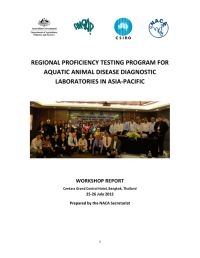
This is the report of the first workshop of the Regional proficiency testing program for aquatic animal disease diagnostic laboratories in Asia-Pacific, held from 25-26 July 2012 in Bangkok, Thailand. The objectives of the programme were to strengthen Asia’s regional capability to diagnose important aquatic animal diseases that impact on trade, train participating laboratory personnel in diagnostic standards and proficiency testing procedures, and to provide technical assistance to improve laboratory performance.
This report, the 56th in the series, contains information about the aquatic animal health status of fifteen states in the Asia-Pacific region. The foreword discusses a case definition for acute hepatopancreatic necrosis syndrome ("early mortality syndrome") in cultured shrimp in Asia.
This report, the 55th in the series, contains information about the aquatic animal health status of fourteen states in the Asia-Pacific region. The foreword discusses acute hepatopancreatic necrosis syndrome ("early mortality syndrome") in cultured shrimp in Asia.
This report, the 54th in the series, contains information about the aquatic animal health status of fourteen states in the Asia-Pacific region. The foreword discusses emerging aquatic animal diseases in the region, including acute hepatopancreatic necrosis disease and scale-drop syndrome.
This report, the 5rnd in the series, contains information about the aquatic animal health status of thirteen states in the Asia-Pacific region. The foreword discusses the 8th Symposium on Diseases in Asian Aquaculture.