NACA member governments are: Australia, Bangladesh, Cambodia, China, Hong Kong SAR, India, Indonesia, I.R. Iran, Kingdom of Saudi Arabia, Korea (DPR), Lao PDR, Malaysia, Maldives, Myanmar, Nepal, Pakistan, Philippines, Sri Lanka, Thailand and Vietnam.
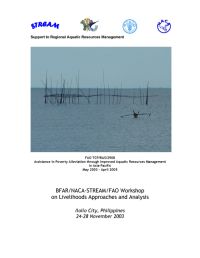
This is the report of the “BFAR/NACA-STREAM/FAO Workshop on Livelihoods Approaches and Analysis” held in Iloilo City, Philippines from 24-28 November 2003. The main purpose of the workshop was to develop and document mechanisms for training in livelihoods approaches and analysis, and to build national capacity to conduct livelihoods analysis. The workshop in Iloilo was the first in a series which will take place in other countries in the region.
3 February 2004 | Haylor, G., Briggs, M.R.P., Pet-Soede, L., Tung, H., Yen, N.T.H., Adrien, B., O'Callaghan, B., Gow, C., De Vantier, L., Santos, R., Pador, E., de la Torre, M., Bulcock, P., and Savage, W. | 26833 views | .pdf | 2.25 MB
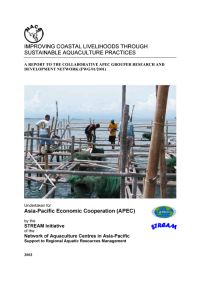
Wild-harvest fisheries for live reef fish are largely over-exploited or unsustainable. Sustainable aquaculture – such as that of groupers – is one option for meeting increasing demand for reef fish as well as potentially maintaining livelihoods of coastal communities. This report draws upon secondary literature, media sources and four diverse case studies from at-risk reef fisheries, to frame a strategy for encouraging sustainable aquaculture as an alternative to destructive fishing practices. It was commissioned by the APEC Secretariat.
The Second SPARK-STREAM Workshop on Livelihoods and Languages took place in Tagaytay City, Philippines, from 12-14 June 2003. The outputs of the workshop included drafts of a language-specific “Guide to Learning and Communicating about Livelihoods”, drafts of articles for STREAM Journal and SPARK Newsletter, identification of priorities and practical follow-up for capacity-building in carrying out participatory livelihoods analysis and the development of follow-up plans.
3 February 2004 | Ronet Santos, Erwin Pador and Meddy De La Torre | 6317 Downloads | .pdf | 761.14 KB
This study characterised the coral reef fisheries in Tubigon, Bohol, Philippines, and sought to derive lessons from the management interventions to eliminate unsustainable fishing practices and improve coastal livelihoods employed by various groups in Tubigon. The study investigated whether recent advances in aquaculture of grouper and reef fisheries had helped improve coastal community livelihoods and prevent unsustainable and destructive practices, and whether there was a role for the private sector in eliminating unsustainable fishing practices and improving coastal livelihoods.
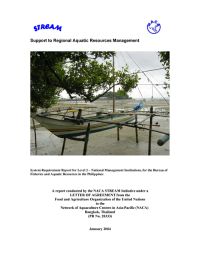
This System Requirement Report describes national level requirements for data collection and sharing mechanisms for fisheries co-management in the Philippines. It also provides a broad picture of the following for the national fisheries management level in the Philippines.
This report presents an overview of the state of aquatic resources in the Philippines, its performance and importance in the Philippine economy, and explores the situation of poverty in the "aquatic resources sector." The report describes the policy environment that guides the action of key actors in the sector. A general analysis of some trends in relation to factors that keep the poor from participating and benefiting from aquatic resource management is also provided.
This report, the 23rd in the series, contains information about the aquatic animal health status of twenty states in the Asia-Pacific region. The foreword discusses a project on Capacity and Awareness Building on Import Risk Analysis for Aquatic Animals, funded by the APEC Fisheries Working Group.
1 January 2004 | Geoff Allan and Don Fielder (eds.) | 2611 Downloads | .pdf | 376.27 KB
To review mud crab aquaculture in Australia and Southeast Asia, ACIAR funded a scoping study, followed by a workshop to review the study and discuss status and problems in different regions of Australia and Southeast Asia. The primary conclusion from the scoping study, verified by workshop discussion, was that the substantial crab farming operations which exist throughout Southeast Asia are still mainly based on wild caught crablets.
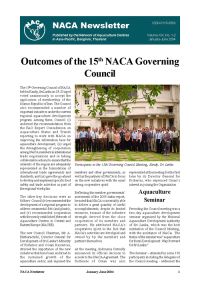
Outcomes of the 15th Governing Council. Aquaculture seminar. Council Chair for 2004-2005. Shrimp disease and coastal management - four years. New Import Risk Analysis publications. Reducing the risk of shrimp disease outbreaks in Vietnam. Network of Aquaculture Centres in Central and Eastern Europe. OASIS: The One Stop Aqua Shop Information Service. Other recent STREAM activities. New faces at NACA.
19 November 2003 | De Silva, S.S., S.Y. Sim and M.J. Phillips (eds.) | 2478 Downloads | .pdf | 960.92 KB
The Expert Consultation on Aquaculture Education in the Asia-Pacific was held in, Vietnam, 2000. The consultation was the final activity of APEC project FWG/02/99 “Collaborative Aquaculture Education Program”. This report gives the findings and papers presented to the Expert Consultation, including the follow-up recommendations for establishing an Aquaculture Educational Consortium, in the form of a network, comprising academic and training institutions in the Asia and Oceania regions.
This report, the 22nd in the series, contains information about the aquatic animal health status of seventeen states in the Asia-Pacific region. The foreword discusses the role of disease surveillance programmes and issues realted to the OIE Aquatic Animal Health Standards Commission.
In this issue: Livelihood improvements through fisheries in the Pode community in Pokhara, Nepal. Women's participation in coastal resources management and livelihoods in Khanh Hoa Province, Vietnam. Supporting people's efforts and interactions in coastal resources management in Indonesia. Planning for a community fisheries M&E system. Identifying needs and recommendations for efficient stakeholder communications through an information access survey. IEC Seminar-Workshop in Support of Fisheries Ordinance Implementation in Roxas City, Philippines. About the STREAM Journal. About STREAM.
This report, the 21st in the series, contains information about the aquatic animal health status of sixteen states in the Asia-Pacific region. The foreword discusses the outcomes of the second meeting of the Asia Regional Advisory Group on Aquatic Animal Health.
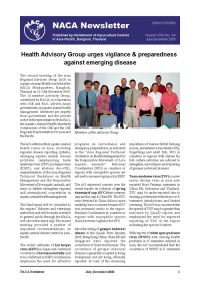
Health Advisory Group urges vigilance and preparedness against emerging disease. New Zealand farmer helps train Asian aquaculturists. Mr Junaidi Che Ayub. Global Aquaculture Discussion Forum, Dhaka, Bangladesh. STREAM Conducts Livelihood Capacity-building in the Philippines, India. MPEDA/NACA shrimp farmer workshop held in Andhra Pradesh, India. Learning by Doing - Fisheries and Adaptive Learning. NACA cooperation expanded to shrimp health management in Vietnam. 150 people trained in Q3-Q4, 2003. International Symposium on Freshwater Prawns Held at Kochi, India. Developing an online aquaculture community for NACA.
The Second STREAM Regional Conference was held in Tagaytay City, Philippines, from 8-10 June 2003 with the participation of 23 people from Australia, Cambodia, India, Nepal, Philippines, Thailand, Vietnam and Yunnan Province of China. Following a regional overview of STREAM’s themes, country partners, donors and funding, and activities, participants visited four “stations” on the themes of livelihoods, institutions, policy development, and communications, working in groups representing National Coordinators, Communications Hub Managers, and Partners. STREAM operations were discussed.
In this issue: Livelihoods and languages - a SPARK-STREAM learning and communications process. Towards broader contextual understandings of livelihoods. Using tools to build shared understandings, using a sustainable livelihoods framework to learn. Learning about rattan as a livelihood. Meanings of "community-managed area". Lessons learnt about processes for learning and communicating. About the STREAM Journal. About STREAM. This edition is also available in Bahasa (Indonesia), Ilonggo, Vietnamese, Bengali and Oriya.
This report, the twentieth in the series, contains information about the aquatic animal health status of nineteen states in the Asia-Pacific region. The editorial discusses health risks associated with trans-boundary movement of live aquatic animals and the role of risk analyses.
Recommendations of the Aquamarkets Consultation 2003. EC-funded project targets seafood trade and poverty. Shrimp disease control and coastal management. Fisheries and Adaptive Learning project. Shrimp aquaculture certification: Request for information & advice on a new web site. Workshop on control and responsible use of alien species. MPEDA/NACA Technical Assistance on Shrimp Health and Coastal Management. Changes to the regional list of aquatic animal diseases. STREAM SAPA Stakeholder Workshop in Hanoi. Regional Training Course on Grouper Hatchery Production. Review on low food chain species for marine fish culture. NACA/Deakin University to visit Indonesia 2-7 April 2003.
In this issue: Learning insights from the Fisheries Resource Management Project. An orientation on the SIAD approach and participatory local development planning. Group-building, production success and the struggle to prevent capture of the resource. Urban agriculture, water reuse and local economies: Case study of coastal riverine settlements of Ondo State, Nigeria. Livelihoods analysis: Actual experience from using PRA. A sustainable livelihoods approach to fisheries development for poverty alleviation in southeastern Vietnam. About the STREAM Journal. About STREAM.
This report, the nineteenth in the series, contains information about the aquatic animal health status of sixteen states in the Asia-Pacific region. The editorial discusses the role of the Quarterly Aquatic Animal Disease Reporting System.