NACA member governments are: Australia, Bangladesh, Cambodia, China, Hong Kong SAR, India, Indonesia, I.R. Iran, Kingdom of Saudi Arabia, Korea (DPR), Lao PDR, Malaysia, Maldives, Myanmar, Nepal, Pakistan, Philippines, Sri Lanka, Thailand and Vietnam.
Since 2009, tilapia aquaculture has been threatened by mass die-offs in Israel and Ecuador, which have been caused by a novel Orthomyxo-like (RNA) virus named Tilapia lake virus. This has been reported as a newly emerging virus that causes syncytial hepatitis of tilapia. An emergency regional consultation was held in Guangzhou, China from 27-28 September 2017 to discuss and plan actions on the overall prevention and management of this disease.
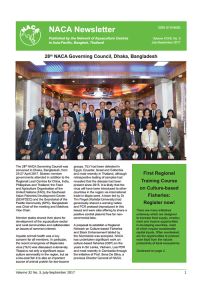
28th NACA Governing Council, Dhaka, Bangladesh; register for the First Regional Training Course on Culture-based Fisheries; 11th Indian Fisheries and Aquaculture Forum, Kochi, 21-24 November; audio recordings for regional feed consultation now available; tilapia lake virus; Proceedings of the International Symposium on Aquatic Animal Health and Epidemiology for Sustainable Asian Aquaculture; ICAR-CIBA launch "Vanami Shrimpapp", a mobile app on Pacific white shrimp (Penaeus vannamei) farming; Pakistan officials train on aquaculture certification.
The SEAFDEC-Sweden project is seeking a Gender and Social Development Specialist with a knowledge and passion for gender equality, human rights and social development. As a Gender and Social Development Specialist, you shall have deeper understanding of gender, human rights and social development aspects helping SEAFDEC-Sweden project, its implementing partners and project staff on how to promote gender equality, human rights and social development through internal practice and gender analysis.
Each year, the Sustainable Rice Platform brings together its members and dialogue partners to discuss collaborative approaches and innovative solutions to critical sustainability challenges facing the rice sector. This year, the SRP will convene the First Global Sustainable Rice Conference and Exhibition, from 4-5 October in Bangkok, Thailand.
The 73rd edition of the Quarterly Aquatic Animal Disease Report contains information from 14 governments. The foreword provides a disease advisory on tilapia lake virus (TiLV), an emerging threat to farmed tilapia in the Asia-Pacific region.
A regional consultation on aquaculture feed production and use in Asia-Pacific was held from 7-9 March 2017. The consultation reviewed the current situation of aquaculture feed production and use, sourcing of ingredients, policy and research needs. This collection contains audio recordings of the technical presentations made by experts, international organisations, the private sector and governments in the region. The report of the consultation is in press and will be made available for download in due course.
The Asian Institute of Technology (AIT) is launching a new Certificate programme on Sustainable Asian Aquaculture via the AARM Academic programme, for one semester beginning August 2017. This certificate programme is a combination of well-designed course work and hands-on experience in specialised areas (fish/shrimp hatchery or farming). The programme is useful for both students (with credit transfer) and for working professionals and entrepreneurs (without credits).
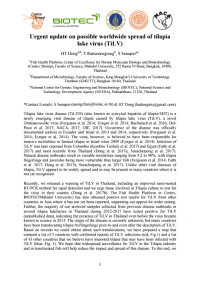
Recently, we released a warning of TiLV in Thailand and an improved RT-PCR detection methodology. The Fish Health Platform in Centex, BIOTEC/Mahidol University has also obtained positive test results for TiLV in other Asian countries where it has not yet been reported. Many countries have been translocating tilapia fry/fingerlings prior to and even after the description of TiLV. We have prepared a map listing countries with confirmed reports of TiLV infections and 43 other countries that we believe have imported infected fish.
The 73rd edition of the Quarterly Aquatic Animal Disease Report contains information from 14 governments. The foreword provides information about the implementation of a National Surveillance Programme for Aquatic Animal Diseases (NSPAAD) in India.
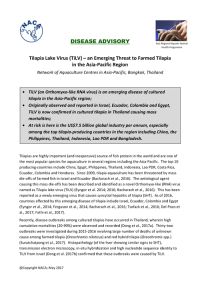
Tilapia lake virus (TiLV) is an emerging disease of cultured tilapia in the Asia-Pacific region. Originally observed and reported in Israel, Ecuador, Colombia and Egypt, TiLV is now confirmed in cultured tilapia in Thailand causing mass mortalities. At risk is here is the US$7.5 billion global industry per annum, especially among the top tilapia-producing countries in the region including China, the Philippines, Thailand, Indonesia, Lao PDR and Bangladesh. This advisory describes signs of the disease and PCR detection methods.
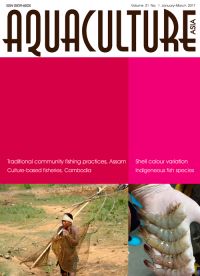
Anti-microbial resistance in aquaculture; participatory market chain approaches to boost fish nurseries; traditional community fishing practices of rural Assam; practical significance of restricted feeding regimes in aquaculture; Bangana dero: A potential indigenous fish species for diversification of carp culture; shell colour variation in farmed Litopenaeus vannamei: Comparison of white- and brown-shelled shrimp; culture-based fisheries: A low-tech, greenhouse friendly approach to improving food and income for Cambodian families.
The 15th meeting of the Asia Regional Advisory Group on Aquatic Animal Health; a regional consultation on responsible production and use of feed in aquaculture; a report on the Giant Prawn 2017 conference; a preview of the new NACA website; and new initiatives on a very serious emerging issue - reducing the human and animal health risks from development of anti-microbial resistance in the aquaculture industry.
Tilapia lake virus (TiLV) is an emerging virus that causes syncytial hepatitis of tilapia with mortalities of up to 90%. Recent disease outbreaks in Thai tilapia farms have been associated with high cumulative mortalities and histopathological features typical of SHT. Infection has now been confirmed. The semi-nested RT-PCR protocol described here may be used freely for non-commercial applications to detect TiLV. The authors urge laboratories in Asia to test for TiLV when abnormal tilapia mortality occurs.
The fourth major international event on giant freshwater prawns was organised by the Asian Institute of Technology from 20-24 March 2007. The conference, organised by Salin Krishna and Michael New, built on a series of highly successful events that trace back to the very beginnings of the industry. The first conference, Giant Prawn 1980 brought together all those involved in freshwater prawn research and farming for the first time and set many priorities for future research and development.
FAO, NACA and the Thai Department of Fisheries convened a Regional Consultation Responsible Production and Use of Feed and Feed Ingredients for Sustainable Growth of Aquaculture in Asia-Pacific in Bangkok, 7-9 March 2017. The objective of the consultation was to review the current status of aquaculture feed production and use, demand and supply, sourcing of ingredients, government policies and institutional support, ongoing progress and development gaps. The meeting brought together government and private sector representatives.
Over the years, there have been two growing sustainability concerns with shrimp supply chain, namely human trafficking and environmental impacts. Solving these two issues can sometime result in conflicting agendas. This summary outlines CPF’s approach and experience in dealing with the two issues. The most difficult challenge in our experience is in building trust and understanding between the stakeholders, including governments and regulators, fisherfolk, commercial fishermen, suppliers and buyers. However, we feel that CPF is now a pioneer in our programs.
The Department of Fisheries is responsible for aquaculture sustainability, including food safety, animal health and welfare, environmental integrity, social and community welfare and regulation of fishing activities across the whole aquaculture supply chain. The Feed Quality Control and Development Division is responsible for registration and certification of feed formulas and monitoring of feed quality. In addition to input controls, end products are also subject to inspection and monitoring, certification and traceability systems.
Approximately 90% of aquaculture produce in Thailand are fed with a complete commercial feed. The Department of Fisheries is responsible for the licensing and registration of feed to be sold for commercial purposes. High quality fishmeal is a priority for aquaculture feed production especially for shrimp and marine fish and this has significantly affected feed cost. Most agricultural by-products are already utilised for purposes such as livestock, pet foods, fertilisers and biofuels, so competition for alternative ingredients is high.
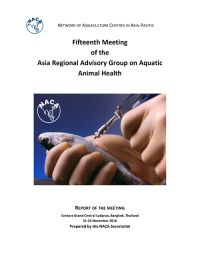
The Asia Regional Advisory Group on Aquatic Animal Health meets annually to discuss regional health issues including emerging disease threats. This report includes a review of regional disease status circa 2016, global and regional disease reporting arrangements, global issues and standards, progress in implementation of the the Regional Technical Guidelines on Health management for the Responsible Movement of Live Aquatic Animals, identification and designation of regional aquatic animal health resources and regional and international cooperation.