Technical publications

NACA publishes technical papers and manuals for a wide variety of farming systems and related environmental and social issues. Many of these provide guidance on better management practices with a view to improving crop outcomes and on-farm resource utilisation efficiency. By using inputs such as feed and power more efficiently, farmers can simultaneously improve their profitability and environmental performance.

Creative Commons Attribution.
Related

Publications

NACA publishes a wide range of aquaculture publications including technical manuals, workshop proceedings, better practice guidelines and several serials including Aquaculture Asia Magazine, the NACA Newsletter and the Quarterly Aquatic Animal Disease Report. To keep up to date with developments you could consider subscribing to our RSS feed

In this collection

An improved traditional shrimp culture technique for increasing pond yield

A series of research studies were conducted to refine existing traditional culture practices for the tiger shrimp, Penaeus monodon. Natural food produced in a shrimp pond through fertilisation is not fully consumed in the first two months at a stocking rate of 5,000 postlarvae per hectare. Natural food produced by organic and inorganic fertilisation using the traditional practice can sustain an optimal growth of shrimp at a density of 20,000 postlarvae per hectare for a period of 60 days.

A prototype warm water shrimp hatchery

A successful hatchery usually depends on a number of conditions; among the more important ones are right choice of site, effectiveness and efficiency of operational management. The present technology series attempts to describe the prototype warm water shrimp hatchery established and operated by SEAFDEC Aquaculture Department in collaboration with FAO since 1982. The techniques used in the operation of the hatchery have been refined, repeatedly tested and are now packaged for further testing in different environmental conditions elsewhere in the Philippines and other tropical countries.

Introductions and movement of Penaeus vannamei and Penaeus stylirostris in Asia and the Pacific

This report has attempted to gather all of the currently available data on the extent of P. vannamei and P. stylirostris importation and culture in Asia, its potential problems and benefits, to provide a source document from which to investigate further the means by which control over this issue might be re-established. Recommendations aimed at controlling the importation, testing and culture of these species have been made for all levels and are included in this report.

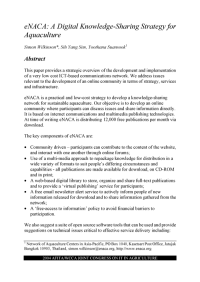
eNACA: A digital knowledge-sharing strategy for aquaculture

This paper provides a strategic overview of the development and implementation of a very low cost ICT-based communications network. We address issues relevant to the development of an online community in terms of strategy, services and infrastructure. Our objective is to develop an online community where participants can discuss issues and share information directly. It is based on internet communications and multimedia publishing technologies. At time of writing eNACA is distributing 12,000 free publications per month via download.

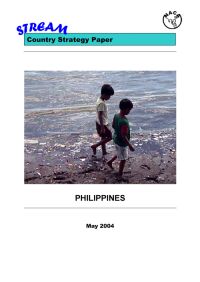
Philippines country strategy paper

In 2002, the Philippines Government signed a Partnership Agreement with the NACA-STREAM Initiative. The initial focal point for STREAM work is Western Visayas, including the Sapian Bay and Banate Bay areas where BFAR Region 6, the STREAM country host, has on-going engagements, and also areas within Regions 6 and 7 where marine ornamentals collection and trading occur. The key disadvantaged groups for whom aquatic resources are a source of livelihood are the primary stakeholders for the initiative.

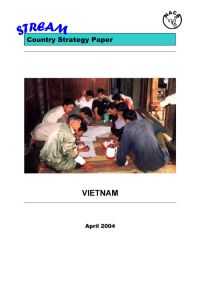
Vietnam country strategy paper

Although Vietnam has long been listed among the poorest countries of the world, it has recently made large strides in reducing poverty and improving food security. However, the dramatic gains in poverty reduction in Vietnam still remain quite fragile. There is growing evidence to indicate that dependence on aquatic resources is correlated to poverty, and that aquatic resources constitute an important component of wider livelihoods strategies (largely from the Mekong Delta, Central Coast and the Northern Mountains).

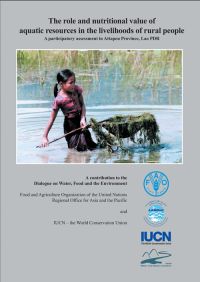
The role and nutritional value of aquatic resources in the livelihoods of rural people: A participatory assessment in Attapeu Province, Lao PDR

This assessment is intended to address the concern that the ecological and livelihood functions and values of rice fields and adjoining wetlands are not fully appreciated in development planning. A participatory assessment was conducted in Attapeu Province, Lao PDR to determine the role of aquatic resources in the nutritional status of people engaged in rural livelihoods and to determine any opportunities, constraints or threats that may exist concerning the management of aquatic resources and future development in the province.

Information access survey, Vietnam

This study aims to provide an overview of media currently used in Vietnam, with particular focus on use of media for extension purposes, to explore access to information, and information exchange between stakeholder groups and institutions within the aquatic resources and fisheries sectors, to investigate the information needs of rural communities involved in fisheries and aquatic resources management and to make recommendations for increasing the efficiency of communication with different stakeholders.

Emerging Trends and Experiences in Asia-Pacific Aquaculture: 2003

This document provides an overview of topical issues in Asian aquaculture for 2003, including a review of its status, progress in research and development, major issues and experiences, together with suggestions on actions for addressing opportunities and constraints. The document was prepared by NACA and FAO to facilitate discussions at the 15th NACA Governing Council meeting, hosted by the Government of Sri Lanka on 21st-25th April 2004.

The international seafood trade: Supporting sustainable livelihoods among poor aquatic resource users in Asia

The purpose of this report is to provide an overview of the international seafood trade and poverty, with special reference to the trade in some selected marine products between Asia and the European Union. It represents Output 1 of the project “The International Seafood Trade: supporting sustainable livelihoods among poor aquatic resource users in Asia”, which was funded by the European Community's Poverty Reduction Effectiveness Programme (EC-PREP).

Basic overview of the regulatory procedures for authorisation of veterinary medicines with emphasis on residues in food animal species

This report presents a précis of the regulatory procedures for authorisation of veterinary medicines in Europe and the USA. In particular it concentrates upon the requirements for consumer safety in regard to presence of residues of veterinary medicines in the edible tissues of food animal species. In both Europe and the USA the regulations in regard to veterinary residues and consumer safety require that countries wishing to export into those markets demonstrate equivalent standards to the domestic requirements.

Report of the Emergency Disease Control Task Force on a Serious Disease of Koi and Common Carps in Indonesia, June 2002

An Emergency Disease Control Task Force on a Serious Disease of Koi and Common Carps in Indonesia was organised by NACA in June 2002. The Task Force conducted an emergency assessment of the disease situation in July through field and laboratory examinations of collected samples. The Task Force collected information about the disease occurrence. Koi herpes virus was detected from all case samples which indicates that it may have played a role in the observed mortalities.

Information access survey Western Visayas, Philippines, June 2003

The aim of this report is to provide brief profiles of the main stakeholders within the aquatic resources and fisheries sectors in Western Visayas, to describe their access to information, and the communication between and within stakeholder groups, organisations and institutions within the sector. The report goes on to identify current needs and key action points which might maximise efficient communication.

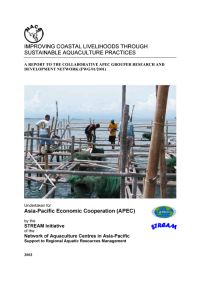
Improving coastal livelihoods through sustainable aquaculture practices: Full report

Wild-harvest fisheries for live reef fish are largely over-exploited or unsustainable. Sustainable aquaculture – such as that of groupers – is one option for meeting increasing demand for reef fish as well as potentially maintaining livelihoods of coastal communities. This report draws upon secondary literature, media sources and four diverse case studies from at-risk reef fisheries, to frame a strategy for encouraging sustainable aquaculture as an alternative to destructive fishing practices. It was commissioned by the APEC Secretariat.

Facilitating a diversity of voices to influence policy

This paper is about a process and practice which is bringing representatives of tribal communities in three Indian states together with district, state and national government officials, around the issue of aquaculture services provision. The project comprises a series of visits, fieldwork, workshops, case studies, a consensus-building process, literature research and documentation. Among its aims are building shared understandings of government services provision among recipients, implementers and policy-makers, and facilitating an equitable dialogue towards policy change.

Case studies: Investigating improved policy on aquaculture service provision to poor people

The six case studies published here grew in concept and content throughout the Project period. To follow the progress of the Case Studies, excerpts have been taken from previous Project documents, and adapted for the purpose of showing how they changed from an initial idea to the form in which they appear here and were presented finally at the Policy Review Workshop in Noida, Delhi, in April 2003. Each of the studies is different in focus and format. 

Research learning and new thinking

This report, at the request of NRSP, highlights “research learning and new thinking” arising from project R8100. It considers the project’s process from a strategic viewpoint, which is summarised in a conceptual matrix. The main features of the process’s overall strategy considered in more detail are a strategy for bringing through the voices of poor people – described as facilitated advocacy, with the role played by the project being one of “making it easier for people to speak for themselves”.


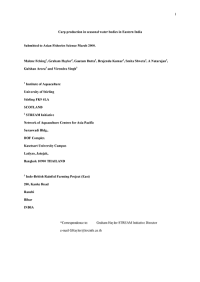
Carp production in seasonal water bodies in Eastern India

The feasibility of integrated aquaculture in seasonal water bodies in rainfed farming areas of Eastern India was assessed in on-farm trials. Fry of Indian major carps: Catla, mrigal, rohu, common carp, and silver barb, and advanced fingerlings of Indian major carps were raised to marketable size. Key factors for the success of aquaculture in seasonal water bodies are access to credit, production enhancing inputs and water bodies that hold water for more than 120 days of the year.

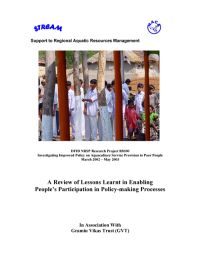
A review of lessons learnt in enabling people's participation in policy-making processes

Development approaches are constantly evolving, acting on and utilising lessons learnt from past experiences. As a result, “good governance” approaches are currently topical, an intrinsic component of which is how rural poor people can participate in policy-making processes. By reviewing lessons learnt, and considering these with examples from within and outside India, an indication can be given of the most appropriate ways to begin to affect policy, although a specific blueprint will not be suggested.

System requirements report for level 2 - national management institutions

This System Requirement Report describes national level requirements for data collection and sharing mechanisms for fisheries co-management in the Philippines. It also provides a broad picture of the following for the national fisheries management level in the Philippines.