Technical publications

NACA publishes technical papers and manuals for a wide variety of farming systems and related environmental and social issues. Many of these provide guidance on better management practices with a view to improving crop outcomes and on-farm resource utilisation efficiency. By using inputs such as feed and power more efficiently, farmers can simultaneously improve their profitability and environmental performance.

Creative Commons Attribution.
Related

Publications

NACA publishes a wide range of aquaculture publications including technical manuals, workshop proceedings, better practice guidelines and several serials including Aquaculture Asia Magazine, the NACA Newsletter and the Quarterly Aquatic Animal Disease Report. To keep up to date with developments you could consider subscribing to our RSS feed

In this collection

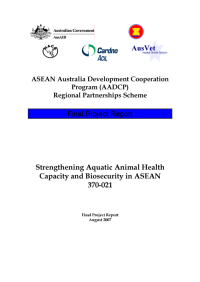
Strengthening Aquatic Animal Health Capacity and Biosecurity in ASEAN

This final report of the project “Strengthening Aquatic Animal Health Capacity and Biosecurity in ASEAN” contains two parts: A. Recommended Minimum Operational Requirements for Implementing National Aquatic Animal Health Strategies within ASEAN and B. ASEAN progress in the implementation of National Aquatic Animal Health Strategies. The report provides guidance for countries in ASEAN to implement key elements of national aquatic animal health strategies, and for monitoring progress of national strategy implementation in ASEAN member countries.

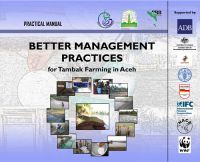
Practical Manual on Better Management Practices for Tambak Farming in Aceh

This practical manual provides better management practices for the farming of shrimp in tambak systems in Aceh, Indonesia. The manual addresses the formation of farmer groups, crop planning, and specifies better management practices. These include: Location of tambaks, design and construction of tambaks, pond preparation practices, shrimp seed selection and stocking practices, feed management practices, water management practices, health management practices, harvest and post-harvest handling practices, keeping records and improved marketing practices.

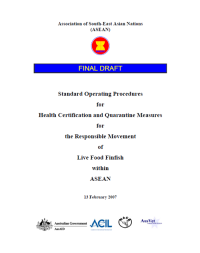
Standard operating procedures for health certification and quarantine measures for the responsible movement of live food finfish within ASEAN

These standard operating procedures were developed to reduce the risk of spread of trans-boundary disease of aquatic animals through the movement of live food fish. The procedures are a set of documents for health certification and quarantine measures to be used by competent authorities in trade among ASEAN member countries. The procedures recognise the existing variation in capacity between ASEAN members and have been designed so that they can be implemented across varying policy and legal frameworks.

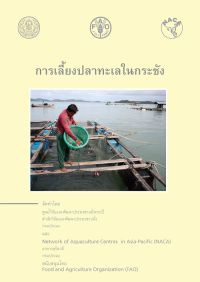
การเลี้ยงปลาทะเลในกระชัง (Training manual on marine finfish cage culture)

This training manual (in Thai language) provides guidance in marine finfish cage aquacutlure techniques. It is geared towards giving small-scale farmers a solid technical grounding that will enable them to improve their farm productivity and reduce losses through understanding of markets and economic factors, better farm siting. and improved feeding, handling and stock management practices. This knowledge will help the trainees and other fish farmers to improve their productivity and profitability while also reducing their risk profile.

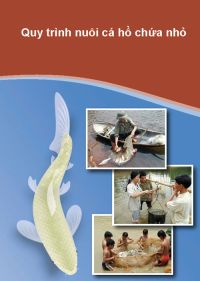
Quy trình nuôi cá hồ chứa nhỏ

Mục tiêu của cuốn sách nhằm cung cấp những chỉ dẫn cơ bản của CBF, một hình thức nuôi cá hiệu quả, đang được quan tâm nhiều ở các vùng nông thôn miền núi châu.

Guidelines on digital publishing: A practical approach for small organisations with limited resources

These guidelines on digital publishing are targeted primarily at small organisations with limited resources in developing countries, in order to facilitate decision-making on how to publish and disseminate their information, with emphasis on the internet. The Guidelines are based on the years of experience of the Network of Aquaculture Centres in Asia-Pacific and its partners. The approach is practical in orientation, covering topics including planning, maintenance, making content accessible and suggested tools.

Good management practices for broodstock collectors

The National Aquaculture Development Authority of Sri Lanka (NAQDA) took several steps to regularise collectors of Penaeus monodon under the restructuring programme of the shrimp aquaculture industry in Sri Lanka. Regularisation of broodstock collectors is very imperative mitigate transmission of white spot disease. NAQDA developed these practices in consultation with the Department of Fisheries and Aquatic Resources, shrimp hatchery owners, broodstock suppliers, NARA, Wayamba environmental authority, Sri Lanka aquaculture development alliance and the consortium for shrimp aquaculture development.

Strengthening Aquatic Animal Health Capacity and Biosecurity in ASEAN: Technical mission to Myanmar

A technical mission to Myanmar was undertaken to support development and implementation of national aquatic animal health strategies from 3 - 9 September 2006. The mission was part of the AADCP-RPS project "Strengthening Aquatic Animal Health Capacity and Biosecurity in ASEAN". The mission was coordinated by NACA and worked with stakeholders to develop simple and practical approaches to implement national aquatic animal health strategies in Myanmar.

Strengthening Aquatic Animal Health Capacity and Biosecurity in ASEAN: Technical mission to Vietnam

This is the report of a technical mission to Vietnam from 3 - 9 December 2006, as a part of the project “Strengthening Aquatic Animal Health Capacity and Biosecurity in ASEAN” to assist national authorities in the development and implementation of simple and practical national aquatic animal health management strategies. The objective of the mission was to assist the government to support development of national strategies on aquatic animal health management and develop short and long term plans.

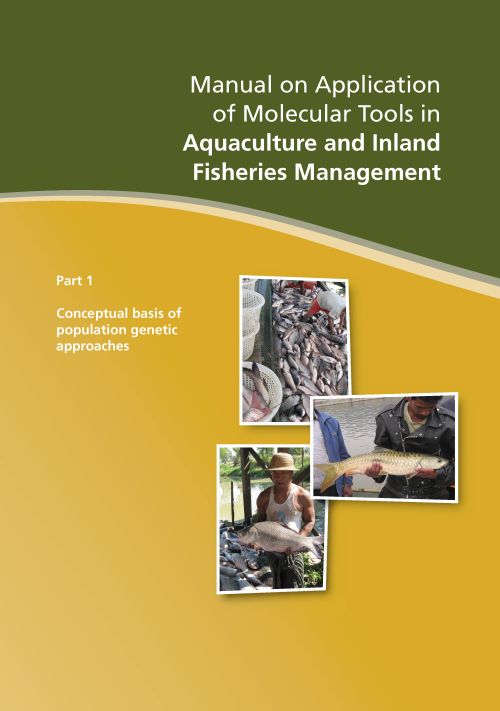
Manual on Application of Molecular Tools in Aquaculture and Inland Fisheries Management

This manual provides a comprehensive practical tool for the generation and analysis of genetic data for subsequent application in aquatic resources management in relation to genetic stock identification in inland fisheries and aquaculture. The material only covers general background on genetics in relation to aquaculture and fisheries resource management, the techniques and relevant methods of data analysis that are commonly used to address questions relating to genetic resource characterisation and population genetic analyses.

Guidelines for environmental management of aquaculture investments in Vietnam

This document provides an analysis of the environmental impacts and risks associated with aquaculture development in Viet Nam and guidance on better environmental management and monitoring for its future development. Part 1 provides a summary of the main findings, and guidelines for future development of the aquaculture sector. Part 2 provides the detailed case study findings. The guidelines presented in Part 1 are based on cases studies of all major aquaculture commodities in Viet Nam.

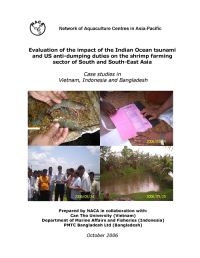
Evaluation of the impact of the Indian Ocean tsunami and US anti-dumping duties on the shrimp farming sector of South and South-East Asia

This report is the outcome of a study conducted by NACA to assess the impact of the 2004 Indian Ocean tsunami and of the introduction of US anti-dumping duties on the shrimp farming sectors of countries in the Asia-Pacific region, with special focus on the effect that these unusual events had on shrimp prices and stakeholders' livelihoods. The assessment was conducted by collecting data from a wide range of stakeholders involved with shrimp farming.

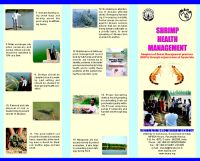
Shrimp health management brochures

Shrimp Health Management brochures provide better management practices in a reader friendly format. These brochures were prepared as extension materials through the village based demonstration programme by the Marine Products Export Development Authority of India and NACA. The programme continues building success and involved a total of 29 villages and 29 Aquaclubs in five Indian states (Andhra Pradesh, Tamilnadu, Orissa, Gujarat, and Karnataka) in 2006.

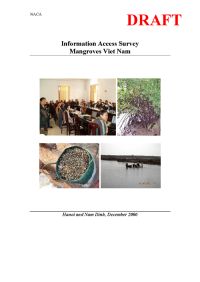
Information access survey on mangroves, Viet Nam

Viet Nam's mangrove forests have been severely impacted by human interventions, with a reduction in forestation from 408,000 ha in 1943 to a low of 150,000 ha in 2000. This study provides an overview of the information needs and communication issues surrounding people living in mangrove regions of Viet Nam. It is hoped that this study will help to raise the awareness of issues surrounding mangrove environments and improve the accessibility to information, for all stakeholders.

Capacity building on sustainable livelihoods analysis and participatory rural appraisal

The practical application of livelihoods approaches is still relatively new in development work and guidance is much sought by field teams. The concept aims to build a comprehensive picture of how people within communities live, rather than approaching development planning from a sectoral perspective such as agriculture, forestry or fisheries, to assist in planning interventions that will benefit present and future generations. This document discusses the concepts of livelihoods and sustainable livelihoods analyses with these objectives in mind.

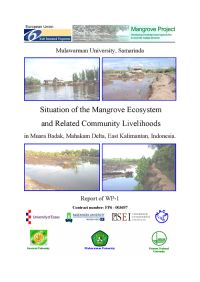
Situation of the mangrove ecosystem and related community livelihoods in Muara Badak, Mahakam Delta, East kalimantan, Indonesia

This reports describes the status of mangrove ecosystems and associated communities in the Mahakam Delta, Indonesia. It describes historical degradation of the mangrove ecosystems for shrimp farming and land speculation. The report describes the livelihoods of the local communities, their usage and connections with the mangrove forests and farming activities, and socio-economic factors impeding the restoration of mangrove habitats, which are in large part related to poverty. Attempts to replant areas are described.

Aquaculture in the Asia-Pacific and the outlook for mariculture in southeast Asia

This paper provides an overview of seafood consumption production in southeast Asia circa 2006. It forecasts a need for aquaculture to expand area under culture and intensity; highlights the potential for fishmeal to constrain growth, and identifies a trend towards cultivation of high-value species. Sources for the review included a regional synthesis of aquaculture developed for a regional workshop in 2005, a review of marine finfish hatchery development and a regional survey of cage fish culture.

Better-practice approaches for culture-based fisheries development in Asia

This manual provides guidelines for attaining better practices in culture-based fisheries, an emerging practice in rural areas in the Asian region. It deals with the principles of culture-based fishery practices, primarily based on relatively long-term experiences in Sri Lanka and Vietnam. It deals with the gross factors that are applicable to improving fish yields and therefore revenue; and sustaining culture based fisheries as a development activity in the long-term.

Better-practice guidelines: What are better practice guidelines?

Our better-practice guidelines are an attempt to share lessons that are learnt from local practice or from research, with many more people within Asia-Pacific and to enable people, institutions and policy-makers to use new tools and mechanisms which support aquatic resources management in ways that benefit the livelihoods of people who are poor. This publication is also available in Bahasa Indonesia, Bengali, Hindi, Ilonggo, Khmer, Myanmar, Nepali, Oriya, Sinhala, Urdu and Vietnamese.

Better practice guidelines: Self-help groups

Self-help groups are a way to start working that helps to build up the social connections which people find useful in support of their livelihoods objectives, helping people to agree on things and to speak together, giving people a stronger voice in decision-making and in negotiating with more powerful forces. This publication is also available in Bahasa Indonesia, Bengali, Hindi, Ilonggo, Khmer, Myanmar, Nepali, Oriya, Sinhala, Urdu and Vietnamese.