Technical publications

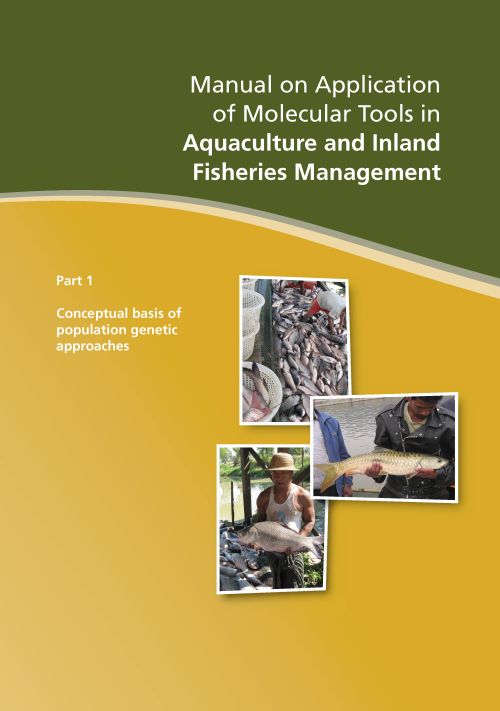
NACA publishes technical papers and manuals for a wide variety of farming systems and related environmental and social issues. Many of these provide guidance on better management practices with a view to improving crop outcomes and on-farm resource utilisation efficiency. By using inputs such as feed and power more efficiently, farmers can simultaneously improve their profitability and environmental performance.

Creative Commons Attribution.
Related

Publications

NACA publishes a wide range of aquaculture publications including technical manuals, workshop proceedings, better practice guidelines and several serials including Aquaculture Asia Magazine, the NACA Newsletter and the Quarterly Aquatic Animal Disease Report. To keep up to date with developments you could consider subscribing to our RSS feed

In this collection

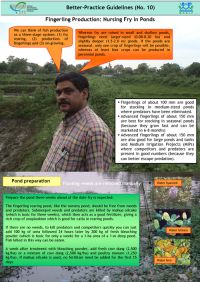
Better practice guidelines: Fingerling production nursing fry in ponds

The fingerling rearing pond, like the nursery pond, should be free from weeds and predators. Submerged weeds and predators are killed by mahua oilcake, which then acts as a good fertiliser. If there are no weeds, to kill predators and competitors quickly you can just add 100 kg of urea followed 24 hours later by 200 kg of fresh bleaching powder for a 1-ha area of a 1-m deep pond.

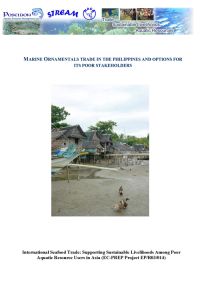
The international seafood trade: Marine ornamentals trade in the Philippines and options for its poor stakeholders

This report provides insight into the status of the marine ornamental fish trade in the Philippines, including policy environment, collection, distribution channels, markets and constraints. The report also reviews the livelihoods of poor stakeholders in market chains including economic and financial aspects, natural and physical resources, livelihood patterns, social structures. The report provides recommendations for policy makers and stakeholders in improving the livelihoods of poor stakeholders in marine ornamental fish collection and market chains and resource management.

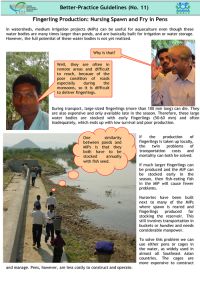
Better practice guidelines: Fingerling production nursing spawn and fry in pens

In watersheds, medium irrigation projects can be useful for aquaculture even though these water bodies are many times larger than ponds, and are basically built for irrigation or water storage. However, the full potential of these water bodies is not yet realised. Net pens or cages can be used to rear fingerlings in such environments.

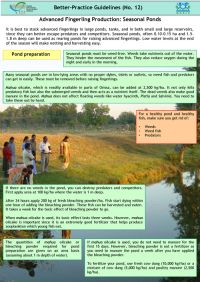
Better practice guidelines: Advanced fingerling production in seasonal ponds

It is best to stock advanced fingerlings in large ponds, tanks, and in both small and large reservoirs, since they can better escape predators and competitors. Seasonal ponds, often 0.10-0.15 ha and 1.5-1.8 m deep can be used as rearing ponds for raising advanced fingerlings. Low water levels at the end of the season will make netting and harvesting easy.

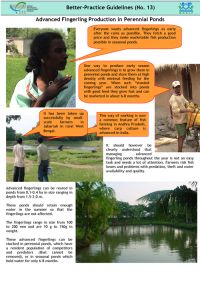
Better practice guidelines: Advanced fingerling production in perennial ponds

Everyone wants advanced fingerlings as early after the rains as possible. They fetch a good price and make marketable fish production possible in seasonal ponds. One way to produce early season advanced fingerlings is to grow them in perennial ponds and store them at high density with minimal feeding for the coming year. Whe such "stunted" fingerlings are stocked into ponds with good feed they grow fast and can be marketed in about 6-8 months.

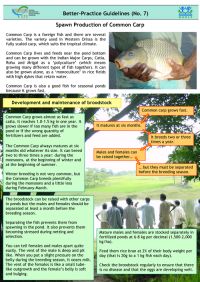
Better practice guidelines: Spawn production of common carp

Common carp is a foreign fish and there are several varieties. The variety used in Western Orissa is the fully scaled carp, which suits the tropical climate. Common carp lives and feeds near the pond bottom and can be grown with the Indian major carps, catla, rohu and mrigal as a 'polyculture' (which means growing many different types of fish together). It can also be grown alone, as a 'monoculture' in rice fields with high dykes that retain water.

Better management practices manual for black tiger shrimp (Penaeus monodon) hatcheries in Viet Nam

In order to provide practical and effective technical guidance for shrimp hatchery management, it is necessary to establish a set of better management practices (BMPs) which underpin an effective hatchery production system. This document is not a complete manual on the management of P. monodon hatcheries but concentrates on the implementation of BMPs for the hatchery covering all of the critical stages and processes in the production cycle, which are currently believed to be causing problems in Vietnamese hatcheries. 

Reducing the risk of aquatic animal disease outbreaks and improving environmental management of coastal aquaculture in Viet Nam

This report describes the experiences and lessons learnt from activities conducted by NACA in Viet Nam to support the sustainable development of the aquaculture sector using better management practices and harmonised strategies for the management of aquatic animal health and environmental problems. Achievements included reducing the risk of diseases from seed and on farms, developing capacity at the provincial and national levels, developing an effective surveillance system and wide dissemination of experiences.


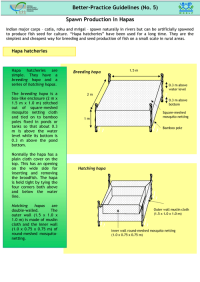
Better practice guidelines: Spawn production in hapas

These guidelines provide advice on producing fish seed of the Indian major carps in hapas within ponds to improve survival.

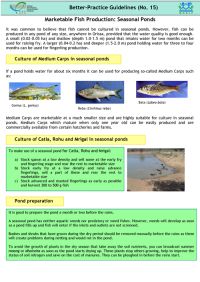
Better practice guidelines: Marketable fish production in seasonal ponds

It was common to believe that fish cannot be cultured in seasonal ponds. However, fish can be produced in any pond of any size, anywhere in Orissa, provided that the water quality is good enough. A small and shallow pond that retains water for two months can be used for raising fry. A larger and deeper pond holding water for three to four months can be used for fingerling production.

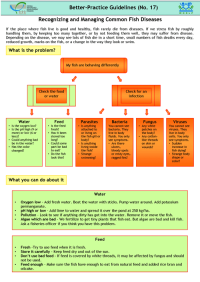
Better practice guidelines: Recognising and managing common fish diseases

If the place where fish live is good and healthy, fish rarely die from diseases. If we stress fish by roughly handling them, by keeping too many together, or by not feeding them well, they may suffer from disease. Depending on the disease, we may see lots of fish die in a short time, small numbers of fish deaths every day, reduced growth, marks on the fish, or a change in the way they look or swim.

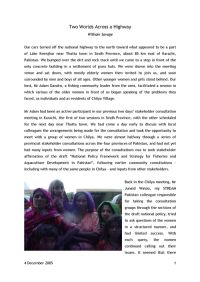
Two worlds across a highway

This story comes from Lake Keenjhar near Thatta town Sindh Province in Pakistan. It contrasts the lives of women in the fishing village of Chilya with the life of an influential business man with a fish farm on the opposite side of the highway.

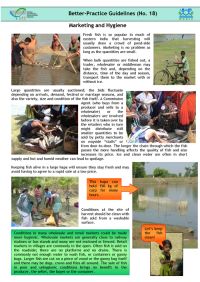
Better practice guidelines: Marketing and hygiene

Fresh fish is so popular in much of eastern India that harvesting will usually draw a crowd of pond side customers. Marketing is no problem so long as the quantities are small. When bulk quantities are fished out a trader, wholesaler or a middleman may take the fish and depending on the distance, time of the day and season, transport them to the market with or without ice.

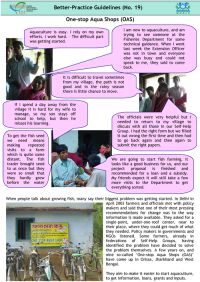
Better practice guidelines: One-stop aqua shops

When people talk about growing fish, many say their biggest problem was getting started. In Delhi in April 2003 farmers and officials met with policy makers and said that one of their most pressing recommendations for change was to the way information is made available. They asked for a single-point, under-one-roof center, near to their place, where they could get much of what they needed.

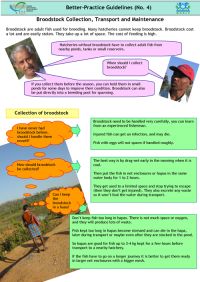
Better practice guidelines: Broodstock collection, transport and maintenance

These guidelines illustrate good practice for broodstock handling and management using practices that are suitable for small-scale operations. This document is also available in Oriya.

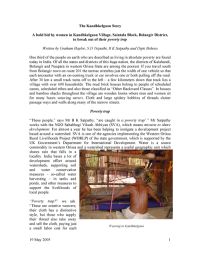
The Kandhkelgaon story

A bold bid by women in Kandhkelgaon Village, West Bengal, to break out of their poverty trap. This story describes how women who could no longer make a living from weaving turned to aquaculture. Success came, not just through income generation but by reducing the cost of being poor. The story highlights the influences that constrain and enhance development, including the sheer bravery and entrepreneurial spirit of people who are poor. 

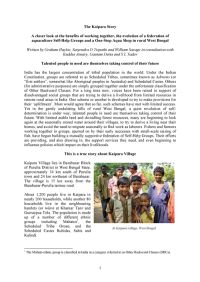
The Kaipara story

A closer look at the benefits of working together, the evolution of a federation of aquaculture self-help groups and a one-stop aqua shop in rural West Bengal. India has the largest concentration of tribal population in the world. For a long time now, voices have been raised in support of disadvantaged social groups that are trying to derive a livelihood from limited resources in remote rural areas in India.

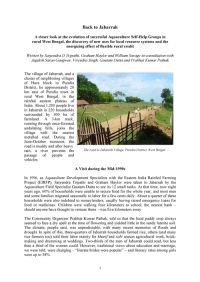
Back to Jabarrah

A closer look at the evolution of successful aquaculture self-help groups in rural West Bengal, the discovery of new uses for local resource systems and the energising effect of flexible rural credit.

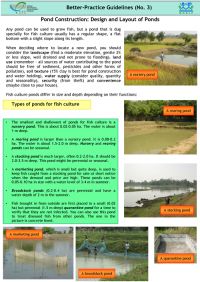
Pond construction: Design and layout of ponds

Any pond can be used to grow fish, but a pond that is dug specially for fish culture usually has a regular shape, a flat bottom with a slight slope along its length. When deciding where to locate a new pond, you should consider the landscape, land use, soil texture (15% clay is best for pond construction and water holding), water supply (consider quality, quantity and seasonality), security (from theft) and convenience (maybe close to your house).

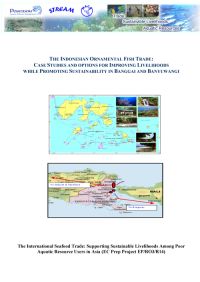
The Indonesian ornamental fish trade: Case studies and options for improving livelihoods while promoting sustainability in Banggai and Banyuwangi

This report provides insight into the status of the marine ornamental fish trade in Indonesia, including policy environment, collection, chain of custody, distribution channels, markets and constraints. The report also reviews the livelihoods of poor stakeholders in market chains including economic and financial aspects, natural and physical resources, livelihood patterns, social structures. The report provides recommendations for policy makers and stakeholders in improving the livelihoods of poor stakeholders in marine ornamental fish collection and market chains.