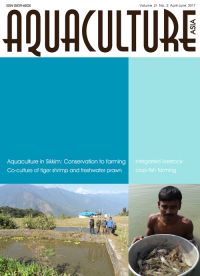
In this issue:
Inspiring story of aquaculture in Sikkim - a journey from conservation to farming; farming of scampi and tiger shrimp together - a case study from West Bengal; Labeo pangusia - a candidate for diversification of hill aquaculture; sustainability of an integrated livestock-fish-crop farming system as a small scale enterprise; sustainable coastal aquaculture in India; potential scope and prospects of domestic fish market in Chhattisgarh.
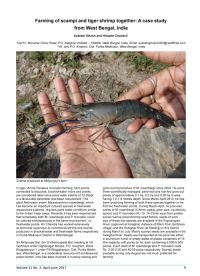
We report on an Indian farmer co-culturing tiger shrimp Penaeus monodon and the giant freshwater prawn, Macrobrachium rosenbergii. The farm utilises wild-caught riverine seed, stocked at a relatively low density and fed on a Macrobrachium pellet which P. monodon also accepts.
Coastal aquaculture in India was historically focussed mainly on tiger shrimp farming (Penaeus monodon) but production issues and disease led to the introduction of SPF Pacific white shrimp (L. vannamei) in 2009. A robust technical and legal framework was established by the Coastal Aquaculture Authority. Improved regulation has improved sustainability of the sector and underpinned production, with farmed Pacific shrimp output rising from 1,731 tonnes in 2009-2010 to 353,413 tonnes in 2014-2015.
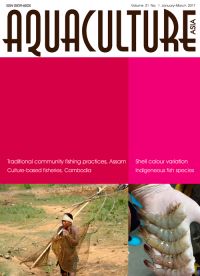
In this issue:
Anti-microbial resistance in aquaculture; participatory market chain approaches to boost fish nurseries; traditional community fishing practices of rural Assam; practical significance of restricted feeding regimes in aquaculture; Bangana dero: A potential indigenous fish species for diversification of carp culture; shell colour variation in farmed Litopenaeus vannamei: Comparison of white- and brown-shelled shrimp; culture-based fisheries: A low-tech, greenhouse friendly approach to improving food and income for Cambodian families.
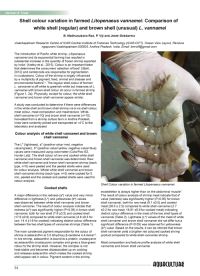
The regular shell colour of farmed Litopenaeus vannamei is off-white to greenish-white but instances of L. vannamei with brown-shell colour do occur in farmed shrimp. A study was conducted to determine if there were differences vis-à-vis shell colour, meat colour, meat composition and meat texture. White-shelled vannamei was determined to be better in terms of meat composition and texture profile but brown-shelled vannamei yielded a more brightly red-coloured cooked product.