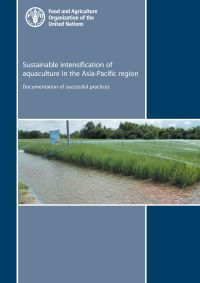
This publication is the major output of a regional programme jointly implemented by FAO and NACA in 2015 to document and disseminate successful practices that contribute to the sustainable intensification of aquaculture in the Asia-Pacific region. Twelve practices are described that contribute to at least one of the following: Improved production and resource use efficiency (land, water, feed, energy); improved environmental benefits; strengthened economic viability and farmers' resilience; and improved social acceptance and equity.
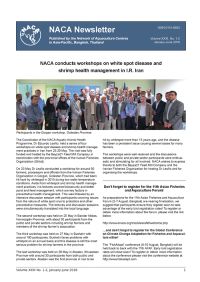
In this issue:
NACA conducts workshops on white spot disease and shrimp health management in I.R. Iran. Don’t forget to register for the 11th Asian Fisheries and Aquaculture Forum! NACA pays tribute to Professor H.P.C. Shetty – Patron of the Pillay Aquaculture Foundation. EHP: Shrimp industry survey. 3rd International Conference on Fisheries and Aquaculture, 24-25 August, Negombo, Sri Lanka. Special Session on the Status of Aquatic Genetic Resources for Food and Agriculture. Second International Technical Workshop on Acute Hepatopancreatic Necrosis Disease (AHPND). Guidebook on Farmer-to-Farmer Extension Approach for Small-Scale Freshwater Aquaculture. Sustainable intensification of aquaculture in the Asia-Pacific region.
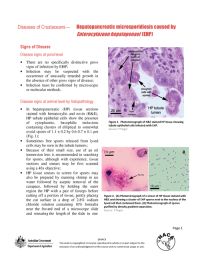
This disease card describes the diagnosis and range of a microsporidian shrimp pathogen, Enterocytozoon hepatopenaei (EHP), first discovered in Penaeus monodon in Thailand in 2004. It infects only the tubule epithelial cells of the hepatopancreatic tissue of shrimp. EHP was later found to also infect P. vannamei cultivated in Thailand and is suspected to have been reported from P. japonicus in Australia in 2001. EHP has been reported from Vietnam and is associated with white faeces syndrome.
A Regional Proficiency Testing Program for Aquatic Animal Disease Diagnostic Laboratories in Asia-Pacific was developed to strengthen diagnostic capability across Asia. This capability was identified as a requirement to facilitate the sanitary safety of trade in aquatic animal products. The program provided 41 laboratories across the Asia-Pacific with the opportunity to assess their diagnostic performance for 10 regionally significant aquatic animal pathogens, and to adapt or modify practices where necessary to improve.
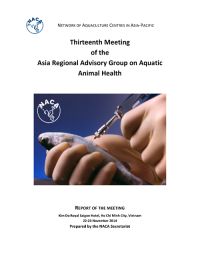
The Asia Regional Advisory Group on Aquatic Animal Health meets annually to discuss regional health issues including emerging disease threats. This report includes a review of regional disease status circa 2014, global and regional disease reporting arrangements, global issues and standards, progress in implementation of the the Regional Technical Guidelines on Health management for the Responsible Movement of Live Aquatic Animals, identification and designation of regional aquatic animal health resources and regional and international cooperation.