A new method for the detection of AHPND-bacteria (AP4) has been published and is available for download. The advantage of the AP4 method over the previously published AP3 method is that it has 100 times higher sensitivity. Because of its higher sensitivity, the bacterial culture enrichment step needed when using the AP3 with low levels of AHPND bacteria may be omitted. However, the AP4 method should not be considered as a replacement for AP3.
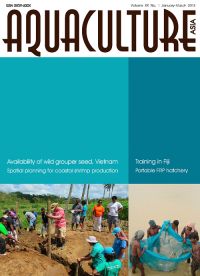
Further training provided to aquaculturists in Fiji. Spatial planning for sustainable coastal shrimp production. Availability of grouper (Serranidae) fingerlings and seed in the coral reef of Son Tra Peninsula, central Viet Nam. Small-scale carp seed production through portable FRP hatchery at Khanguri, Odisha. Regional consultation on culture-based fisheries developments in Asia. Gender Assessment Synthesis Workshop. Broodstock management in aquaculture. Urgent appeal to control spread of the shrimp microsporidian parasite Enterocytozoon hepatopenaei (EHP).
In this issue:
Regional consultation on culture-based fisheries developments in Asia. Gender Assessment Synthesis Workshop. NACA participation in the 5th Global Symposium on Gender in Aquaculture and Fisheries, Lucknow, India. Broodstock Management in Aquaculture: Long term effort required for regional capacity building. Urgent appeal to control spread of the shrimp microsporidian parasite Enterocytozoon hepatopenaei (EHP).
Enterocytozoon hepatopenaei (EHP) is a microsporidian parasite that was first characterized and named from the giant or black tiger shrimp Penaeus monodon from Thailand in 2009. EHP is confined to the shrimp hepatopancreas (HP) and morphologically resembles an unnamed microsporidian previously reported in the HP of Penaeus japonicas from Australia in 2001. Together, these studies suggest that EHP is not an exotic pathogen but that it is endemic to Australasia.
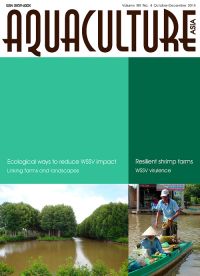
Promising aquaculture practices for sustainable intensification. Culture and breeding of Archcentrus spilurum at Tuticorin District of Tamil Nadu, India. Searching for ecological ways to reduce WSSV impact. Fisheries and aquaculture-based livelihoods prospects in East Kalimantan, Indonesia. Linking farms and landscapes in the governance of sustainable Vietnamese shrimp aquaculture. Resilience of shrimp farming based livelihoods in the Mekong Delta, Vietnam. Farming system affects the virulence of white spot syndrome virus (WSSV) in penaeid shrimp.