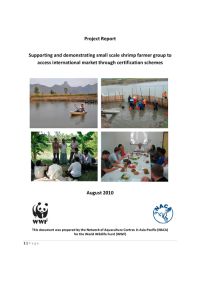
This project was conducted to demonstrate small scale shrimp farmer group access to international markets through certification schemes. This project proved that small-scale farmers organised into groups, can improve their technical capacities, and achieve access to markets. This achievement was the result of strong partnerships with producers, private sector and government agencies assisting to develop a sustainable business model for small scale aquaculture. Cost of compliance was found to be a significant barrier to entry.
International requirements on food safety, traceability, animal health and welfare and social responsibility are increasingly stringent. The burden of compliance and the cost of certification are particularly heavy for small scale farmers who are often excluded by the limited resources at their disposal. Working in groups can help small scale farmers attain economies of scale necessary to address compliance issues and participate in certification schemes, improving their competitive position.
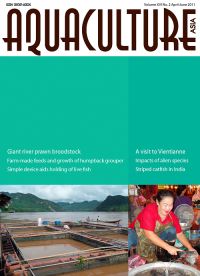
In this issue:
A visit to Vientianne, Lao PDR. Development of captive broodstock of giant river prawn Macrobrachium rosenbergii. Alien introduction and its impact on native fisheries and aquatic bioiversity of West Bengal, India. Ecological impacts of exotic fish species in India. Farm-made feeds support good growth and survivial of the humpback grouper. An easy way to hold live fish. Litopenaeus vannamei introduction: Sound management or expediency? Newsletter and more.
The Asia Regional Advisory Group on Aquatic Animal Health meets annually to discuss regional health issues including emerging disease threats. This report includes a review of regional disease status circa 2010, global and regional disease reporting arrangements, global issues and standards, progress in implementation of the the Regional Technical Guidelines on Health management for the Responsible Movement of Live Aquatic Animals, identification and designation of regional aquatic animal health resources and regional and international cooperation.
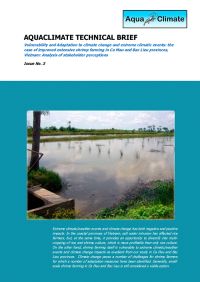
In Vietnam, small scale farmers and other stakeholders involved in aquaculture perceive that climate changes such as frequent extreme weather events have serious impacts on their farming systems. Farmers have started to adapt by changing the management practices. Institutional initiatives that have been introduced includes provision of budget for climate change response for aquaculture, aquaculture area planning and monitoring, government financial support, policy on mangrove planting for coastal protection and development of farmer associations.