Workshop and conference proceedings
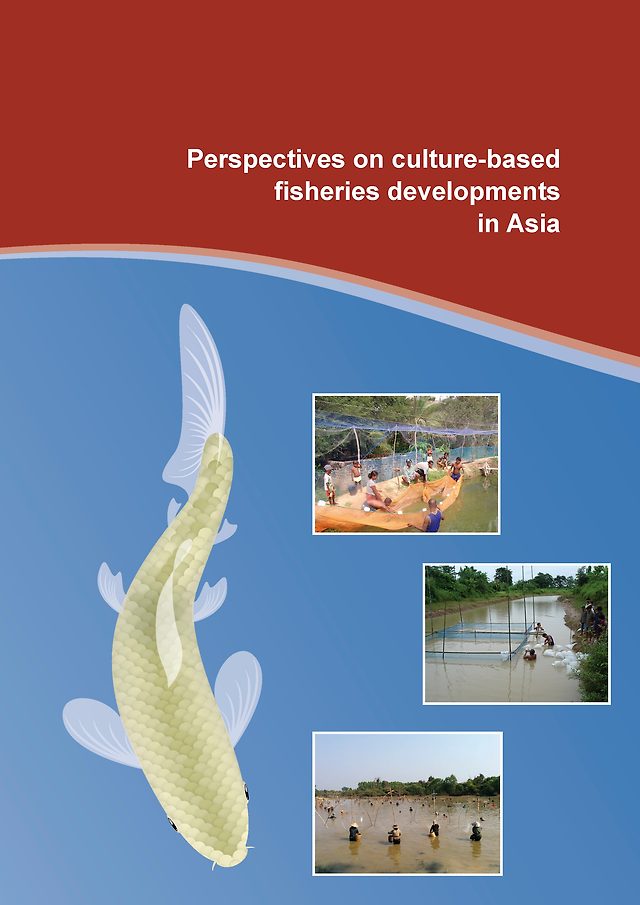
NACA frequently organises technical workshops and consultations on aspects of aquaculture. The proceedings of such meetings are made available for free download. Audio and video recordings of technical presentations are also available for some meetings (please see the podcast section).

Creative Commons Attribution.
Related

Publications

NACA publishes a wide range of aquaculture publications including technical manuals, workshop proceedings, better practice guidelines and several serials including Aquaculture Asia Magazine, the NACA Newsletter and the Quarterly Aquatic Animal Disease Report. To keep up to date with developments you could consider subscribing to our RSS feed

In this collection

Building capacity to combat impacts of aquatic invasive alien species and associated trans-boundary pathogens in ASEAN countries

This is the proceedings of the workshop on Building capacity to combat impacts of aquatic invasive alien species and associated trans-boundary pathogens in ASEAN countries, held in Penang, Malaysia, on the 12th-16th July 2004. The workshop built on the recommendations from a 2002 workshop organised by the Global Invasive Species Program and a 2003 workshop of countries sharing the Mekong watershed, in promoting awareness, coordination mechanisms and information exchange systems and identifying management and risk mitigation measures.


Workshop on capacity building for situation analysis of mangroves ecosystem and communities

These are the proceedings of two Workshops on Capacity Building for Situation Analysis of Mangroves Ecosystem and Communities, held in Hanoi and Nam Dinh, 4-8 December 2006. The workshop focused on developing the knowledge and skills of the VNU team in Sustainable Livelihoods Analysis through the application of Participatory Rural Appraisal (PRA) techniques. The workshops were funded under the European Union Mangrove Project (2005-2008) in preparation for commencement of field-based activities and situation analysis.

Reef Fish Aquaculture R&D Project: Annual Report 2003-2004

This is the annual report (2003-2004) of the Reef Fish Aquaculture R&D Project, based at the Northern Fisheries Centre, Cairns. The project provides a core platform for a suite of R&D projects addressing the feasibility of aquaculture technologies for high-value marine finfish species. This report outlines progress on the three core components of the programme, namely broodstock management and spawning, live prey production, and larval rearing and grow-out.

Codes of practice and better management: A solution for shrimp health management?

This presentation, delivered at the Sixth Symposium on Diseases in Asian Aquaculture (Sri Lanka, 2005), reviews the strategies adopted to promote a more sustainable approach to shrimp health management. It also presents and compares the experiences gathered to date, with the aim to identify an effective way forward for the sustainable development of the sector, and provides guidance on a way forward to implement better management practices with reference to small-scale producers.

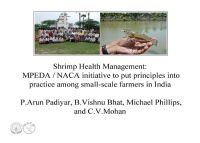
Shrimp health management: MPEDA/NACA initiative to put principles into practice among small-scale farmers in India

Presentation on a MPEDIA/NACA intiative to implement better management practices for shrimp farming amongst small-scale farmers in India via formation of farmer groups. The practices are based on the International Principles for Responsible Shrimp Farming. Adoption of improved farming practices reduces the incidence of disease and improves crop outcomes for small-scale farmers. This presentation was made at the World Aquaculture Society Conference in Bali, Indonesia, 2005.

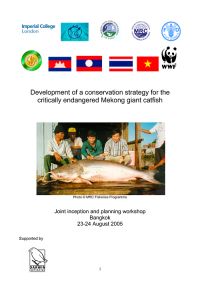
Development of a conservation strategy for the critically endangered Mekong giant catfish: Joint inception and planning workshop

This is the report of an inception workshop for the Mekong Giant Catfish Working Group. The Mekong giant catfish Pangasianodon gigas is listed as critically endangered in the 2003 IUCN Red List. The purpose of the workshop was to exchange information on the current state of the Mekong giant catfish and the relevant conservation and research activities of key organisations, and to establish a joint planning process aimed at developing an overarching conservation strategy for the Mekong giant catfish.

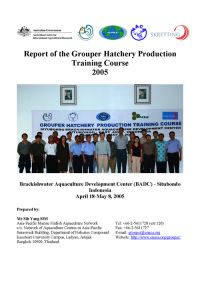
Report of the Grouper Hatchery Production Training Course 2005

This is the report of the 3rd Regional Grouper Hatchery Production Training Course, which was conducted at the Brackishwater Aquaculture Development Center, Situbondo, East Java, Indonesia from April 18-May 8, 2005. There were a total of 17 participants coming from Australia, Brunei Darussalam, Indonesia, Malaysia, Maldives, Marshall Islands, Singapore, and Vietnam. The training consisted of a  mixture of theory, practical and field trips for the participants.

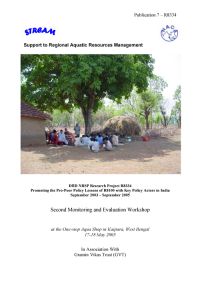
Second monitoring and evaluation workshop: Promoting the pro-poor policy lessons of R8100 with key policy actors in India

The objective of this project, in taking forward the achievements of the earlier projects, is to develop and promote mechanisms for the delivery of rural services that can reach and benefit marginalised poor men and women of scheduled tribes and scheduled castes. This workshop in Kaipara Village was meant to “understand the quality of performance in service delivery to poor people through the project monitoring and evaluation system.” Significant change stories were prepared by participants.


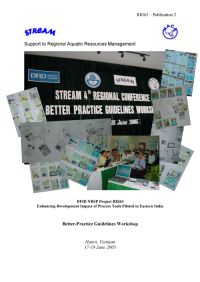
Report of the Better-Practice Guidelines Workshop, Hanoi, Vietnam, 17-18 June 2005

This workshop report is an output from an additional uptake and promotion activity of the DFID NRSP Project R8363 “Enhancing Development Impact of Process Tools Piloted in Eastern India”, which was extended to the end of August 2005. It describes a Better-Practice Guidelines (BPG) Workshop which was the latest project activity to share process tools for Building Social Capital (Self-Help Groups), Consensus-Building and Information Access Surveys. Since the project began, the BPG genre has expanded from the original three concepts shared, to currently twenty-five BPGs prepared not only by STREAM but also by farmers and fish producers. The genre has also been adopted by other organisations, including the DFID-funded Western Orissa Rural Livelihoods Project to share rural aquaculture techniques, and Stirling University to support the uptake and promotion of their work on Self-Recruiting Species and Local Resource User Groups.

The workshop was attended by STREAM National Coordinators and Communications Hub Managers from Cambodia, India, Indonesia, Myanmar, Nepal, Pakistan, Philippines, Sri Lanka and Vietnam, and STREAM Regional Office colleagues based in Thailand, Australia and India. The participants reviewed and assessed the BPGs and Policy Briefs in Bahasa Indonesia, Bengali, English, Hindi, Ilongo, Khmer, Myanmar, Nepali, Oriya, Sinhala, Urdu and Vietnamese. They also began to plan how the uptake and promotion of these tools may be specifically supported in each national context as well as planning the development of further BPG and PB topics.

Primary aquatic animal health care in rural, small-scale aquaculture development

This document is the technical proceedings of the Asia Regional Scoping Workshop on “Primary Aquatic Animal Health Care in Rural, Small-scale, Aquaculture Development,” held in Dhaka, Bangladesh from 27 - 30 September 1999. The objectives of the workshop were  to review information on socio-economic impacts, risks of disease incursions and health management strategies in rural, small-scale aquaculture and enhanced fisheries programmes; and to identify potential interventions for their better health management and appropriate followup actions.

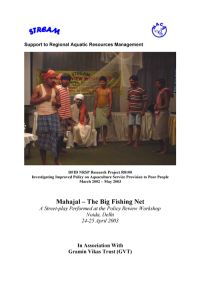
Mahajal - the big fishing net: A street play performed at the Policy Review Workshop, Noida, Delhi, 24-25 April 2003

Mahajal – The Big Fishing Net was written by Mr Rakesh Raman, a playwright from Ranchi, Jharkhand, and performed by his theatre troupe. The play was written as an interpretation of the outcomes of the project case studies carried out in Jharkhand, Orissa and West Bengal. Act One sets the scene of fisherfolk’s livelihoods and the difficulties they face in a tribal village. Act Two places the project’s policy change recommendations within the context of their lives and aspirations.

Report on indigenous participation in aquaculture - the Pacific experience, Sydney, Australia, 27-28 September 2004

The workshop Indigenous Participation in Aquaculture – the Pacific Experience was held as a day-and-a-half session in the Australasian Aquaculture 2004, Sydney, 27–28 September 2004. The workshop promoted exchange of information and experiences between researchers, government representatives and industry involved in aquaculture development in the Pacific. The workshop recognised the increasing interest in aquaculture as an industry that can provide benefits for indigenous communities in Australia as well as the Pacific Islands.

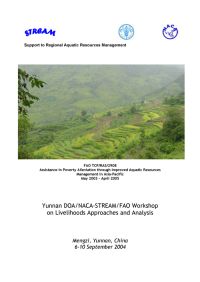
Workshop on Livelihoods Approaches and Analysis, 6-10 September 2004, Yunnan, China

This is the report of the “Yunnan DOA/NACA-STREAM/FAO Workshop on Livelihoods Approaches and Analysis” that was conducted in Mengzi, Yunnan from 6-10 September 2004. The purpose of the workshop was to develop and document mechanisms for training in livelihoods approaches and analysis, and to build national capacity to conduct livelihoods analysis. The workshop in Yunnan was the first STREAM event in China, with colleagues coming to participate from throughout the province.

Presentation on STREAM Vietnam's experience

Established in early 2002, STREAM Vietnam has so far attained a number of good experiences and lessons in using participatory approaches for its work. The Country Office has been able to link to a wide range of stakeholders, and is working hard to build close relationships amongst them, so that institutional entities can better support the livelihoods of poor aquatic resources users, and support disadvantaged groups of people to improve their living standards by themselves.

Adopting a STREAM approach for inland fisheries management

This paper advocates strategies, processes and practices that enable: livelihoods approaches rather than resource-based approaches, ‘direct’ institutional and policy development, rather than ‘project demonstrations’, and support for regional, national and local communications. It was presented at the Symposium on Participatory approaches in reservoir fisheries management: Issues, challenges and policy, October 4-6th 2004 at the Culture Club Resort, Dambulla, Sri Lanka hosted by the National Aquaculture Development Authority in collaboration with FAO..

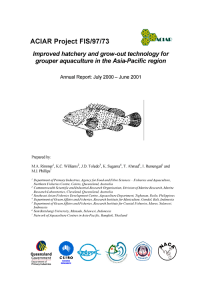
Improved hatchery and grow-out technology for grouper aquaculture in the Asia-Pacific region: Annual report 2000-2001 ACIAR Project FIS/97/73

This is the annual report 2000-2001 of the ACIAR Project FIS/97/73 Improved hatchery and grow-out technolgy for grouper aquaculture in the Asia-Pacific region. The report describes progress by research partners in development of larval rearing, grow-out diet development, and collaboration via the Asia-Pacific Marine Finfish Aquaculture Network. It also provides an indicative research workplan for the year ahead and future plans for the network.

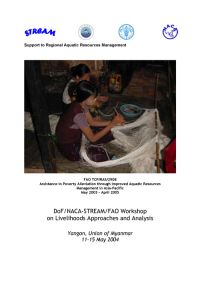
Workshop on Livelihoods Approaches and Analysis, 11-15 May 2004, Myanmar

The purpose of the workshop was to develop and document mechanisms for training in livelihoods approaches and analysis, and to build national capacity to conduct livelihoods studies. The workshop in Yangon was the fourth in a series, the first of which was held in Iloilo City, Philippines, in November 2003, the second in Ranchi, India, in February 2004, and the third in Vientiane, Lao PDR in March 2004. A subsequent workshop will take place in Yunnan, China.

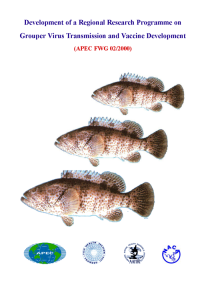
Development of a Regional Research Programme on Grouper Virus Transmission and Vaccine Development

These are the proceedings of a workshop, funded by the APEC Fisheries Working Group Project 02/2000. The project developed a framework with nine major research components: Health and production at hatcheries, regional collaborative disease resource centers, regional disease monitoring and surveillance, improving regional diagnostic capabilities, responsible trans-boundary movement, farm health management, vaccines and vaccination, funding mechanisms and establishment of an ad-hoc working group.

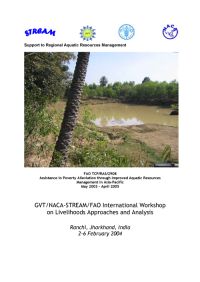
International Workshop on Livelihoods Approaches and Analysis, Ranchi, India, 2-6 February 2004

The purpose of the workshop was to develop and document mechanisms for training in livelihoods approaches and analysis, and to build national capacity to conduct livelihoods analysis. The workshop in Ranchi was a joint India-Nepal event. A central element of the workshop was a visit to the Jabarrah community, where participants learnt about the community’s livelihoods. In addition to gaining information about the Jabarrah community itself, participants also had important insights into how best to conduct livelihoods analyses.


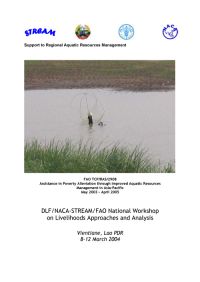
Workshop on Livelihoods Approaches and Analysis, 8-12 March 2004, Lao PDR

This is the report of the “DLF/NACA-STREAM/FAO National Workshop on Livelihoods Approaches and Analysis” that was conducted in Vientiane, Lao PDR from 8-12 March 2004. The purpose of the workshop was to develop and document mechanisms for training in livelihoods approaches and analysis, and to build national capacity to conduct livelihoods analysis. The workshop in Vientiane was the first STREAM event in Lao PDR.