NACA member governments are: Australia, Bangladesh, Cambodia, China, Hong Kong SAR, India, Indonesia, I.R. Iran, Kingdom of Saudi Arabia, Korea (DPR), Lao PDR, Malaysia, Maldives, Myanmar, Nepal, Pakistan, Philippines, Sri Lanka, Thailand and Vietnam.
This report, the 62nd in the series, contains information about the aquatic animal health status of sixteen states in the Asia-Pacific region. The foreword discusses the outcomes of the 12th meeting of the Asia Regional Advisory Group on Aquatic Animal Health.
This report, the 61st in the series, contains information about the aquatic animal health status of fifteen states in the Asia-Pacific region. The foreword discusses the OIE tool for evaluation of performance of aquatic veterinary services.
This document presents a tool in the form of an audit table that can be used to broadly screen and identify gaps in the management systems of government agencies responsible for regulating aquaculture. These gaps, once identified, can be a first step toward building regulatory frameworks that can better deliver on jurisdictional ecologically sustainable development and ecosystems approach to aquaculture objectives. The end product of an assessment is a report for consideration by decision makers.
This report, the 60th in the series, contains information about the aquatic animal health status of fifteen states in the Asia-Pacific region. The foreword discusses response to aquatic animal disease emergencies.
This report, the 59th in the series, contains information about the aquatic animal health status of sixteen states in the Asia-Pacific region. The foreword contains an update on acute hepatopancreatic necrosis syndrome (AHPNS) of cultured shrimp.
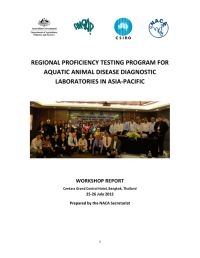
This is the report of the first workshop of the Regional proficiency testing program for aquatic animal disease diagnostic laboratories in Asia-Pacific, held from 25-26 July 2012 in Bangkok, Thailand. The objectives of the programme were to strengthen Asia’s regional capability to diagnose important aquatic animal diseases that impact on trade, train participating laboratory personnel in diagnostic standards and proficiency testing procedures, and to provide technical assistance to improve laboratory performance.
This report, the 58th in the series, contains information about the aquatic animal health status of fifteen states in the Asia-Pacific region. The foreword contains a disease advisory notice on acute hepatopancreatic necrosis syndrome (AHPNS) of cultured shrimp.
This report, the 57th in the series, contains information about the aquatic animal health status of thirteen states in the Asia-Pacific region. The foreword discusses the outcomes of the 11th meeting of the Asia Regional Advisory Group on Aquatic Animal Health.
This report, the 56th in the series, contains information about the aquatic animal health status of fifteen states in the Asia-Pacific region. The foreword discusses a case definition for acute hepatopancreatic necrosis syndrome ("early mortality syndrome") in cultured shrimp in Asia.
This report, the 55th in the series, contains information about the aquatic animal health status of fourteen states in the Asia-Pacific region. The foreword discusses acute hepatopancreatic necrosis syndrome ("early mortality syndrome") in cultured shrimp in Asia.
This report, the 54th in the series, contains information about the aquatic animal health status of fourteen states in the Asia-Pacific region. The foreword discusses emerging aquatic animal diseases in the region, including acute hepatopancreatic necrosis disease and scale-drop syndrome.
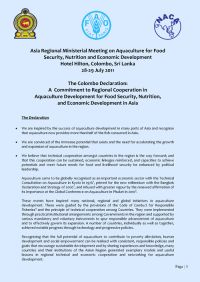
The Colombo Declaration is a commitment to regional cooperation in aquaculture development for food security, nutrition and economic development in Asia. It was developed and agreed on by delegations from 18 states at a ministerial-level meeting held in Colombo, Sri Lanka, 28-29 July 2011.
This report, the 5rnd in the series, contains information about the aquatic animal health status of thirteen states in the Asia-Pacific region. The foreword discusses the 8th Symposium on Diseases in Asian Aquaculture.
This report, the 52nd in the series, contains information about the aquatic animal health status of thirteen states in the Asia-Pacific region. The foreword discusses transboundary disease issues and contingency planning.
4 February 2011 | Miao Weimin, Sena De Silva and Brian Davy (eds.) | 6371 Downloads | .pdf | 1.16 MB
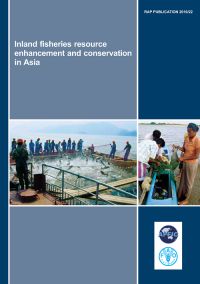
This regional review study is an effort to promote improved inland fisheries management under the Code of Conduct for Responsible Fisheries. It covers ten Asian countries with significant inland capture fisheries, namely Bangladesh, China, India, Indonesia, the Republic of Korea, Myanmar, Nepal, Sri Lanka, Thailand and Viet Nam. The papers were presented and discussed at a regional workshop held from 8-11 February 2010 in Pattaya, Thailand. Audio recordings of the presentations are also available for download.
This report, the 51st in the series, contains information about the aquatic animal health status of twelve states in the Asia-Pacific region. The foreword discusses animal welfare in aquaculture.
This report, the 49th in the series, contains information about the aquatic animal health status of fifteen states in the Asia-Pacific region. The foreword discusses the outcomes of the ninth meeting of the Asia Regional Advisory Group on Aquatic Animal Health.
This report, the 48th in the series, contains information about the aquatic animal health status of fifteen states in the Asia-Pacific region. The foreword discusses current fish health concerns.
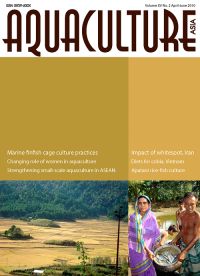
The Dedanaw Project, Myanmar. The changing face of women for small-scale aquaculture in Bangladesh. Strengthening capacity of small holders in ASEAN. Carp seed production in Orissa, India. Sustainable mountain paddy-fish farming of the Apatani tribes. The economic impacts of whitespot virus on shrimp production in Iran. Current practices of marine finfish cage culture in China, Indonesia, Thailand and Vietnam. Effects of trash fish on growth and body composition of cobia.
7 February 2010 | U Aung Htay | 4016 views | .mp3 | 5.32 MB
Myanmar's inland water resources are still largely in a pristine condition. Fish, consumed in fresh and many processed forms is an important component of the protein intake of the population; consumption is estimated at 43 kg capita per year in 2008-2009. Stock enhancement of inland waters in Myanmar has been conducted since 1967, initiated through a seed replenishing program to the natural water, such rivers, lake, dams even rice fields.