These guidelines prepare and enable aquaculture societies to seek group certification from independent third party certification programmes. The guidelines are independent of commodity and certification standards. They were developed as part of a collaborative MPEDA/NaCSA/NACA project on the certification of aquaculture societies. Draft guidelines developed by the project partners were discussed at the inception meeting on aquacutlure society certifiction held at Kakinada during 1-2 September 2009.
23 February 2011 | Nguyen Thanh Phuong, Nguyen Van Hao, Bui Minh Tam, Phan Thanh Lam, Vo Minh Son, Nguyen Nhut, Duong Nhut Long, Thuy Nguyen T.T., Geoff J. Gooley, Brett A. Ingram and Sena S De Silva | 2647 Downloads | .pdf | 3.3 MB
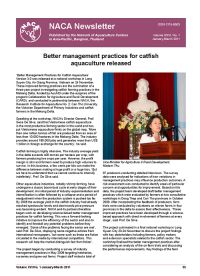
This document is Version 3.0 of “Better Management Practices for Catfish Aquaculture in the Mekong Delta, Vietnam”. It incorporates revisions of previous versions and experiences from demonstration farms, as well as feedback from a National CatFish BMP Workshop, held 23-24 November 2010 in Long Xuyen City, An Giang Province, involving all stakeholders of the tra/striped catfish (Pangasianodon hypophthalmus) farming sector of the Lower Mekong Delta. A Vietnamese translation is available.
4 February 2011 | Miao Weimin, Sena De Silva and Brian Davy (eds.) | 6377 Downloads | .pdf | 1.16 MB
This regional review study is an effort to promote improved inland fisheries management under the Code of Conduct for Responsible Fisheries. It covers ten Asian countries with significant inland capture fisheries, namely Bangladesh, China, India, Indonesia, the Republic of Korea, Myanmar, Nepal, Sri Lanka, Thailand and Viet Nam. The papers were presented and discussed at a regional workshop held from 8-11 February 2010 in Pattaya, Thailand. Audio recordings of the presentations are also available for download.
Recent developments and future prospects of inland aquaculture in Asia. Factors influencing success of Penaeus vannamei culture. Freshwater prawn farming in a carbon-nitrogen controlled periphyton-based system: A sustainable approach to increase stagnant pond productivity. Constraints to fish production in community ponds in Orissa, India. Continued confidence in inland fisheries developmentg of a Sri Lankan youth begins to pay off. The Asia-Pacific Quarterly Aquatic Animal Disease Report: 12 years and beyond.
Better management practices for catfish aquaculture released. 9th Meeting of the Asia Regional Advisory Group on Aquatic Animal Health. Trialling ocean temperature forecasts for fish farms. Global Conference on Aquaculture 2010: Publications. Capacity of small holder ASEAN aquaculture farmers for competitive and sustainable aquaculture strengthened.
This presentation builds on countries’ recent experiences to review the role of aquaculture in countries’ socio-economic growth and development, and discusses how institutional arrangements can lead to aquaculture’s enhanced net benefits to society. Aquaculture growth has recently been slowing down, and the sector is facing various resource, environmental, economic, knowledge and institutional constraints. Population growth, economic expansion and increasing preference for healthy food are expected to sustain the demand for aquaculture products.
25 September 2010 | Max Troell | 3214 views | .mp3 | 8.24 MB
Aquaculture is today considered the only viable option for meeting the increasing future demand for fish and seafood products. There are concerns that unconstrained sectoral expansion and intensification, coupled with its ecological and social impacts, globalisation and fluctuation of markets and resources, climate change may have undesirable impacts on the resilience of social-ecological systems. Aquaculture makes demands on, but also can provide a range of ecosystem services.
25 September 2010 | Michael Phillips | 2632 views | .mp3 | 11.19 MB
Public and private sectors, including non-governmental agencies are all involved in provision of aquaculture services, although roles and responsibilities differ. Growth in aquaculture over the past 10 years, under the influence of a range of global drivers, has changed not only the nature of services required but also the way in which these services are delivered. In less-developed and newly emerging aquaculture countries, there are still considerable gaps in services, particularly in rural areas.
An essential element for the ecosystem approach to aquaculture is the use of virtual technology and decision-support tools, particularly if developing nations are to promote the key elements of aquaculture sustainability. We provide an overview of current and emerging issues and trends related to this topic over the past decade, an assessment of progress with regard to the expectations and commitments expressed in the Bangkok Declaration and conclude with some thoughts for the future.
It has been recognised that farmers’ innovations are crucial in order to achieve cumulative growth, both economically and socially. However, several social, political, economical and environmental factors have hampered farmers’ innovation, such as lack of information on aquaculture, inadequate science and technology policies and lack of governmental support. The panel will assess crucial factors needed to promote, encourage and support farmers’ innovative processesand transform developing countries to innovatoin-driven economies.
The Phuket Consensus is a declaration on aquaculture development endorsed by participants of the Global Conference on Aquaculture 2010, held in Phuket, Thailand, 22-25 September. The consensus builds on the Bangkok Declaration, which was formulated at the International Conference on Aquaculture in the Third Millennium, held in Bangkok, 20-25 February 2000. The consensus and declaration provide strategic guidance on sustainable development of aquaculture considering social, environmental, technical and economic issues.
Vietnamese catfish - better management practices update. Is this the perfect prawn? Fish Oil Replacement and Alternative Lipid Sources in Aquaculture Feeds. Multilingual CD-ROM of FAO cultured aquatic species fact sheets. Aquaclimate Annual Progress Report 2010. Training course on application of business management principles in small-scale aquaculture.
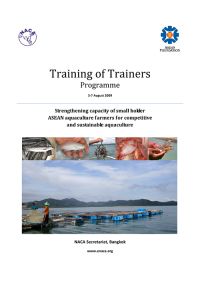
This is the manual for the "train the trainers" course aiming to increase the capacity of small-scale farmers in ASEAN countries. The manual focusses on five countries and commodities: Snakehead (Cambodia), Tilapia (Thailand), seaweed (Philippines), marine fish (Indonesia) and shrimp (Vietnam). In this volume, lectures presented by experts are included. The training program included technical aspects related to the culture of commodities, marketing, access to information, organization of farmer groups, gender and good culture practices.
28 January 2010 | Sena De Silva and Brian Davy (eds.) | 1560 Downloads | .pdf | 4.14 MB
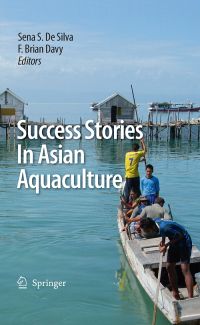
The stories presented in Success Stories in Asian Aquaculture reflect the unique nature of Asian aquaculture, providing first-time insight into how and why it has become so successful. Overall, the book demonstrates how the resiliency, adaptability, and innovation of small-scale aquaculture farmers have been crucial to this success. It is unique in demonstrating how aquaculture can have a lasting positive impact on livelihoods, food security, and sustainable development.
Development of modern aquaculture in Java, Indonesia. Better management practices - gateway to sustainability. Update on organic scampi aquaculture in Andhra Pradesh. Domestic fish marketing in south India. Seed rearing of catfish Clarias batrachus. Supply and use of catfish Pangasianodon hypopthalmus seed in the Mekong Delta. Risk analysis and sustainability of catfish seed in the Mekong Delta. Life of a river in the Himalaya: Ecological study of the Trisuli River, Nepal and more.
Inception meeting on methodologies for aquaculture society certification. Meetings discuss impacts, adaptation to climate change of Vietnamese shrimp farmers. Aquaclimate project: India case study. In memory of Gagan Bahadur Nhuchhe Pradhan. Version 2 of the draft better management practices for catfish farming released. Technical course on federating digital library systems.
Mussel farming initiatives in North Kerala, India. Selective study on availability of indigenous fish with ornamental value in West Bengal. Aquaculture livelihoods centre in Aceh, Indonesia. e-Sagu Aqua - an innovative information and communication technology model for transfer of technology for aquaculture. Freshwater pearl crop: An emerging enterprise in the Indian subcontinent. Preliminary risk assessment of Pacific white shrimp (P. vannamei) introduced to Thailand for aquaculture. Black gill disease of lobster and more.
Success Stories in Asian Aquaculture. Twelfth Regular Session of Commission on Genetic Resources for Food and Agriculture. Training of trainers programme will strengthen small scale farmer competitiveness in ASEAN. Workshop on development of better management practices for catfish farming in the Mekong Delta organised in Vietnam. Vulnerability & adaption of climate change impacts on catfish farming - case study Can Tho, Vietnam. NACA welcomes Dr Nigel Abery, Coordinator of the Adaption of aquaculture to climate change project. EU supports better management practices for responsible aquaculture. Myanmar delegation visits CIFA to study aquaculture.