Culture-based fisheries

Culture-based fisheries (CBF) are stock enhancement practices to improve the productivity of water bodies that do not have enough natural recruitment to support a capture fishery. The stocked seed usually rely on the natural productivity of the water body as food supply.

CBF is usually conducted in small water bodies, which are often communally managed by local communities, and the where the seed is owned either individually or collectively. CBF practices are therefore a form of aquaculture.

Creative Commons Attribution.
Related

Subject tags

A collection of subject tags relating to technical matters.

In this collection

Constraints to the sustainability of culture-based fisheries

A discussion of issues affecting the sustainability of culture-based fisheries development.

Risks associated with culture-based fisheries and their management

A discussion of risk management in the context of culture-based fisheries.

Gender mainstreaming in culture-based fisheries

A presentation on mainstreaming gender issues in culture-based fisheries development.

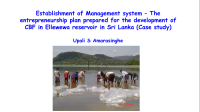
Entrepreneurship plan prepared for the development of culture-based fisheries in Ellewewa reservoir, Sri Lanka

How an entrepreneurship plan facilitated the development of culture-based Fisheries in a Sri Lankan reservoir.

Legal and policy framework for culture-based fisheries development

A discussion of the governance issues relevant to culture-based fisheries at local community, provincial and national levels.

Community consultation in culture-based fisheries

People-oriented approaches for engaging communities in culture-based fisheries development.

Multiple use of water resources in culture-based fisheries

Harmonising culture-based fisheries with other users and uses of water resources.

Species selection in culture-based fisheries

A technical presentation on selection of appropriate species in culture-based fisheries.

Assessment of production potential

A presentation on technical assessment of water bodies for culture-based fisheries production potential.

Hydrobiological characterisation of water bodies for CBF development

A presentation on assessment of the suitability of water bodies for culture-based fisheries development.

Culture-based fisheries experiences, practices and constraints in Vietnam

A presentation on the current state of culture-based fisheries practices in Vietnam.

CBF experiences, current practices and constraints in China

A presentation on the current state of culture-based fisheries practices in China.

Culture-based fisheries: What, why, where and how?

A briefing on the context and relevance of culture-based fisheries in rural development.

Why fish and aquaculture?

Video presentation on the rationale for increased fish production and consumption.

First training course on culture-based fisheries held in Nha Trang, Vietnam

The first ever Regional Training Course on Culture-based Fisheries in Inland Waters was held at Nha Trang University from 30 October to 8 November. The objective of the course was to provide participants with the skills to assist local communities to plan and manage culture-based fisheries. These practices are an example of a relatively simple and low cost technology that can deliver nutritional and economic benefits to rural communities, which often have few livelihood options.

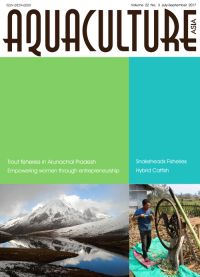
Aquaculture Asia Magazine, July-September 2017

In this issue:

Regional network on culture-based fisheries and stock enhancement; trout fisheries in the uplands of Arunachal Pradesh - resources and opportunities; empowering young Indian women through entrepreneurship development - opportunities and constraints; a view on murrel (snakehead) fisheries in India; hybrid catfish Clarias batrachus x Heteropneustes fossilis produced by farmers in West Bengal, India; Backyard fish based pig farming using low-cost feed in Arunachal Pradesh - a success story; NACA Newsletter.

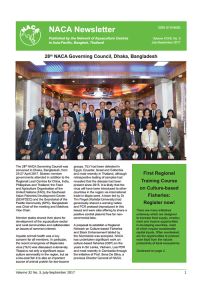
NACA Newsletter, Vol. XXXII, No. 3, July-September 2017

In this issue:

28th NACA Governing Council, Dhaka, Bangladesh; register for the First Regional Training Course on Culture-based Fisheries; 11th Indian Fisheries and Aquaculture Forum, Kochi, 21-24 November; audio recordings for regional feed consultation now available; tilapia lake virus; Proceedings of the International Symposium on Aquatic Animal Health and Epidemiology for Sustainable Asian Aquaculture; ICAR-CIBA launch "Vanami Shrimpapp", a mobile app on Pacific white shrimp (Penaeus vannamei) farming; Pakistan officials train on aquaculture certification.

First Regional Training Course on Culture-based Fisheries: Register now!

There are many initiatives underway which are designed to increase food supply, employment and income opportunities, most of which require considerable capital inputs. Often overlooked, are the opportunities to produce more food from the natural productivity of local ecosystems. Culture-based fisheries are one example of a relatively simple and low cost technology which can deliver nutritional and economic benefits to communities which often have few livelihood options.

The first Regional Training Course on Culture-based Fisheries will be held from 29 October to 9 November 2017 in Nha Trang, Vietnam. The course is designed to guide development professionals in the design of culture-based fisheries managed by local communities.

What are culture-based fisheries?

Culture-based fisheries (CBF) are often conducted in small water bodies, perennial and or seasonal, that retain water for at least six to eight months of the year. CBF are stock enhancement practices in water bodies that are generally incapable of supporting sustainable fisheries through self-recruiting fish populations, and where the stock is managed and owned, either individually and or collectively. Feed is rarely added and the stock are left to forage on natural foods.

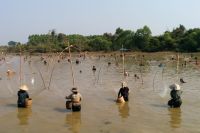
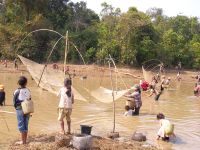
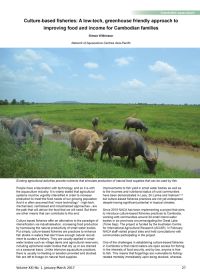
Culture-based fisheries: A low-tech, greenhouse friendly approach to improving food and income for Cambodian families

Improvements to fish yield in small water bodies as well as to the incomes and nutritional status of rural communities have been demonstrated. in Laos, Sri Lanka and Vietnam but culture-based fisheries practices are not yet widespread, despite having significant potential in tropical climates. A project to introduce culture-based fisheries to Cambodia is described. Participating communities reported improved catch per unit effort, an increase in the number of people engaged in fishing and lower food costs.