Food Security, Safety and Certification

Food safety is a key concern for international trade in fish products. The constantly changing regulatory environment and safety requirements of importing countries pose a special challenge to small-scale aquaculture producers.

The programme assists members to assure the safety and quality of aquaculture products through the adoption of science-based better management practices. Policy issues concerning aquaculture certification and activities in market access are also addressed.

The programme focuses on assisting small-scale farmers to adapt to the changing trade and safety environment. Cluster-based management approaches and formation of farmer societies are promoted as practical mechanisms for implementation of better management practices.

Key activities

  • Evaluation of commodity-specific better management practices for meeting domestic and international food safety standards.
  • Facilitating establishment of national residue testing and monitoring programmes and sharing of information amongst member countries.
  • Improving access to markets by small-scale farmers.
  • Improving market development for low-cost aquaculture commodities.
  • Address biosecurity and associated human health issues regarding the consumption of fish and processed products.
  • Development of farmer groups and cluster-based certification concepts and methodologies.

Creative Commons Attribution.
Related

Subject tags

A collection of subject tags relating to technical matters.

In this collection

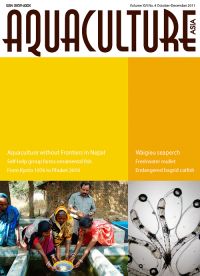
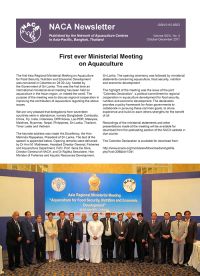
NACA Newsletter, Volume XXVI, No. 4, October-December 2011

In this issue:

First ever Ministerial Meeting on aquaculture. Keynote address delivered by His Excellency, Mahinda Rajapaksa, President of Sri Lanka. Farewell Sena and welcome Eknath! 2nd Regional Training Course on Application of Business Management Principles in Small Scale Aquaculture. Consultation on Lake and Reservoir Fisheries and Aquaculture Development in Asia. Asia Regional Seminar on Certification for Small Scale Aquaculture in Thailand. Special issue of the AFS Journal: Integrated technologies for advanced shrimp production. Farmers as Stakeholders in Commercial Aquaculture: Free download. Marker for banned antibiotic naturally occurs in freshwater prawns and other crustaceans.

Aquaculture certification and market access: Opportunity or bottleneck for small scale farmers?

C.V. Mohan presents on aquaculture certification and market access and the implications for small-scale farmers.

Fair trade certification: Enabling mechanism for small scale farmer groups

Sureel Singh presents on Fair trade as an enabling mechanism for small-scale farmers in India.

Role of industry in scaling up: Certification bodies

Ken Corpron presents on the role of certification in scaling up the national programme on better management practices for shrimp aquaculture in India.

NACA Newsletter, Volume XXVI, No. 3, July-September 2011

In this issue:

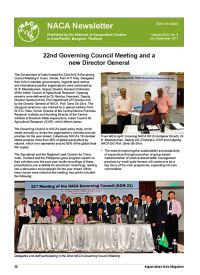
22nd Governing Council Meeting and a new Director General. NACA receives the Margarita Lizárraga Medal. NACA receives Gold Medal Award from the Asian Fisheries Society. Special address by Dr E.G. Silas at the inaugural session of the 22nd Governing Council Meeting 9-12 May, Kochi, India. Striped catfish farming in the Mekong Delta: A tumultuous path to a global success. Sign up for the NACA Email Newsletter. Diseases in Asian Aquaculture VIII: Registration and abstract submission open. Food safety and biosecurity. Ramping up adoption of catfish BMPs. Scaling up BMPs: A national workshop. 2nd Aquaclimate project meeting.

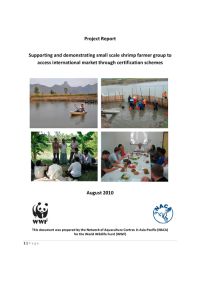
Supporting and demonstrating small scale shrimp farmer group to access international market through certification

This project was conducted to demonstrate small scale shrimp farmer group access to international markets through certification schemes. This project proved that small-scale farmers organised into groups, can improve their technical capacities, and achieve access to markets. This achievement was the result of strong partnerships with producers, private sector and government agencies assisting to develop a sustainable business model for small scale aquaculture. Cost of compliance was found to be a significant barrier to entry.

Opportunities and challenges facing small-scale farmers in Asia

Miao Weimin presents on aquaculture certification opportunities and challenges for small scale farmers.

Thailand GAP: A potential tool for farmers, in comparison to global standard

Michael Phillips presents on Thailand's Good Aquaculture Practices certification scheme, and compares it to global standards.

Cluster certification: Way forward for small-scale farmers

A cluster-based approach allows small-scale farmers to participate in aquaculture certification schemes.

Opportunities and challenges facing small-scale farmers in Asia

Small-scale farmers face many challenges in the face of globalisation. Ever-increasingly competition, increasingly strict food safety and evironmental standards, and a growing regulatory burden can make it difficult for small farmers to survive. A cluster or cooperative approach can help farmers achieve economies of scale to remain competitive.

Thailand GAP: A potential tool for farmers, in comparison to global standard

A comparison of the variance between Thailand GAP and the global standard, and it's application to the aquaculture industry.

Cluster certification: Way forward for small-scale farmers

Cost and logistical constraints can be barriers to the inclusion of small-scale farmers in aquaculture certification schemes. Adopting a cluster-based approach, where groups of adjacent farms are certified together, can facilitate the participation of small-scale producers maintain their access to markets. Group-based certification can also assist with extension and implementation of better management practices required to achieve certification and compliance monitoring.

National Training Workshop for Cluster Certification Trainers

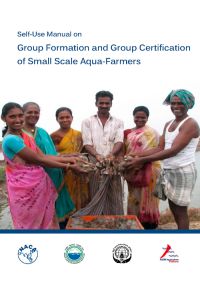
International requirements on food safety, traceability, animal health and welfare and social responsibility are increasingly stringent. The burden of compliance and the cost of certification are particularly heavy for small scale farmers who are often excluded by the limited resources at their disposal. Working in groups can help small scale farmers attain economies of scale necessary to address compliance issues and participate in certification schemes, improving their competitive position.

National Training Workshop for Cluster Certification Trainers

International requirements on food safety, traceability, animal health and welfare and social responsibility are increasingly stringent. The burden of compliance and the cost of certification are particularly heavy for small scale farmers who are often excluded by the limited resources at their disposal. Working in groups can help small scale farmers attain economies of scale necessary to address compliance issues and participate in certification schemes, improving their competitive position.

NACA Newsletter, Volume XXVI, No. 2, April-June 2011

In this issue:

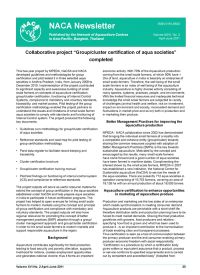
Collaborative project "Grouper/cluster certification of aqua societies" completed. Report of the Advisory Group on Aquatic Animal Health available. Guidelines on Aquaculture Society Certification released. Listen to us online. Workshop on ecosystem approach to inland fisheries: Data needs and implementation strategies. Disease advisory: Infectious myonecrosis (IMN) status and threat. 7th Regional Grouper Hatchery Production Training Course, 25 September - 15 October, Situbondo, Indonesia.

Guidelines on Aquaculture Society Certification

These guidelines prepare and enable aquaculture societies to seek group certification from independent third party certification programmes. The guidelines are independent of commodity and certification standards. They were developed as part of a collaborative MPEDA/NaCSA/NACA project on the certification of aquaculture societies. Draft guidelines developed by the project partners were discussed at the inception meeting on aquacutlure society certifiction held at Kakinada during 1-2 September 2009.

Facilitating market access for producers: addressing market access requirements, evolving consumer needs and trends in product development and distribution

Certification schemes for both wild and farmed products are gaining market share in many developed country markets. In a not too distant future, aquaculture’s share of total supply for human consumption will rise to somewhere between 60 and 70 percent. This will have a profound impact on the sector’s ability to shape world markets but it will also challenge the sector’s ability to respond successfully to evolving consumer needs.

Consumer assurance: market-based quality schemes, certification and traceability, ecolabeling, retailer specifications

As standards, certification schemes and claims proliferate, their value is being questioned. Producers and producing countries in particular question whether these private standards and certification schemes duplicate or complement government work, especially in relation to food safety and animal health. The expert panel will review current practices and future trends in market-based quality standards and certification schemes in aquaculture, including international initiatives to promote transparent market standards for improved safety, quality and sustainability in aquaculture. 

Organic aquaculture: the future of expanding niche markets

There is unprecedented growth in the demand for organic food and new areas of organic food production, such as fish, are proving increasingly popular. Today, several specific and relatively precise standards of organic aquaculture production (hatchery, feed, grow-out) and processing exist which aim at achieving optimal agro-ecosystems which are socially, ecologically and economically sustainable. Around 80 different organic aquaculture standards exist, both public as well as private.

Thematic session 4 summary and conclusions: Responding to market demands and challenges; making aquaculture a safe and diverse food producing sector for the benefit of world consumers

Presentation of the summary, conclusions and recommendations of Thematic Session 4 (Responding to market demands and challenges; making aquaculture a safe and diverse food producing sector for the benefit of world consumers).