9 January 2012 | Reza Shah Pahlevi, Abdullah and N. Kurnia | 4163 Downloads | .pdf | 3.66 MB
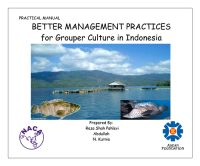
This practical manual covers key aspects for successful grouper farming including formation of farmer groups, cage crop planning, crop calendar and better management practices for cage aquaculture of grouper. These include site selection, design, cage preparation, seed selection and stocking practices, feed, water and health management, harvest and post-harvest, record keeping, marketing and capital strengthening. It is designed for use by small-scale farmers.
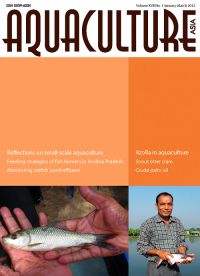
Reflections on small-scale aquaculture. Azolla - an aquatic fern of significance to small-scale aquaculture. Monitoring quantity and quality of striped catfish pond effluent. Feeding strategies adopted by fish farmers in Andhra Pradesh, India. Hatchery techniques applied for the artificiant production of snout otter clam (Lutraria rhynchaeria) in small scale farms in Nha Trang City, Vietnam. Crude palm oil is a sustainable alternative to the growing fish oil scarcity, particularly for the aquaculture of warm freshwater fish species.
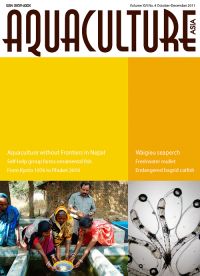
Visit to the AwF funded small-scale aquaculture project in Nepal. Success story of the Barakhandapat Ornamental Fish Breeding Unit, India. From Kyoto 1976 to Bangkok 2000 and Phuket 2010: Aquaculture development and personal transitions. Embryonic and larval development of Waigieu seaperch Psammoperca waigiensis. Culture feasibility of freshwater mullet Rhinomugil corsula in ponds in India. Management in seed production of an endangered catfish Horabagrus brachysoma during its hatchery phase.
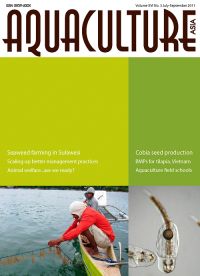
Seaweed farming in Sulawesi, Indonesia. Scaling up better management practices: Empowering small scale farmers. Animal welfare for farmed fish...is Asia-Pacific ready? Aquaculture field schools as an extension methodology. Successful seed production of cobia, Rachycentron canadum in India. 22nd Governing Council Meeting and a new Director General. NACA receives the Magarita Lizárraga Medal. NACA receives Gold Medal Award from the Asian Fisheries Society. Striped catfish farming in the Mekong Delta and more.
International requirements on food safety, traceability, animal health and welfare and social responsibility are increasingly stringent. The burden of compliance and the cost of certification are particularly heavy for small scale farmers who are often excluded by the limited resources at their disposal. Working in groups can help small scale farmers attain economies of scale necessary to address compliance issues and participate in certification schemes, improving their competitive position.
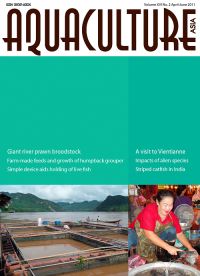
A visit to Vientianne, Lao PDR. Development of captive broodstock of giant river prawn Macrobrachium rosenbergii. Alien introduction and its impact on native fisheries and aquatic bioiversity of West Bengal, India. Ecological impacts of exotic fish species in India. Farm-made feeds support good growth and survivial of the humpback grouper. An easy way to hold live fish. Litopenaeus vannamei introduction: Sound management or expediency? Newsletter and more.
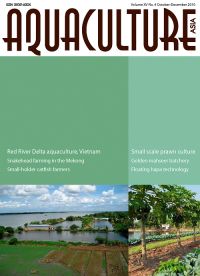
Rapidly changing aquaculture scene in the Red River Delta, Vietnam. Current situation and challenges for the farming of snakeheads in the Mekong Delta. Is there a business case for small-holders in Vietnamese pangasius? Small scale prawn culture practices towards sustainable development in Chittagong region, Bangladesh. Gloating hapa technology for the mass production of tilapia Oreochromis niloticus in Bangladesh. Management in seed production of golden mahseer Tor putitora in hatchery condictions.
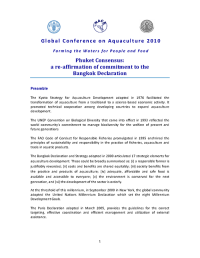
The Phuket Consensus is a declaration on aquaculture development endorsed by participants of the Global Conference on Aquaculture 2010, held in Phuket, Thailand, 22-25 September. The consensus builds on the Bangkok Declaration, which was formulated at the International Conference on Aquaculture in the Third Millennium, held in Bangkok, 20-25 February 2000. The consensus and declaration provide strategic guidance on sustainable development of aquaculture considering social, environmental, technical and economic issues.
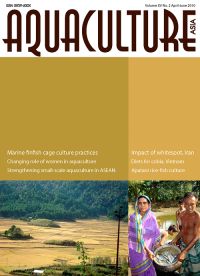
The Dedanaw Project, Myanmar. The changing face of women for small-scale aquaculture in Bangladesh. Strengthening capacity of small holders in ASEAN. Carp seed production in Orissa, India. Sustainable mountain paddy-fish farming of the Apatani tribes. The economic impacts of whitespot virus on shrimp production in Iran. Current practices of marine finfish cage culture in China, Indonesia, Thailand and Vietnam. Effects of trash fish on growth and body composition of cobia.
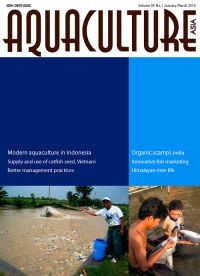
Development of modern aquaculture in Java, Indonesia. Better management practices - gateway to sustainability. Update on organic scampi aquaculture in Andhra Pradesh. Domestic fish marketing in south India. Seed rearing of catfish Clarias batrachus. Supply and use of catfish Pangasianodon hypopthalmus seed in the Mekong Delta. Risk analysis and sustainability of catfish seed in the Mekong Delta. Life of a river in the Himalaya: Ecological study of the Trisuli River, Nepal and more.
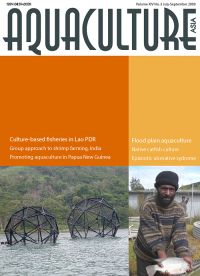
Community management and revenue sharing practices of culture-based fisheries in Lao PDR. Floodplain aquaculture in Bangladesh. Promoting small-scale inland aquaculture in Papua New Guinea. Group approaches to shrimp farming: The key to sustainability. Native catfish culture - a technology package for farmers. Influence of salinity in the growth of the black clam Villorita cyprinoides. EUS in Asia and Africa. Offshore opportunities for artisinal aquaculture. Grouper aquaculture in Brazil. NACA Newsletter.
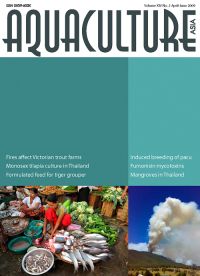
GLOBALGAP standard in Thai shrimp farms: Mission (im)possible? The Victorian trout industry and the bushfires. Small-scale aquaculture in the Ayeyarwady Delta, Myanmar. The history, status and future prospects of monosex tilapia culture in Thailand. Mangroves of Nakhon Si Thammaarat Province in Souther Thailand. Induced breeding of pacu Piaractus brachypomus in captivity. Fumosins - mycotoxins of increasing importance in fish. Microsatellite DNA markers, a fisheries perspective. Formulated feed for tiger grouper grow out.
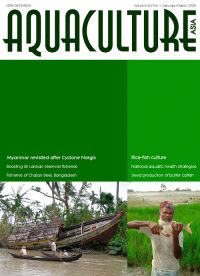
Myanmar revisited. Harvesting, traditional preservation and marketing of fishes of Chalan Beel, Bangladesh. Role of community in production and supply of larger, quality fingerlings. Can rice-fish farming provide food security in Bangladesh? Nutritional and food security for rural poor through multi-commodity production from a lake of eastern Uttar Pradesh. Emerging boost in Sri Lankan reservoir fish production. Farming the freshwater prawn Macrobrachium malcolmnsonii. Breeding and seed production of catfish Ompok pabda.
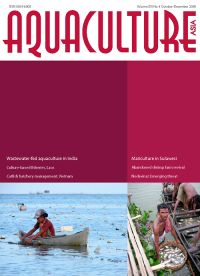
An increasingly secure future for wastewater-fed aquaculture in Kolkata, India? First culture-based fisheries growth cycle in Lao PDR is overhwelmingly encouraging. Revival of abandoned shrimp farms in Andhra Pradesh. Growth of industries linked with aquaculture in Kolleru Lake area, India. Applications of nutritional biotechnology in aquaculture. Technical and management aspects of catfish hatcheries in Vietnam. Asian seabass farming. Mariculture development opportunities in southeast Sulawesi, and much more.
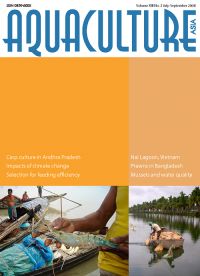
Possible improvements to carp culture in Andhra Pradesh. Aquaculture and environmental issues in the region of Nai Lagoon, Vietnam. Selection potential for feed efficiency in farmed salmonids. Freshwater prawn broodstock concern in Bangladhesh hatcheries. Production of Cirrhinus molitorella and Labeo chrysophekadion for culture-based fisheries in Lao PDR: Nursery and grow-out. Mussel farming: Alternate water monitoring practice. Use of poultry by-product meals in pelleted feed for humpback grouper Cromileptes altivelis.
17 April 2008 | Melba G. Bondad-Reantaso (ed.) | 6729 Downloads | .pdf | 9.61 MB
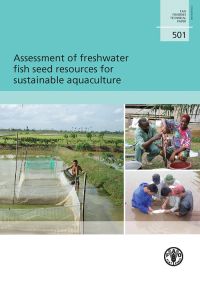
This publication contains the proceedings and major recommendations of the expert workshop which tackled three major themes: Seed quality, genetics, technology and certification; seed networking, distribution, entrepreneurship and certification; and how rural fish farmers can benefit from the seed sector. It also contains the outcomes of a desk study consisting of three regional syntheses, twenty-one country case studies and five thematic reviews (seed quality, genetics and breeding, seed networks, role of seed supply, farmer innovations and womens' involvement).
From integrated carp polyculture to intensive monoculture in the Pearl River Delta, China. Better management practices for Vietnamese catfish. Ipomoea aquatica - an aquaculture friendly macrophyte. Status of fisheries and aquaculture development in Pakistan. The changing face of post-grad education in aquaculture: Contributing to soaring production and sustainable practices. Hatchery management in Bangladesh. Production of Cirrhinus molitorella and Labeo chrysophekadion for culture-based fisheries in Lao PDR and much more.
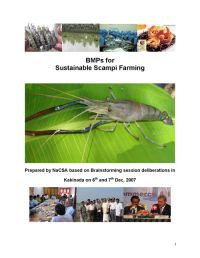
This manual provides practical advice on good management practices for sustainable freshwater prawn (scampi) farming in India. The manual covers general principles of sustainable farming, relevant legal issues including for hatcheries, land and water use, impact on natural habitats, hatchery, nursery and growout management, and environmental and social responsibility. The manual was developed via a multi-stakeholder consultation held at the Head Office of the National Centre for Sustainable Aquaculture (NaCSA), Kakinada, 6-7 December 2007.
The Project 'Artificial propagation of empurau, Tor tambroides and semah, Tor douronensis, two species of commercial and conservation value to Sarawak, Malaysia' successfully achieved captive breeding and larval to fingerling rearing. An enhancement strategy for the long-term management of semah and empurau broodstock, and conservation of wild stocks, based on genetic findings is discussed. Guidelines on best husbandry management practices to ensure a supply of physically and genetically healthy quality seed are provided.
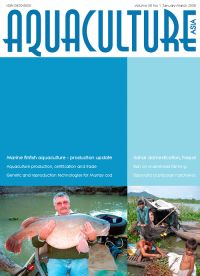
Developing guidelines for sustainable freshwater aquaculture planning in Vietnam. Aquaculture production, certification and trade for small-scale farmers. Backyard hatcheries for crustaceans in Thailand. Alternative carp species for diversification in India. Genetic and reproduction technologies for aquaculture and fisheries management of Murray cod. Status of sahar domestication in Nepal. Comparative advantage analysis of shrimp production in Asia. Strategies to improve the livelihoods of the rural poor, Vietnam, and more.