O Cultivo de Camarão é um dos setores de mais rápido crescimento na aqüicultura em várias partes do mundo e também o mais controverso. A rápida expansão deste setor possibilitou a geração de renda para muitos países, entretanto, ela tem sido acompanhada por crescentes preocupações sobre seus impactos ambientais e sociais. Os Princípios Internacionais para a Carcinicultura Responsável provêm a base sobre a qual todas as partes interessadas poderão colaborar para um desenvolvimento mais sustentável do cultivo de camarão.
El cultivo de camarón es uno de los sectores de la acuicultura de más rápido crecimiento y también uno de los más polémicos en muchas partes del mundo. La rápida expansión de este sector generó ingresos para muchos países, pero ha estado acompañada por preocupaciones crecientes relacionadas con sus impactos ambientales y sociales. Los Principios Internacionales para el Cultivo Responsable de Camarón proporcionan las bases sobre las cuales los diversos participantes pueden colaborar en pro de un desarrollo más sostenible de la camaronicultura.
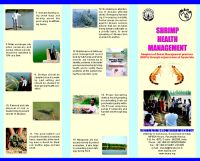
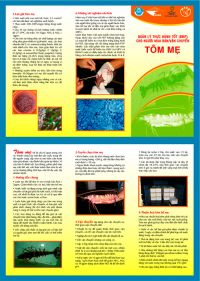
Shrimp Health Management brochures provide better management practices in a reader friendly format. These brochures were prepared as extension materials through the village based demonstration programme by the Marine Products Export Development Authority of India and NACA. The programme continues building success and involved a total of 29 villages and 29 Aquaclubs in five Indian states (Andhra Pradesh, Tamilnadu, Orissa, Gujarat, and Karnataka) in 2006.
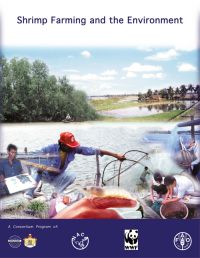
Shrimp farming is one of the fastest growing aquaculture sectors in many parts of the world and also one of the most controversial. Rapid expansion of this sector generated income fo many countries, but has been accompanied by rising concerns over environmental and social impacts. The International Principles for Responsible Shrimp Farming provide the basis upon which stakeholders can collaborate for a more sustainable development of shrimp farming.
Shrimp farming is one of the fastest growing aquaculture sectors in many parts of the world and also one of the most controversial. Rapid expansion of this sector generated income fo many countries, but has been accompanied by rising concerns over environmental and social impacts. The International Principles for Responsible Shrimp Farming provide the basis upon which stakeholders can collaborate for a more sustainable development of shrimp farming.
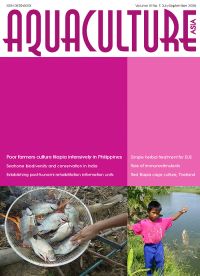
Resources and biodiversity of seahorses and their need for conservation in India. Captive breeding of pangasid catfish Pangasius pangasius. Establishment of post-tsunami rehabilitation information units in Thailand. Poor farmers culture tilapia intensively in ponds in Central Luzon, Philippines. Simple herbal treatment for treatment of EUS in snakehead. DNA vaccination in health management. The role of immunostimulants. Red tilapia cage culture in central Thailand. Quality improvement of farmed fish in Iranian markets.
A series of leaflets on better management practices for Penaeus monodon shrimp aquaculture in Vietnam. The leaflets are available in both Vietnamese and English and cover: Broodstock management for suppliers, postlarvae selection and transportation for seed traders, shrimp seed quality, pond preparation, good pond management, shrimp health management.
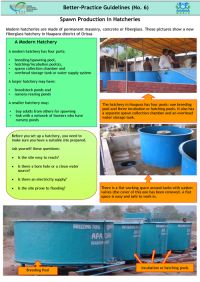
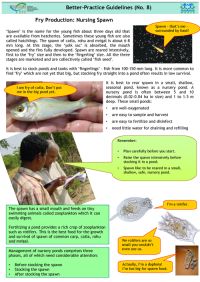
‘Spawn’ is the name for the young fish about three days old that are available from hatcheries. Sometimes these young fish are also called hatchlings. The spawn of catla, rohu and mrigal is about 6-8 mm long. At this stage, the ‘yolk sac’ is absorbed, the mouth opened and the fins fully developed. Spawn are reared intensively, first to the ‘fry’ size and then to the ‘fingerling’ size. All the three stages are marketed and collectively called ‘seed’.
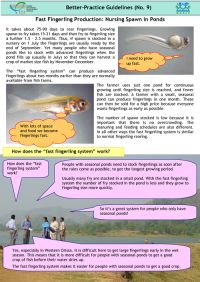
The “fast fingerling system” can produce advanced fingerlings about two months earlier than they are normally available from fish farms. The farmer uses just one pond for continuous growing until fingerling size is reached, and fewer fish are stocked. A farmer with a small, seasonal pond can produce fingerlings in one month. These can then be sold for a high price because everyone wants fingerlings as early as possible.
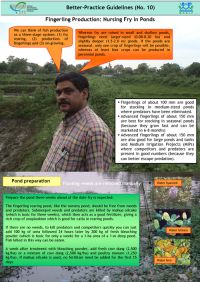
The fingerling rearing pond, like the nursery pond, should be free from weeds and predators. Submerged weeds and predators are killed by mahua oilcake, which then acts as a good fertiliser. If there are no weeds, to kill predators and competitors quickly you can just add 100 kg of urea followed 24 hours later by 200 kg of fresh bleaching powder for a 1-ha area of a 1-m deep pond.
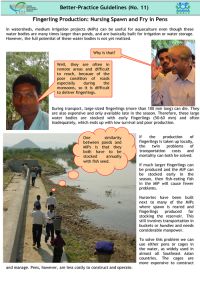
In watersheds, medium irrigation projects can be useful for aquaculture even though these water bodies are many times larger than ponds, and are basically built for irrigation or water storage. However, the full potential of these water bodies is not yet realised. Net pens or cages can be used to rear fingerlings in such environments.
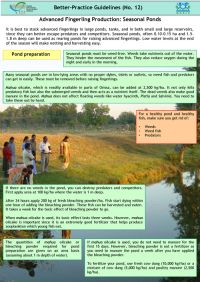
It is best to stock advanced fingerlings in large ponds, tanks, and in both small and large reservoirs, since they can better escape predators and competitors. Seasonal ponds, often 0.10-0.15 ha and 1.5-1.8 m deep can be used as rearing ponds for raising advanced fingerlings. Low water levels at the end of the season will make netting and harvesting easy.
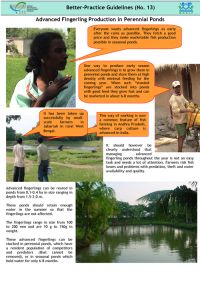
Everyone wants advanced fingerlings as early after the rains as possible. They fetch a good price and make marketable fish production possible in seasonal ponds. One way to produce early season advanced fingerlings is to grow them in perennial ponds and store them at high density with minimal feeding for the coming year. Whe such "stunted" fingerlings are stocked into ponds with good feed they grow fast and can be marketed in about 6-8 months.
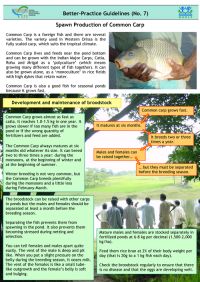
Common carp is a foreign fish and there are several varieties. The variety used in Western Orissa is the fully scaled carp, which suits the tropical climate. Common carp lives and feeds near the pond bottom and can be grown with the Indian major carps, catla, rohu and mrigal as a 'polyculture' (which means growing many different types of fish together). It can also be grown alone, as a 'monoculture' in rice fields with high dykes that retain water.
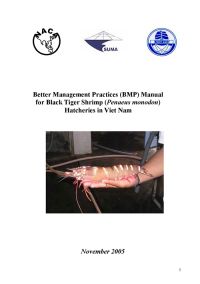
In order to provide practical and effective technical guidance for shrimp hatchery management, it is necessary to establish a set of better management practices (BMPs) which underpin an effective hatchery production system. This document is not a complete manual on the management of P. monodon hatcheries but concentrates on the implementation of BMPs for the hatchery covering all of the critical stages and processes in the production cycle, which are currently believed to be causing problems in Vietnamese hatcheries.
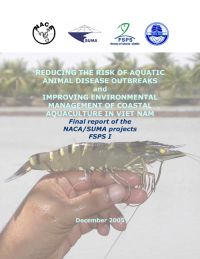
This report describes the experiences and lessons learnt from activities conducted by NACA in Viet Nam to support the sustainable development of the aquaculture sector using better management practices and harmonised strategies for the management of aquatic animal health and environmental problems. Achievements included reducing the risk of diseases from seed and on farms, developing capacity at the provincial and national levels, developing an effective surveillance system and wide dissemination of experiences.
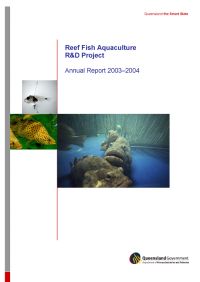
This is the annual report (2003-2004) of the Reef Fish Aquaculture R&D Project, based at the Northern Fisheries Centre, Cairns. The project provides a core platform for a suite of R&D projects addressing the feasibility of aquaculture technologies for high-value marine finfish species. This report outlines progress on the three core components of the programme, namely broodstock management and spawning, live prey production, and larval rearing and grow-out.
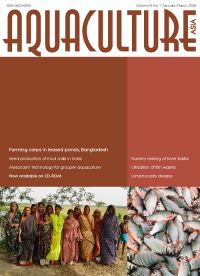
Nursery rearing of silver barb Puntius goniotus. Artemia enrichment and biomasss production for larviculture. Seed production of mud crab Scylla serrata in India. Macrobrachium on the southwest coast of India. Fish wastes in urban and suburban markets of Kolkata: Problems and solutions. Groups of poor women farming carps in leased ponds, Bangladesh. Lymphocystis disease and diagnostic methods in China. Mesocosm technology advances grouper aquaculture in northern Australia.