30 January 2004 | Susana V. Siar, William Lee Johnston and Sih Yang Sim | 2163 Downloads | .pdf | 2.16 MB
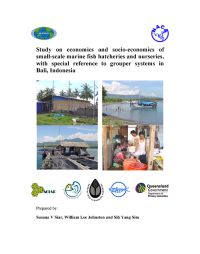
The main objectives of the study were to describe the development of the small-scale or back yard multispecies hatcheries and their economic structure and benefits to the farmers and local community in Bali, Indonesia. The social and economic impact of the back yard multi-species hatchery systems were analysed and details of the benefit of this system to the community described. The strengths and weaknesses of the back yard multi-species hatchery system are described.
1 January 2004 | Geoff Allan and Don Fielder (eds.) | 2616 Downloads | .pdf | 376.27 KB
To review mud crab aquaculture in Australia and Southeast Asia, ACIAR funded a scoping study, followed by a workshop to review the study and discuss status and problems in different regions of Australia and Southeast Asia. The primary conclusion from the scoping study, verified by workshop discussion, was that the substantial crab farming operations which exist throughout Southeast Asia are still mainly based on wild caught crablets.
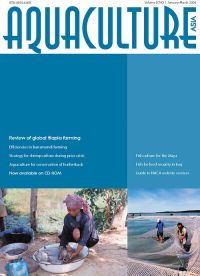
Aquaculture and food security in Iraq. Natural breeding in captivity - conservation of the threatened freshwater featherback Notopterus notopterus. Culture of Penaeus japonicus. Enzymes for sustainable aquaculture. Review of global tilapia farming practices. Fish culture in Yucatan, Mexico. Shrimp farm project planning, preparation and implementation. Coping with low shrimp prices. Efficiencies in barramundi culture. The innovative contributions of women in aquaculture. Marine finfish section. What's new on the web. Aquaculture calendar.
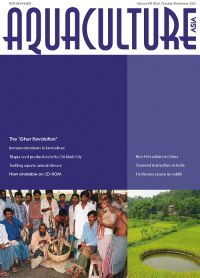
Freshwater prawn Macrobrachium nobilii for rural nutrition. Snapshots of a socially responsible farm in Sri Lanka. Introduction of rainbow trout in Nepal. Tilapia seed production in Ho Chi Minh City, Vietnam. Seaweed mariculture - scope and potential in India. Growth enhancement of carp and prawn through dietary suppliementation with salt. Fertilisation and water quality management in small ponds. The "Gher Revolution". Exercising responsibilities to tackle aquatic animal disease. Immunostimulants in aquaculture.
Ornamental fish farming in India. Tilapia for Indian aquaculture? Peri-urban food production in southeast Asia. Socio-economic consequences of shrimp farming in Andhra Pradesh. Breeding techniques for golden arowana Scleropages formosus. Captive breeding of peacock eel Macrognathus aculeatus. Substrate-based aquaculture systems. Extension in shrimp health management - experiences from India. Treatment of disease in freshwater shrimps and crabs in China. Larval rearing techniques for humpback grouper Cromileptes altivelis.
1 May 2003 | Sih Yang Sim | 1712 Downloads | .pdf | 830.7 KB
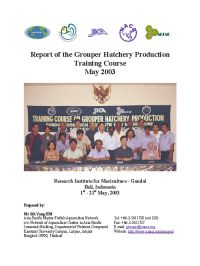
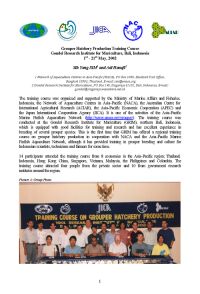
This report documents a training course that was held at the Research Institute for Mariculture, Bali, Indonesia in May 2003. The course covered both theoretical aspects of grouper husbandry via lectures and practical hands-on work in a grouper hatchery, including broodstock management, tank preparation egg collection, live feed production, health management, harvesting and transport and visits to commmercial grouper and milkfish hatcheries, grow-out facilities, markets and exporters.
Peri-urban aquaculture in Kolkata. Diffusion and adoption of shrimp farming technologies. Aquaculture education in India. Information system on fish germplasm resources in China. Freshwater crustacean aquaculture in China. The role of macronutrients. Innovations by Bengal farmers. Scientific guidelines for freshwater prawn farmers in India. Status of mariculture in Indonesia. Use of probiotics in larval rearing. Problems in shrimp culture during the wet season.
Fertilisation, soil and water quality management. Commercialisation of giant freshwater prawn culture in India. Aquaculture in reservoir-fed canal systems. Production of black-lip pearl oyster Pinctada margaritifera. Hybridisation hassles. Breeding sea cucumber Holothuria scabra in Vietnam. Use of palm kernel meal in feeds. Getting the most out of your feed. Marine finfish aquaculture in Myanmar. Penaeus monodon culture in low-salinity areas. Fisheries and aquaculture in Nepal.
Aquaculture for poverty alleviation and food security. Shrimp pond waste management. Properties of liming materials. Seed production of mud crab Scylla spp. The dilemmas of strain selection. Seed production of the crucifix crab Charybdis feriatus. A general approach to disease treatment and control. Breeding and seed production of mangrove snapper Lutjanus argentimaculatus. Responsible use of antibiotics in shrimp farming. Health management for cultured marine fishes. Molecular methods for rapid detection of pathogens in seafood.
1 May 2002 | Sih Yang Sim | 1950 Downloads | .pdf | 2.7 MB
This report documents a training course that was held at the Research Institute for Mariculture, Bali, Indonesia in May 2003. The course covered both theoretical aspects of grouper husbandry via lectures and practical hands-on work in a grouper hatchery, including broodstock management, tank preparation egg collection, live feed production, health management, harvesting and transport and visits to commmercial grouper and milkfish hatcheries, grow-out facilities, markets and exporters.
Prawn farm energy audits. Freshwater fish farming and poverty alleviation in Bangladesh. Artificial propagation for conservation of endangered species. Sewerage-fed aquaculture systems of Kolkata. Rice-fish farming in India. The use of lime, gypsum, alum and potassium permanganate in water quality management. Fish gene technology research in China. Low-salinity shrimp farms. Seed production of Clarius batrachus. Supplying good-quality seed for sustainable aquaculture and more.
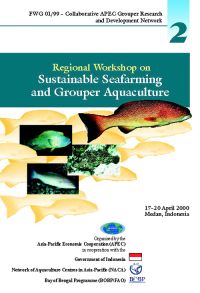
These are the proceedings of a workshop hosted by APEC and NACA under the project 'Collaborative APEC-NACA Grouper Aquaculture Network' (APEC Project FWG 01/99). The objectives of the workshop included the establishment of a regional research network to facilitate development of a sustainable grouper aquaculture industry; reduction of reliance on wild fingerlings for coastal grouper aquaculture, facilitate development of new aquaculture industries.
These are the proceedings of a workshop focussed on grouper culture, but also explored management strategies required to support the sustainable development of seafarming in the Asian region. The emphasis was on technology transfer and management strategies for the benefit of farmers and coastal communities. The workshop included special sessions on diversification of seafarming systems and culture species, the role of seafarming in the livelihoods of coastal communities.
This volume, the third major publication arising from the Conference on Aquaculture in the Third Millennium, contains the information essential to conduct well-informed discussion of sustainable aquaculture development - both at the Conference, as well as after. The information provide basic reference points on the progress, direction and magnitude of aquaculture changes, and the factors associated with these changes, within global, regional, sectoral, thematic and technical perspectives.
The Asia Regional Advisory Group on Aquatic Animal Health meets annually to discuss regional disease issues including emerging disease threats. The group was established by the Governing Council of NACA to provide advice to member governments in the Asia-Pacific region. This collection comprises the reports of the annual meetings of the group. The reports are a rich source of information concerning the current disease status of the region and new or emerging diseases of aquatic animals.
This training manual on scallop and sea cucumber hatchery and aquaculture techniques was prepared for the Scallop and Sea Cucumber Breeding and Culture Training Course, conducted by the Yellow Sea Fisheries Research Institute in Qindao, People’s Republic of China and organised by the Regional Seafarming Development and Demonstration Project in May 1991.