Health and Biosecurity

The Health and Biosecurity Programme assists members to reduce the risks of aquatic animal disease impacting the livelihoods of farmers, national economies, trade, environment and human health by:

  • Improving regional cooperation in aquatic animal health and welfare.
  • Developing and implementing national strategies on aquatic animal health.
  • Improving surveillance, reporting and response to disease emergencies.
  • Promoting harmonisation of diagnostic procedures and risk assessment.
  • Widespread promotion of better aquatic animal health management practices at the farm level.

Key activities

Key activities of the programme include:

  • Convening the annual meeting of the Asia Regional Advisory Group on Aquatic Animal Health, coordinating the Quarterly Aquatic Animal Disease Report and bringing regional issues to the attention of global standard setting bodies such as the Office International des Epizooties.
  • Establishment and expansion of a three-tier shared resource in aquatic animal health.
  • Development of farm-level health management tools for key aquaculture commodities.
  • Supporting regional disease surveillance and reporting.
  • Strengthening aquatic animal health and biosecurity in the region.
  • Facilitating harmonisation in disease diagnostic techniques.
  • Developing resource material in support of diagnosis and surveillance.

Contacts

Creative Commons Attribution.
Related

Subject tags

A collection of subject tags relating to technical matters.

In this collection

Report of the ICAR/NACA Workshop on Aquatic Epidemiology, Surveillance and Emergency Preparedness, 3-7 September 2007

This is the report of a five-day training workshop was to build capacity and awareness of relevant stakeholders in the areas of aquatic epidemiology, risk analysis, surveillance and emergency preparedness. The long term objective was to support implementation of national strategies for better aquatic animal health management with a focus on improved surveillance, reporting, early response, emergency preparedness, risk analysis, certification and quarantine.

Quarterly Aquatic Animal Disease Report, October-December 2007

This report, the 38th in the series, contains information about the aquatic animal health status of seventeen states in the Asia-Pacific region. The foreword discusses the OIE/NACA Regional Workshop on Aquatic Animal Health.

Aquaculture Asia Magazine, October-December 2007

In this issue:

A different form of dumping: The need for a precautionary approach for yet another new species for shrimp farming in Asia. Sustainable livelihoods of pangus farming in Bangladesh. Business approach to national broodstock centres in Vietnam. Freshwater aquaculture in Myanmar. Traditional carp culture in Central Europe. Egg and larval quality in sand bass Psammoperca weigiensis. Effect of protein and lipid level of growth performance of tiger grouper Epinephelus fuscoguttatus.

NACA Newsletter Volume XXII, No. 4, October-December 2007

In this issue:

Lao culture-based fisheries project gets underway. Expert Workshop on Aquaculture Certification, Brazil. Strategies for Development of Asian Reservoir and Lake Fisheries Management. EUS identified as cause of fish kills in Africa. NACA seeks shrimp farm specialists for assignments in Indonesia. FDA detains five species of farm-raised seafood from China. 7th Symposium on Diseases in Asian Aquaculture. Aquafeed Horizons Asia 2008. Scientists join fight against frog diseases. Artificial propagation of snow trout Schizothorax zarudnyi by Iranian experts. NACA keynotes three international meetings. Culture, capture conflicts project review, Indonesia. Sign up to the coldwater aquaculture Yahoo! Tech Group. Website publishing and administration training, Vietnam. Aquatic Animal diseases Significant to Asia-Pacific: Identification Field Guide.

Strengthening Aquatic Animal Health Capacity and Biosecurity in ASEAN

This final report of the project “Strengthening Aquatic Animal Health Capacity and Biosecurity in ASEAN” contains two parts: A. Recommended Minimum Operational Requirements for Implementing National Aquatic Animal Health Strategies within ASEAN and B. ASEAN progress in the implementation of National Aquatic Animal Health Strategies. The report provides guidance for countries in ASEAN to implement key elements of national aquatic animal health strategies, and for monitoring progress of national strategy implementation in ASEAN member countries.

Application of PCR for improved shrimp health management in Asia

This is the report of the project Application of PCR for improved shrimp health management in the Asian region. The training programme included two training workshops that were designed to provide a good understanding of PCR methodology, laboratory practices and trouble shooting in detection of both DNA and RNA viruses. The workshops were followed by by two rounds of an anonymous PCR inter-calibration or ring testing exercise to allow laboratories to gauge their own performance.


Standard operating procedures for health certification and quarantine measures for the responsible movement of live food finfish within ASEAN

These standard operating procedures were developed to reduce the risk of spread of trans-boundary disease of aquatic animals through the movement of live food fish. The procedures are a set of documents for health certification and quarantine measures to be used by competent authorities in trade among ASEAN member countries. The procedures recognise the existing variation in capacity between ASEAN members and have been designed so that they can be implemented across varying policy and legal frameworks.

Quarterly Aquatic Animal Disease Report, July-September 2007

This report, the 37th in the series, contains information about the aquatic animal health status of fourteen states in the Asia-Pacific region. The foreword discusses emerging diseases in the region.

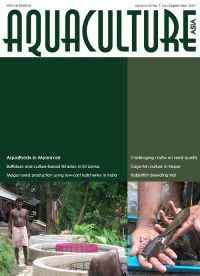
Aquaculture Asia Magazine, July-September 2007

In this issue:

Buffaloes in favour of culture-based fisheries in Sri Lanka. Aquafeeds in Myanmar: A change from farm-made to factory-made feeds. Challenging myths about seed quality and potential benfits to the rural poor. Catfish Clarius batrachus production using low cost hatcheries. Cage fish culture and livelihoods in the mid-hill lakes of Pokhara, Nepal. Marine fish hatchery training. Rabbitfish Siganus guttatus breeding and larval rearing. Vietnamese extension manual on culture-based fisheries.

NACA Newsletter Volume XXII, No. 3, July-September 2007

In this issue:

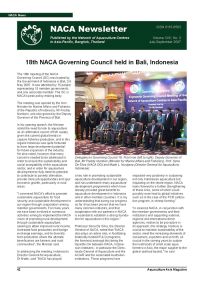
18th NACA Governing Council held in Bali, Indonesia. Strengthening aquatic animal health capacity and biosecurity in ASEAN - final workshop. Aquatic animal pathology master class. Vietnamese extension manual on culture-based fisheries. New project: Culture-based fisheries development in Lao PDR. Guidelines on digital publishing: a practical approach for small organizations with limited resources. Workshop on understanding and applying risk analysis in aquaculture. GISFish: Remote sensing and mapping for aquaculture and inland fisheries. Online encyclopeadia to list 1.8 m known species. DELTA 2007. NACA/FAO partnership working to establish guidelines for certification of farmed fish. Asia-Pacific Aquaculture 2007, 5-8 August 2007, Vietnam. Skretting sponsorship & scholarships for the Marine Finfish Aquaculture Network. The eleventh regular session on genetic resources for food and agriculture.

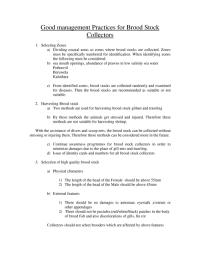
Good management practices for broodstock collectors

The National Aquaculture Development Authority of Sri Lanka (NAQDA) took several steps to regularise collectors of Penaeus monodon under the restructuring programme of the shrimp aquaculture industry in Sri Lanka. Regularisation of broodstock collectors is very imperative mitigate transmission of white spot disease. NAQDA developed these practices in consultation with the Department of Fisheries and Aquatic Resources, shrimp hatchery owners, broodstock suppliers, NARA, Wayamba environmental authority, Sri Lanka aquaculture development alliance and the consortium for shrimp aquaculture development.

Strengthening Aquatic Animal Health Capacity and Biosecurity in ASEAN: Technical mission to Myanmar

A technical mission to Myanmar was undertaken to support development and implementation of national aquatic animal health strategies from 3 - 9 September 2006. The mission was part of the AADCP-RPS project "Strengthening Aquatic Animal Health Capacity and Biosecurity in ASEAN". The mission was coordinated by NACA and worked with stakeholders to develop simple and practical approaches to implement national aquatic animal health strategies in Myanmar.

Strengthening Aquatic Animal Health Capacity and Biosecurity in ASEAN: Technical mission to Vietnam

This is the report of a technical mission to Vietnam from 3 - 9 December 2006, as a part of the project “Strengthening Aquatic Animal Health Capacity and Biosecurity in ASEAN” to assist national authorities in the development and implementation of simple and practical national aquatic animal health management strategies. The objective of the mission was to assist the government to support development of national strategies on aquatic animal health management and develop short and long term plans.

Quarterly Aquatic Animal Disease Report, April-June 2007

This report, the 36th in the series, contains information about the aquatic animal health status of fifteen states in the Asia-Pacific region. The foreword discusses recent activities in support of aquatic animal health in the region.

Quarterly Aquatic Animal Disease Report, January-March 2007

This report, the 35th in the series, contains information about the aquatic animal health status of fifteen states in the Asia-Pacific region. The foreword discusses mechanisms for recognition of emerging diseases in the Asia-Pacific region.

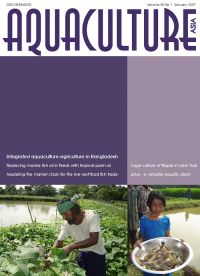
Aquaculture Asia Magazine, January-March 2007

In this issue:

Cage aquaculture of tilapia in Lake Taal, Philippines. Development and adoption of BMPs by farmer groups. Lotus - an aquatic plant of versatile qualities. Integrated aquaculture-agriculture systems in Bangladesh: Potential for sustainable livelihoods and nutrititional security of the rural poor. Spreadsheet model of the market chain for the live reef food fish trade. Regional Grouper Hatchery Production Training Course. Replacing marine fish oil in aquafeeds with tropical palm oil products. NACA Newsletter.

NACA Newsletter Volume XXII, No. 2, April-June 2007

In this issue:

Expert Workshop on Guidelines for Aquaculture Certification. Responsible movement of live food finfish within ASEAN: Cebu Workshop finalises the standard operating procedures. Information and capacity requirements for maintaining aquatic animal biosecurity identified. China-ASEAN efforts to minimise risk of spread of aquatic pathogens. National Centre for Sustainable Aquaculture inaugurated. NACA Better Management Practices program expands in Indonesia. Manual on Application of Molecular Tools in Aquaculture and Inland Fisheries Management. Research Needs to Sustain Asia-Pacific Aquaculture to 2025 and Beyond. Endemic freshwater finfish of Asia: Distribution and conservation status.

NACA Newsletter Volume XXII, No. 1, January-March 2007

In this issue:

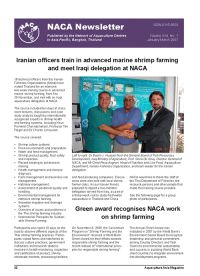
Iranian officers train in advanced marine shrimp farming and meet Iraqi delegation at NACA. Green award recognises NACA work on sustainable shrimp farming. International Principles for Responsible Shrimp Farming now available in Spanish. Building capacity on aquatic animal epidemiology in I.R. Iran. NACA Fisheries Team meets with new Governor of Aceh. Aquaculture Certification: Programme to implement the COFI Sub-Committee on Aquaculture recommendation. Recent Developments in the Aquaculture Feed Industry. Global Advances in the Ecology and Management of Golden Apple Snails. NACA mission to Myanmar. Workshop on Insurance in Aquaculture to be held in Bali, May 2007. Catfish 2007 Vietnam. Tilapia 2007 Kuala Lumpur.

Report of the fifth meeting of the Asia Regional Advisory Group on Aquatic Animal Health, 22-24 November 2006

The Asia Regional Advisory Group on Aquatic Animal Health meets annually to discuss regional health issues including emerging disease threats. This report includes a review of regional disease status circa 2006, global and regional disease reporting arrangements, global issues and standards, progress in implementation of the the Regional Technical Guidelines on Health management for the Responsible Movement of Live Aquatic Animals, identification and designation of regional aquatic animal health resources and regional and international cooperation.

Principes Internationaux pour l'Elevage Responsable de la Crevette

L'élevage de la crevette est l’un des secteurs d'aquaculture le plus en essor dans beaucoup de régions du monde, il est également l’un des plus controversés. L'expansion rapide de ce secteur a généré, certes, des sources de revenus pour plusieurs pays, mais elle a été accompagnée par une préoccupation croissante sur les impacts environnemental et social. Les Principes Internationaux pour l'Elevage Responsable de la Crevette fournissent la base sur laquelle les parties prenantes peuvent collaborer pour un développement plus durable de l'élevage de crevette.