11 December 2003 | Kai Lorenzen, Sophie Nguyen Khoa, Caroline Garaway, Robert Arthur and Geoff Kirkwood | 1610 Downloads | .pdf | 471.03 KB
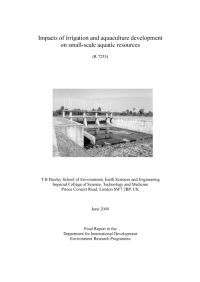
Small-scale aquatic resources play an important but poorly quantified role in the livelihoods of rural people in many developing countries, and are also important reservoirs of biological diversity. We conducted a field study in Southern Laos to quantify small-scale aquatic resource, and to assess the impacts of (small-to medium scale) irrigation and aquaculture development on these resources.
11 December 2003 | Michael Phillips, Pedro Bueno, Graham Haylor and Arun Padiyar | 1363 Downloads | .pdf | 98.06 KB
Small-scale and subsistence fisheries, and aquaculture, play important roles in the livelihoods of many rural people throughout the region, although the significance is often hidden in national, regional and international statistics. With the fishery sector as an important sector for human development in Asia, an understanding of the array of stakeholders involved, and indeed ensuring their better participation in policy setting processes and trade discussions, is necessary to bring a more human development-oriented dimension to trade policy.
11 December 2003 | Erik Hempel, Ulf Winther and John Hambrey | 28362 Downloads | .pdf | 632.13 KB
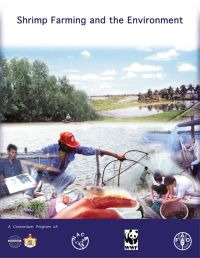
This report is intended primarily as a discussion paper, to serve as the basis for informed dialogue and policy development to encourage more detailed guidelines following further study and consultation. It seeks, in particular, to answer three commonly posed questions: Is sustainable shrimp farming possible? Can poor coastal communities benefit from it? And, if so, what role can agencies like the World Bank play to ensure that basic minimal requirements to achieve this are met?
23 November 2003 | Tran Van Nhuong, Michael J. Phillips and Raymon Van Anrooy | 1541 Downloads | .pdf | 102.66 KB
This case study was carried out in the North and North Central of Vietnam. The study was based on discussions and structured interviews with farmers, extension officers and other stakeholders. The objectives of the study were to describe the current coastal aquaculture practises, the impact on the livelihood of the coastal inhabitants and on the environment, to discuss the current situation in relation to the Code of Conduct for Responsible Fisheries and identify issues where BMPs should be introduced.
23 November 2003 | M.N. Kutty, P. Ravichandran, M. Krishnan, M. Kumaran and C.P. Balasubramanian | 1342 Downloads | .pdf | 11.01 KB
The present case studies concentrated on three sites, Kandaleru in Andhra Pradesh, Dhigirpar in West Bengal and Brahmagiri in Orissa. The three sites are markedly differentbut have a common feature that all three mainly are concerned with small farmers groupings. Earlier shrimp farming failures owing to the overexploitation of the ecosystem, by overstocking and consequent high inputs, resulting in degradation of the environment, diseases and eventual collapse, have alerted all shrimp farm groups to be wary.
23 November 2003 | Stanislaus Sonnenholzner, Laurence Massaut, Carlos Saldias, Jorge Calderon and Claude E. Boyd | 3579 Downloads | .pdf | 18.6 KB
This case study review shrimp aquaculture development in Ecuador. The prevailing farming systems and practices are described. Most farms are extensive or semi-intensive and the industry is shifting to hatchery-reared PL rather than wild due to unpredictability in wild PL supply and disease outbreaks. A survey of water quality intake and outfall from farms is reported on with suggestions for farm design to reduce nutrient load in outfall is discussed. Health issues and mangrove degredation are discussed.
The goal of this project was to optimise the economic yield from mixed shrimp aquaculture-mangrove forestry farming systems in Ca Mau Province, Vietnam, in a sustainable manner. Specific objectives were to investigate factors controlling the yields of shrimp and wood from shrimp farming-mangrove systems, experiment with shrimp pond and mangrove forest management to evaluate different culture options, identify improved practices and assist government to transfer the results of the project to the wider coastal farming community.
This report provides a background to the issues of focusing aquaculture on poverty alleviation based on the conclusions of an FAO/NACA Expert Consultation, which was organised in order to provide field-level professionals in Asia with a unique opportunity to come together to share experience on working in the field of poverty alleviation and aquaculture, and to prepare a platform for future networking.
In this issue: An experience with group formation in Jabarrah, West Bengal. Aquaculture self-help groups in rural West Bengal. Lessons learned for Fulwar Toli from an exposure visit to Jabarrah. Livelihood intervention by Fish Farmers Development Agency - a success story from Mayurbhanj, Orissa. Understanding of assets-based livelihoods through participatory rural appraisal to eliminate hunger. Poverty ranking tools in PRA - experiences of EIRFP in addressing vulnerability. This edition is also available in Vietnamese, Khmer, Ilonggo and Oriya.
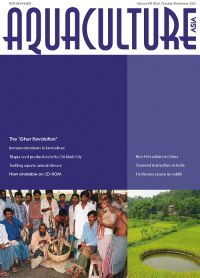
Freshwater prawn Macrobrachium nobilii for rural nutrition. Snapshots of a socially responsible farm in Sri Lanka. Introduction of rainbow trout in Nepal. Tilapia seed production in Ho Chi Minh City, Vietnam. Seaweed mariculture - scope and potential in India. Growth enhancement of carp and prawn through dietary suppliementation with salt. Fertilisation and water quality management in small ponds. The "Gher Revolution". Exercising responsibilities to tackle aquatic animal disease. Immunostimulants in aquaculture.
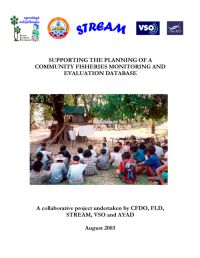
Knowledge of community fisheries and their capacity is a pre-requisite for co-management. This report illustrates the development of a pilot data collection, sharing and interrogation mechanisms for key information in support of co-management, identifying information requirements and procedures for the transmission and sharing of information between relevant stakeholders. A combination of focus group interviews with the community committee and village leaders, and participatory rural appraisal was used as a means of information compilation.
In this issue: Livelihood improvements through fisheries in the Pode community in Pokhara, Nepal. Women's participation in coastal resources management and livelihoods in Khanh Hoa Province, Vietnam. Supporting people's efforts and interactions in coastal resources management in Indonesia. Planning for a community fisheries M&E system. Identifying needs and recommendations for efficient stakeholder communications through an information access survey. IEC Seminar-Workshop in Support of Fisheries Ordinance Implementation in Roxas City, Philippines. About the STREAM Journal. About STREAM.
The Second STREAM Regional Conference was held in Tagaytay City, Philippines, from 8-10 June 2003 with the participation of 23 people from Australia, Cambodia, India, Nepal, Philippines, Thailand, Vietnam and Yunnan Province of China. Following a regional overview of STREAM’s themes, country partners, donors and funding, and activities, participants visited four “stations” on the themes of livelihoods, institutions, policy development, and communications, working in groups representing National Coordinators, Communications Hub Managers, and Partners. STREAM operations were discussed.
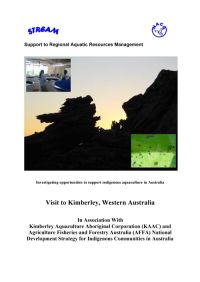
The NACA STREAM Initiative has been working with issues relating to livelihoods, policy and institutional development and communications throughout Asia-Pacific. Recently this has included work in India with indigenous communities supporting people to have a voice in policy making processes. There appear to be some parallels between this work and the objectives of Kimberley Aquaculture Aboriginal Corporation and also the Agriculture Fisheries and Forestry Australia Indigenous Aquaculture Unit, National Aquaculture Development Strategy for Indigenous Communities in Australia.
In this issue: Livelihoods and languages - a SPARK-STREAM learning and communications process. Towards broader contextual understandings of livelihoods. Using tools to build shared understandings, using a sustainable livelihoods framework to learn. Learning about rattan as a livelihood. Meanings of "community-managed area". Lessons learnt about processes for learning and communicating. About the STREAM Journal. About STREAM. This edition is also available in Bahasa (Indonesia), Ilonggo, Vietnamese, Bengali and Oriya.
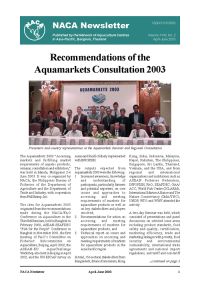
Recommendations of the Aquamarkets Consultation 2003. EC-funded project targets seafood trade and poverty. Shrimp disease control and coastal management. Fisheries and Adaptive Learning project. Shrimp aquaculture certification: Request for information & advice on a new web site. Workshop on control and responsible use of alien species. MPEDA/NACA Technical Assistance on Shrimp Health and Coastal Management. Changes to the regional list of aquatic animal diseases. STREAM SAPA Stakeholder Workshop in Hanoi. Regional Training Course on Grouper Hatchery Production. Review on low food chain species for marine fish culture. NACA/Deakin University to visit Indonesia 2-7 April 2003.
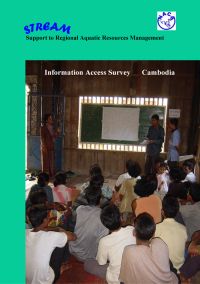
The aim of this report is to identify and recommend methods of communication that are appropriate to aquatic resources management stakeholders, focusing in particular on poor rural communities in Cambodia. As the Cambodian government begins to work more closely with local aquatic resources managers from poor rural communities, increased attention is being paid to the use of communication strategies and tools, in particular by the newly established Community Fisheries Development Office of the Department of Fisheries.
In this issue: Learning insights from the Fisheries Resource Management Project. An orientation on the SIAD approach and participatory local development planning. Group-building, production success and the struggle to prevent capture of the resource. Urban agriculture, water reuse and local economies: Case study of coastal riverine settlements of Ondo State, Nigeria. Livelihoods analysis: Actual experience from using PRA. A sustainable livelihoods approach to fisheries development for poverty alleviation in southeastern Vietnam. About the STREAM Journal. About STREAM.
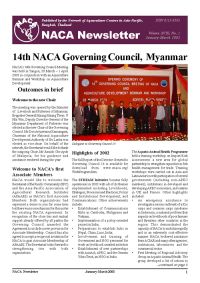
14th NACA Governing Council, Myanmar. Welcome to NACA's first Associate Member. NACA Alumni notes - U Minn Thame. Australian Youth Ambassador. Assisting in the Development of Recirculating Shrimp Farm Technologies. Nepal to join STREAM Initiative. NACA Joins Thai IT for Agriculture Forum. Indigenous Australian aquaculture group visits Thailand. Bangladesh Fisheries Training and Extension Project tour. Ugandan farmers train on catfish breeding and culture.
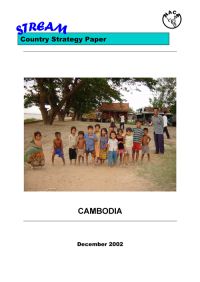
Cambodia is one of the poorest countries in the world; much of its population live in rural areas and many live below the local poverty line. The management of common property aquatic resources is of over-riding importance to food security and sustainable rural development in Cambodia. The key groups of poor people who use aquatic resources as part of their diverse livelihoods portfolios are subsistence fishers, small-scale aquaculture practitioners and aquatic resources collectors.