Nutrition and feeding

Information relating to nutrition and feeding in aquaculture.

Creative Commons Attribution.

Related

Subject tags

A collection of subject tags relating to technical matters.

In this collection

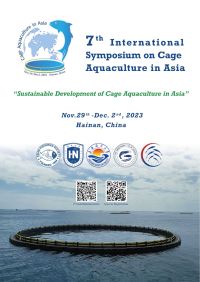
7th International Symposium on Cage Aquaculture in Asia (2nd announcement)

CAA7 will be held in Hainan, China, from 29 November to 2 December, with an option for online participation via Zoom for people that cannot attend in person. The theme of the symposium is "Sustainable development of cage aquaculture in Asia". Sessions will be held on: Production systems; breeding and seed production; nutrition and feed; carbon sink and fouling organisms; health and environmental management; economics, gender, livelihood and policy.

The symposium is organised by the Asian Fisheries Society, Hainan University, Shanghai Ocean University, and the China-ASEAN "Belt and Road" Joint Laboratory of Mariculture Technology, Center for Ecological Aquaculture.
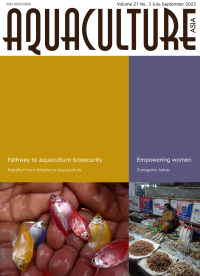
Aquaculture Asia Magazine, July-September 2023

In this issue:

  • Pathway to aquaculture biosecurity: Mitigating risks, managing progressively and engaging the value chain
  • Important considerations for feed and feeding management during Indian catfish culture
  • A transitional journey from fisheries to aquaculture in Moyna
  • Colour widow tetra: A new and highly preferred aquarium fish in West Bengal
  • Expanding the horizon of aquaculture through women's empowerment
  • NACA Newsletter

Important considerations for feed and feeding management during Indian catfish culture

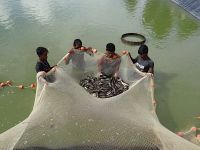
Natural feeds present in ponds contribute to some extent to the nutrition of fish cultured therein. But these natural food stocks become insufficient as production intensity rises. In semi-intensive and intensive systems, nutritional inputs must be partly or wholly supplemented using external feeds to support higher growth and productivity. Good quality feed is essential to achieve higher production. The selection of proper feedstuff and good formulation to meet the requirements of the cultured species will enhance acceptance and utilisation. This article discusses feed preparation, ration size, feeding rate, feed distribution and feeding schedules for culture of Indian catfishes.

Shrimp Summit, 24-26 July, Ho Chi Minh City, Vietnam

The 2023 Shrimp Summit will convene the global seafood value chain to address the critical challlenges of Asia’s shrimp-farming sector, from stagnant production to growers’ livelihoods, with a cross-topic focus on sustainability and climate change. The Summit is presented by The Center for Responsible Seafood (TCRS) and co-hosted by the Global Seafood Alliance. The format of the 2023 Shrimp Summit will allow the industry to develop a common understanding of issues, address key challenges through discussion and work toward consensus and actionable solutions. This in-person and virtual event will feature discussions, relevant content and informative webinars before, during and after the event in the TCRS Online Community. Access to the online community is included with event registration.

13th Asia-Pacific Marine Biotechnology Conference, 2-6 October 2023, Australia

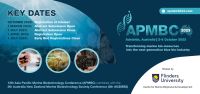
The 13th APMBC and 5th ANZMBS conference are combining to engage marine biotechnologists, industry, investors, and policy makers in current marine biotechnology research, and industry development in the Asia-Pacific region. The conference will be held from 2-6 October 2023 in Adelaide, Australia. This provides a great opportunity to participate in the growth and future development of the marine biotechnology industry in the region and globally. A key objective of the joint Conference is to encourage academic-industry partnerships across the region. Abstract submissions and early bird registrations are now open!

Information for farmers on yellow tail catfish, Pangasius pangasius, for easier captive production

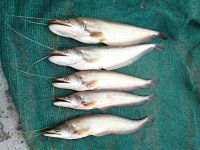
The yellow tail catfish Pangasius pangasius is found throughout the rivers of the Indian subcontinent. A large, omnivorous, and highly fecund species, it is suitable for aquaculture. Initial work on captive breeding of yellow tail catfish was carried out by scientists from the ICAR-Central Institute of Freshwater Aquaculture in the early 1990's. This article provides updated information on captive reproduction, larval rearing and nusery techniques for this species, which will be of use for farmers and entrepreneurs interested in producing it.

Free registration: 2022 China-ASEAN International Forum on "Sustainable Development of Fisheries and Aquaculture Under the Blue Transformation Strategy”

Ocean University of China and partners will convene the forum from 20 to 22 November 2022. The forum will cover the following: Topic 1: International talent cultivation and training;Topic 2: Science and technology innovation; Topic 3: Industrial synergy. The forum will host discussions about the implementation of the “Blue Transformation” strategy, further expansion of the space for fisheries and aquaculture, and ways of improving the production capacity of aquatic products, with the purpose of facilitating the achievement of the UN Sustainable Development Goals. Participation is free but registration is required. Registration closes on 22 October.

NACA Newsletter, Vol. XXXVII, October-December 2022

In this issue:

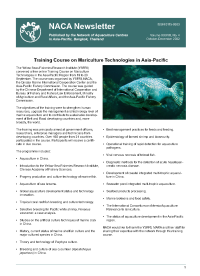
Training Course on Mariculture Technologies in Asia-Pacific; FAO/NACA Virtual Workshop on Aquaculture Transformation in Asia and the Pacific Region; Belt & Road Forum for International Freshwater Fishery Industry Innovation; 8th Global Conference on Gender in Aquaculture and Fisheries, 21-23 November; Reported Aquatic Animal Diseases in the Asia-Pacific Region during the First Quarter of 2022; International Training Course on Biology and Pathology of the Penaeid Shrimp 2022; Angkasa Putra inaugurated as first President of the South-East Asian Fisheries and Aquaculture Student Association; Artemia webinars: Video recordings of technical presentations available.

Register now: Free Training Course on Mariculture Technologies in Asia-Pacific

The Yellow Seas Fisheries Research Institute (YSFRI) will convene a free online Training Course on Mariculture Technologies in the Asia-Pacific Region from 19 to 23 September (please note the change of date). The course is organised by YSFRI, NACA, the Qindao Marine International Cooperation Center and the Asia-Pacific Fishery Commission. The training course will cover: Theory and technology for producing high-quality seed; New mariculture modes and technology; Nutrient regulation and feeding technology; Disease prevention and control technologies; Product processing and utilisation technologies. Applications close 5 September.

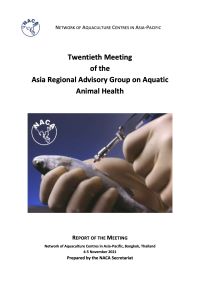
Twentieth Meeting of the Asia Regional Advisory Group on Aquatic Animal Health

This report summaries the proceedings of the 20th meeting of the Regional Advisory Group on Aquatic Animal Health, held 4-5 November 2021. The meeting discussed: Progress on NACA’s Asia Regional Aquatic Animal Health Program; updates from the OIE Aquatic Animal Health Standards Commission; aquaculture biosecurity; Progressive Management Pathway for Improving Aquaculture Biosecurity activities relevant to Asia; a systematic approach for quantifying biosecurity measures in aquaculture; aquatic animal health strategy; updates on the OIE Regional Collaboration Framework on Aquatic Animal Health; and updates on the QAAD Reporting and Disease List.

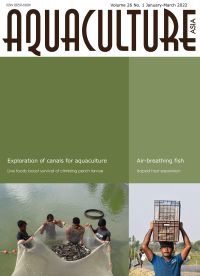
Aquaculture Asia Magazine, January-March 2022

In this issue:

Exploration of canal resources as a potential source for fish production in the Indian Sundarbans; Expansion of new host range of isopod Tachaea spongillicola infestation to fish species could pose a risk to aquaculture food industry in southeast Asian countries; Aspects of air-breathing fish farming practiced at Mathurapur-II Block, West Bengal, India; Magical role of live foods in boosting spawn survival of climbing perch: A success in the farmer’s field; NACA Newsletter.

Magical role of live foods in boosting spawn survival of climbing perch: A success in the farmer’s field

Climbing perch inhabit water bodies ranging from fresh to brackish waters across a wide range of environments, and are widely distributed throughout south and southeast Asia through to southern China. In India it is prized both as a foodfish and as a traditional medicinal food. This article describes the induced breeding of climbing perch and the interaction of scientists and farmers to improve survival of larvae and fry in through the use of live feeds (rotifer) in small-scale hatcheries in India.

NACA Newsletter, Vol. XXXVI, October-December 2021

In this issue:

Global Conference on Aquaculture Millennium +20;  Workshop on SDG-aligned Artemia aquaculture;  Professor Sena De Silva Memorial Oration, 8 October 2021; Apply now: Training Course on Mariculture Technology in Asia-Pacific; New project on “Blue transformation in aquaculture”; Webinar on Status of Artemia cyst use in fish and crustacean hatcheries.

Apply now: Training Course on Mariculture Technology in Asia-Pacific

A free training course on mariculture technologies will be offered online via Zoom from 18 October to 5 November, by the Yellow Sea Fisheries Research Institute (YSFRI), People’s Republic of China. The course will cover genetics and breeding of mariculture species; large-scale propagation; disease control and prevention; nutrition research and feed development; technology for different farming models; equipment research, engineering and construction of farming facilities; quality and safety inspection technology for aquatic products. Space is limited, applications close 11 October.

Some facts on cannibalism in Wallago attu and its management during captive seed production

Wallago attu is a large catfish reaching 45 kg found in the Indian subcontinent, Thailand, Vietnam, Cambodia and Indonesia. Early attempts at captive production encountered high losses due to cannibalism during early life stages. This article discusses the causative factors governing cannibalism in this catfish, including rapid transfer from live to commercial feed, size differences during stocking, seasonal changes, feeding at long intervals, high density rearing, feed distribution, feeding method and size of feed, and management strategies for minimising losses during the seed rearing period.

Imparting skill on formulated fish feed preparation to women’s self-help groups in villages – an experience

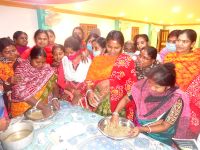
Preparation of locally made floating pelleted fish feed can be a profitable and sustainable income generating entrepreneurial activity for women's self-help groups in rural areas. Using such feed can also help small-scale marginal fish farmers to improve production and reduce their operating costs. This article describes initiatives to train women's self-help groups in formulated feed production in West Bengal, India.

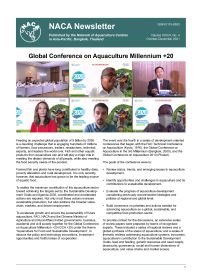
Global Conference on Aquaculture Millennium +20

The GCA +20 was successfully held as a hybrid event from 22-25 September, with physical participation at the venue in Shanghai, China, and international participation via video conference. A total of 1,728 people participated in the event, of which 500 were physically present in Shanghai. A key output from the GCA +20, the Shanghai Declaration is a call to action that highlights the principles and strategic pathways to maximise the contribution of sustainable aquaculture in achieving the Sustainable Development Goals, with a special focus on “Leaving no one behind”.

Join us for the SDG-aligned Artemia Aquaculture Workshop, 22 September

Join us online at the SDG-aligned Artemia Aquaculture Workshop, which will be held on 22 September, via Zoom. With the expansion of hatchery production, the demand for Artemia cysts has continued to increase and annual consumption is now estimated at 3,500 – 4,000 tonnes, underpinning the production of over 10 million tonnes of high-value aquaculture species. Approximately 90 percent of the current Artemia production is harvested from inland salt lakes. The purpose of the Artemia workshop is to explore needs and opportunities for a new international initiative to guarantee a more sustainable provision of Artemia, both from natural sources and from controlled extractive Artemia farming integrated with salt production and other fish/crustacean aquaculture. View programme | register

Videos from the webinar Status of the use of Artemia cysts in fish and crustacean hatcheries

Videos from our recent webinar Status of the use of Artemia cysts in fish and crustacean hatcheries around the world are now available on NACA's Youtube channel. Please consider subscribing for more technical aquaculture content!

Videos from the webinar on Culture-based fisheries for rural development

Video recordings of technical presentations from the webinar on Culture-based fisheries for rural development (31 May 2021) are now available on Youtube. Presentations cover technical constraints, the socio-economic and impact on communities, micro-nutrient security, monitoring and evaluation, improving water quality through stocking selected species, biodiversity considerations, and success stories.

Please visit NACA's Youtube channel to access the videos. Our Youtube channel is brand new, please consider subscribing for more technical aquaculture videos!