Nutrition and feeding

Information relating to nutrition and feeding in aquaculture.

Creative Commons Attribution.

Related

Subject tags

A collection of subject tags relating to technical matters.

In this collection

Aquaculture Asia Magazine, April-June 2025

In this issue:

  • From risk to resilience: Innovative crop insurance solutions for securing shrimp aquaculture in India
  • Efforts to rejuvenate primary fisher cooperative societies in South 24 Parganas District, West Bengal
  • Captive production of Gangetic mystus (Mystus cavasius): A guide for farmers
  • Shrimp farm biosecurity in Saudi Arabia: A journey from past practices to future vision
  • Wolffia globosa (duckweed) in aquafeeds for profitability and eco-friendly sustainable aquaculture
  • NACA Newsletter

Wolffia globosa (duckweed) in aquafeeds for profitability and ecofriendly sustainable aquaculture

The increasing demand for cost-effective and sustainable aquafeeds has prompted interest in alternative protein sources to replace fishmeal. Wolffia globosa (duckweed), is a fast-growing, rootless duckweed with high protein content and favorable nutrient composition, offers significant potential as a feed ingredient in aquaculture. Studies conducted at the College of Fisheries, Central Agricultural University in Tripura, India, demonstrated the feasibility of using Wolffia as a primary feed for rohu fry, yielding promising growth and health outcomes comparable to those achieved with conventional formulated feeds.

Beyond its nutritional value, Wolffia contributes to environmental sustainability through phytoremediation, improving water quality in aquaculture systems, and reducing the reliance on fishmeal and chemical fertilisers. Challenges remain, particularly due to anti-nutritional factors common in plant-based feeds, but these can be mitigated through thermal and enzymatic treatments. With proper processing, Wolffia globosa emerges as a viable, eco-friendly protein source for aquaculture, supporting both profitability and environmental stewardship.

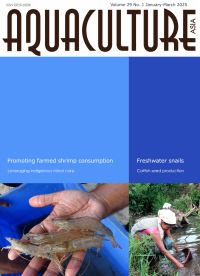
Aquaculture Asia Magazine, January-March 2025

In this issue:

  • Promoting farmed shrimp consumption in India’s domestic market: A step towards sustainability
  • Leveraging indigenous minor carp for sustainable aquaculture in Northeast India
  • Shaping the future of Indian aquaculture: A path to captive catfish seed success
  • Sustainable freshwater snail farming: Advancing nutrition security and rural livelihoods in Northeast India
  • Promotion and protection of small fish species through farming: An initiative in Tripura
  • NACA Newsletter

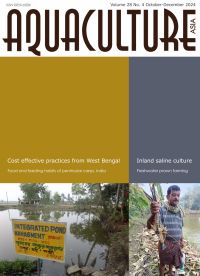
Aquaculture Asia Magazine, October-December 2024

In this issue:

  • Some practices and techniques in cost-effective small and medium-scale aquaculture in West Bengal
  • Food and feeding habits of some peninsular carps
  • Inland saline aquaculture: Prospects and challenges
  • A success story of freshwater prawn farming as an alternative livelihood for self-help and user groups in Mayurbanja District, Odisha, India
  • NACA Newsletter

Food and feeding habits of some peninsular carps

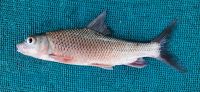
Carps are a vital component of global freshwater fish production, particularly in India, where both Indian major carps and indigenous species contribute to aquaculture. This study reviews the food and feeding habits of select peninsular carps, highlighting their potential for aquaculture diversification and biodiversity conservation. Indigenous species such as Hypselobarbus pulchellus, Barbodes carnaticus, Labeo fimbriatus, Labeo kontius, and Tor khudree demonstrate adaptability to natural productivity, reducing reliance on artificial feeds. Gut content analyses reveal dietary patterns ranging from herbivory to omnivory, with species consuming vascular plants, algae, molluscs, and insects. Feeding behavior varies across life stages, with juveniles relying on zooplankton and diatoms, while adults shift to macrophytes and benthic organisms. Integrating these species into polyculture systems could enhance aquaculture efficiency and support conservation efforts for threatened endemic fish.

Some practices and techniques in cost-effective small and medium-scale aquaculture in West Bengal

Small and medium-scale aquaculture in West Bengal has evolved to incorporate cost-effective, sustainable practices that reduce input costs while maintaining productivity. This article explores various low-cost aquaculture techniques used by rural fish farmers, emphasising farm-made feed formulations, pond fertilisation methods, and integrated farming systems. Farmers utilise non-conventional feed additives to enhance fish health and growth while reducing reliance on expensive commercial products. Fermented feed supplements and probiotic formulations have been successfully implemented to improve water quality and plankton production. Integrated fish farming, incorporating compost manure, vermicomposting, and polyculture with species like giant freshwater prawn, has increased productivity and economic returns.

Videos available: First International Artemia Aquaculture Consortium Conference and Members' Meeting

The first ever IAAC conference was a free half day event held in Ostend, Belgium on 9 September, as a prelude to Larvi 2024, which ran from 9-12 September. The conference featured twelve presentations introducing the IAAC and providing an overview of many of the issues surrounding Artemia, including management of salt lakes habitats that still provide the bulk of global Artemia supplies, Artemia biodiversity, hatching optimisation, and aquaculture of Artemia biomass in tanks and ponds. Video recordings of most will be posted shortly (the programme below will be updated with links). Video recordings of the presentations are now available on the NACA YouTube channel.

The first IAAC Members’ Meeting was held in the afternoon following the IAAC Conference. The proceedings involved two panel discussions, by the Academic Sector and Private Sector respectively. The panels included remote members participating via Zoom.

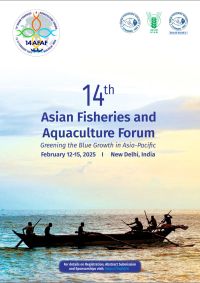
14th Asian fisheries and Aquaculture Forum: Early bird closes 10 November

The 14th Asian Fisheries and Aquaculture Forum (14AFAF) will be held from 12-15 February 2025 in New Delhi, India. Submission of abstracts has been extended until 5 November, and early bird registration closes on 10 November, so get in quick!

The forum is a scientific meeting organised by the Asian Fisheries Society (AFS) once every three years to understand the global trends and address issues and challenges faced by the fisheries and aquaculture sector. The main purpose of this Forum is to provide an international platform for eminent scientists, young researchers, and other stakeholders across the globe to share their research experiences and innovative ideas. By facilitating the exchange of diverse range of knowledge and expertise, the Forum with the Theme ‘Greening the Blue Growth in Asia-Pacific’ aims to address key issues towards developing sustainable fisheries and aquaculture.

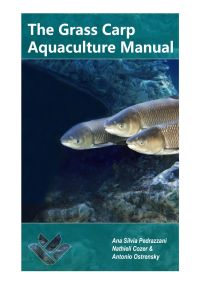
The Grass Carp Aquaculture Manual

This manual covers everything from grass carp's natural distribution and reproductive behaviours to its biology and anatomy. This manual also explores diseases that can affect grass carp and emphasises the crucial connection between animal welfare and stress in fish. With a detailed discussion on cultivation systems, this manual includes pond structures and fish farming techniques in both polyculture and monoculture. It provides practical insights into important aspects such as water quality monitoring, feeding, nutrition, health checks and behaviour assessments at every stage of grass carp farming – from broodstock management to pre-slaughter and slaughter processes. The emphasis is on responsible harvesting techniques, transportation considerations and humane slaughter methods. This manual offers a comprehensive guide for both novice and experienced fish farmers, and enthusiasts interested in cultivating grass carp sustainably and ensuring optimal animal welfare.

WAS Journal Special Issue: Global Conference on Aquaculture Millennium +20 Thematic Reviews

Eight thematic reviews prepared as preparation for the Global Conference on Aquaculture Millennium +20 (GCA +20) have been published in a Special Issue of the Journal of the World Aquaculture Society "Aquaculture for Food and Sustainable Development". A group of experts prepared advanced working drafts of each thematic review and the key findings from each theme were presented and discussed by expert panels during the GCA +20. Participants were then invited to provide their feedback and perspectives on the reviews and their key messages for consideration in finalisation of the papers. The reviews are available for free download.

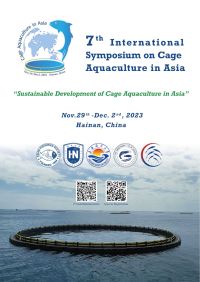
7th International Symposium on Cage Aquaculture in Asia (2nd announcement)

CAA7 will be held in Hainan, China, from 29 November to 2 December, with an option for online participation via Zoom for people that cannot attend in person. The theme of the symposium is "Sustainable development of cage aquaculture in Asia". Sessions will be held on: Production systems; breeding and seed production; nutrition and feed; carbon sink and fouling organisms; health and environmental management; economics, gender, livelihood and policy.

The symposium is organised by the Asian Fisheries Society, Hainan University, Shanghai Ocean University, and the China-ASEAN "Belt and Road" Joint Laboratory of Mariculture Technology, Center for Ecological Aquaculture.

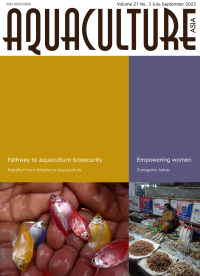
Aquaculture Asia Magazine, July-September 2023

In this issue:

  • Pathway to aquaculture biosecurity: Mitigating risks, managing progressively and engaging the value chain
  • Important considerations for feed and feeding management during Indian catfish culture
  • A transitional journey from fisheries to aquaculture in Moyna
  • Colour widow tetra: A new and highly preferred aquarium fish in West Bengal
  • Expanding the horizon of aquaculture through women's empowerment
  • NACA Newsletter

Important considerations for feed and feeding management during Indian catfish culture

Natural feeds present in ponds contribute to some extent to the nutrition of fish cultured therein. But these natural food stocks become insufficient as production intensity rises. In semi-intensive and intensive systems, nutritional inputs must be partly or wholly supplemented using external feeds to support higher growth and productivity. Good quality feed is essential to achieve higher production. The selection of proper feedstuff and good formulation to meet the requirements of the cultured species will enhance acceptance and utilisation. This article discusses feed preparation, ration size, feeding rate, feed distribution and feeding schedules for culture of Indian catfishes.

Shrimp Summit, 24-26 July, Ho Chi Minh City, Vietnam

The 2023 Shrimp Summit will convene the global seafood value chain to address the critical challlenges of Asia’s shrimp-farming sector, from stagnant production to growers’ livelihoods, with a cross-topic focus on sustainability and climate change. The Summit is presented by The Center for Responsible Seafood (TCRS) and co-hosted by the Global Seafood Alliance. The format of the 2023 Shrimp Summit will allow the industry to develop a common understanding of issues, address key challenges through discussion and work toward consensus and actionable solutions. This in-person and virtual event will feature discussions, relevant content and informative webinars before, during and after the event in the TCRS Online Community. Access to the online community is included with event registration.

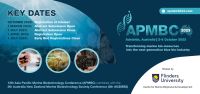
13th Asia-Pacific Marine Biotechnology Conference, 2-6 October 2023, Australia

The 13th APMBC and 5th ANZMBS conference are combining to engage marine biotechnologists, industry, investors, and policy makers in current marine biotechnology research, and industry development in the Asia-Pacific region. The conference will be held from 2-6 October 2023 in Adelaide, Australia. This provides a great opportunity to participate in the growth and future development of the marine biotechnology industry in the region and globally. A key objective of the joint Conference is to encourage academic-industry partnerships across the region. Abstract submissions and early bird registrations are now open!

Information for farmers on yellow tail catfish, Pangasius pangasius, for easier captive production

The yellow tail catfish Pangasius pangasius is found throughout the rivers of the Indian subcontinent. A large, omnivorous, and highly fecund species, it is suitable for aquaculture. Initial work on captive breeding of yellow tail catfish was carried out by scientists from the ICAR-Central Institute of Freshwater Aquaculture in the early 1990's. This article provides updated information on captive reproduction, larval rearing and nusery techniques for this species, which will be of use for farmers and entrepreneurs interested in producing it.

Free registration: 2022 China-ASEAN International Forum on "Sustainable Development of Fisheries and Aquaculture Under the Blue Transformation Strategy”

Ocean University of China and partners will convene the forum from 20 to 22 November 2022. The forum will cover the following: Topic 1: International talent cultivation and training;Topic 2: Science and technology innovation; Topic 3: Industrial synergy. The forum will host discussions about the implementation of the “Blue Transformation” strategy, further expansion of the space for fisheries and aquaculture, and ways of improving the production capacity of aquatic products, with the purpose of facilitating the achievement of the UN Sustainable Development Goals. Participation is free but registration is required. Registration closes on 22 October.

NACA Newsletter, Vol. XXXVII, October-December 2022

In this issue:

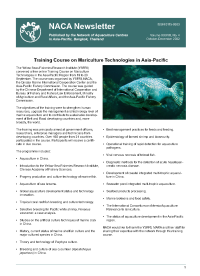
Training Course on Mariculture Technologies in Asia-Pacific; FAO/NACA Virtual Workshop on Aquaculture Transformation in Asia and the Pacific Region; Belt & Road Forum for International Freshwater Fishery Industry Innovation; 8th Global Conference on Gender in Aquaculture and Fisheries, 21-23 November; Reported Aquatic Animal Diseases in the Asia-Pacific Region during the First Quarter of 2022; International Training Course on Biology and Pathology of the Penaeid Shrimp 2022; Angkasa Putra inaugurated as first President of the South-East Asian Fisheries and Aquaculture Student Association; Artemia webinars: Video recordings of technical presentations available.

Register now: Free Training Course on Mariculture Technologies in Asia-Pacific

The Yellow Seas Fisheries Research Institute (YSFRI) will convene a free online Training Course on Mariculture Technologies in the Asia-Pacific Region from 19 to 23 September (please note the change of date). The course is organised by YSFRI, NACA, the Qindao Marine International Cooperation Center and the Asia-Pacific Fishery Commission. The training course will cover: Theory and technology for producing high-quality seed; New mariculture modes and technology; Nutrient regulation and feeding technology; Disease prevention and control technologies; Product processing and utilisation technologies. Applications close 5 September.

Twentieth Meeting of the Asia Regional Advisory Group on Aquatic Animal Health

This report summaries the proceedings of the 20th meeting of the Regional Advisory Group on Aquatic Animal Health, held 4-5 November 2021. The meeting discussed: Progress on NACA’s Asia Regional Aquatic Animal Health Program; updates from the OIE Aquatic Animal Health Standards Commission; aquaculture biosecurity; Progressive Management Pathway for Improving Aquaculture Biosecurity activities relevant to Asia; a systematic approach for quantifying biosecurity measures in aquaculture; aquatic animal health strategy; updates on the OIE Regional Collaboration Framework on Aquatic Animal Health; and updates on the QAAD Reporting and Disease List.