20 April 2006 | Gonzales, E., Maung Soe, K., Mukherjee, R., Nguyen, S.H., Suspita, A., Wattoo, J.M. and Bulcock, P. | 2760 Downloads | .pdf | 287.29 KB
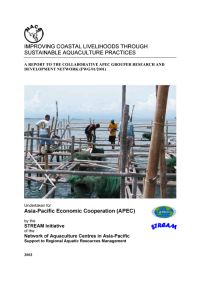
This report examines the role mariculture could play in reducing poverty and providing alternative livelihood opportunities for people living in coastal areas. This includes a review of the current status of coastal poverty, coastal livelihoods and vulnerabilities within the Asia-Pacific region and the experiences and examples of sustainable economic development through mariculture. This review then identifies key follow-up actions and recommends strategies for future pro-poor mariculture development.
The Asia Regional Advisory Group on Aquatic Animal Health meets annually to discuss regional health issues including emerging disease threats. This report includes a review of regional disease status circa 2005, global and regional disease reporting arrangements, global issues and standards, progress in implementation of the the Regional Technical Guidelines on Health management for the Responsible Movement of Live Aquatic Animals, identification and designation of regional aquatic animal health resources and regional and international cooperation.
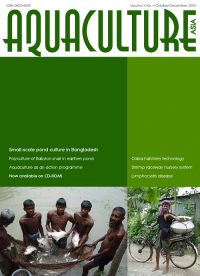
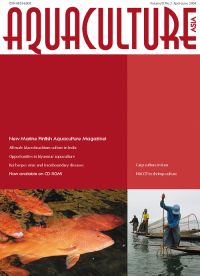
Small-scale pond culture in Bangladesh. Issues and challenges in community-based aquaculture. Aquaculture as an action programme building confidence and self-worth. Transforming policy recommendations into pro-poor service provision. Grow out of spotted Babylon to marketable size in polyculture with seabass. Influence of economic conditions and global shocks on grouper markets. Status of cobia hatchery technology in Vietnam. Organic shrimp raceway system. Macrobrachium rosenbergii in Vembanad Lake. Management of monogenean parasites.
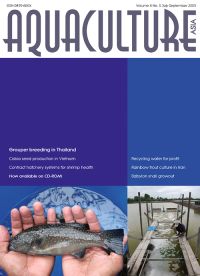
Asian Development Bank study on aquaculture and poverty. The consequences of converting to organic shrimp farming. Recycling water and making money with Artemia. Advances in the seed production of cobia Rachycentron canadum in Vietnam. Australian success with barramundi cod Cromileptes altivelis. Recent grouper breeding developments in Thailand. Application of probiotics in rotifer production systems. Contract hatchery systems. Rainbow trout culture in Iran. Spotted babylon Babylonia areolata growout in earthern ponds.
31 May 2005 | Melba G. Bondad-Reantaso, Sharon E. McGladdery, Iain East and Rohana Subasinghe (eds.) | 2236 Downloads | .pdf | 3.37 MB
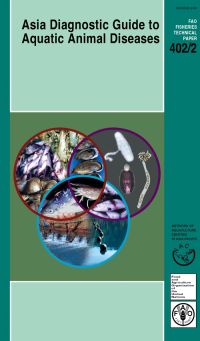
The Asia Diagnostic Guide to Aquatic Animal Diseases or ‘Asia Diagnostic Guide’ is a comprehensive diagnostic guide in support of the implementation of the Asia Regional Technical Guidelines on Health Management for the Responsible Movement of Live Aquatic Animals. It was developed from technical contributions of members of the Regional Working Group and Technical Support Services and other aquatic animal health scientists in the region and outside who supported the Asia-Pacific Regional Aquatic Animal Health Management Programme.
31 May 2005 | M.G. Bondad-Reantaso, S.E. McGladdery, I. East and R.P. Subasinghe (eds.) | 1261 Downloads | .pdf | 3.37 MB
The most comprehensive aquatic disease guide ever published in the region. It covers economically significant diseases of molluscs, fish and crustaceans. Contains information on laboratory and diagnostic techniques, causative agents and distribution, host range, clinical aspects, screening methods, diagnostic procedures, modes of transmission, control measures. Includes contact details for technical support services throughout the region and national health coordinators.
The Asia Regional Advisory Group on Aquatic Animal Health meets annually to discuss regional health issues including emerging disease threats. This report includes a review of regional disease status circa 2004, global and regional disease reporting arrangements, global issues and standards, progress in implementation of the the Regional Technical Guidelines on Health management for the Responsible Movement of Live Aquatic Animals, identification and designation of regional aquatic animal health resources and regional and international cooperation.
Freshwater prawn culture in China and its market prospects. Demise of wastewater-fed duckweed-based aquaculture in Bangladesh. Freshwater finfish biodiversity - an Asian perspective. Her farm is destroyed, how can we help? Women oyster vendors in Eastern Thailand. Farm-level feeds and feeding practices for marine finfish. ACIAR grouper grow-out feeds and CSIRO research. Feed development and application for juvenile grouper. Grouper growout feeds. Silver pomfret culture technology.
20 December 2004 | Shi Zhengli and Judith Handlinger | 1265 Downloads | .pdf | 149.91 KB
Recognising the importance of abalone viral mortality, in terms of its potential to spread and cause economic loss, "abalone viral mortality" was included for listing in the regional NACA/FAO/OIE quarterly aquatic animal disease (QAAD) reporting list under "unknown diseases of serious nature" effective first quarter of 2004. This disease card is developed to provide information to national authorities and support the regional QAAD reporting system.
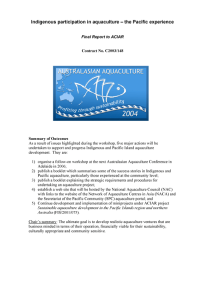
The workshop Indigenous Participation in Aquaculture – the Pacific Experience was held as a day-and-a-half session in the Australasian Aquaculture 2004, Sydney,27–28 September 2004. The workshop promoted exchange of information and experiences between researchers, government representatives and industry involved in aquaculture development in the Pacific. The workshop recognised the increasing interest in aquaculture as an industry that can provide benefits for indigenous communities in Australia as well as the Pacific Islands.
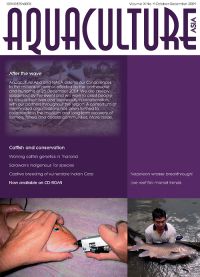
Captive breeding of vulnerable Indian carp Cirrhinus reba for conservation. Conservation of the Asiatic catfish Clarias batrachus through artificial propagation. A perspective on breeding and genetics of walking catfish in Thailand. Decline of wastewater-fed aquaculture in Hanoi. Artificial propagation of indigenous Tor species in Malaysia. Aquaculture of spotted babylon Babylonia areolata. First successful hatchery production of Napoleon wrasse Cheilinus undulatus. Trade and market trends in the live reef fish trade.
1 September 2004 | Katsuhiko T. Wada | 1496 Downloads | .pdf | 126.89 KB
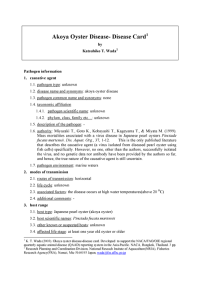
Akoya oyster disease is of concern to the region and was included in the Regional NACA/FAO/OIE quarterly aquatic animal disease (QAAD) reporting list, effective first quarter of 2003, to assist in the collection of occurrence data. This disease card will support the surveillance programs of countries in the Asia-Pacific region.
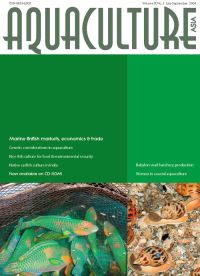
Genetic considerations in fisheries and aquaculture with regards to biodiversity. Rice-fish culture for food and environmental security. Land-based aquaculture of spotted babylon Babylonia areolata in Thailand: Hatchery-based seedling operation. Shrimp health question and answer. Women in coastal aquaculture. Insights into live marine food fish markets in Asia. Farming practices, market chains and prices of marine finfish in Malaysia, Indonesia and Hong Kong.
Genetic impacts of translocation on aquatic biodiversity in Asia. Carp culture in Iran. Opportunities and challenges in Myanmar aquaculture. Impacts of monosex Macrobrachium culture on seed availability in India. Use of new technology and skills for eco-friendly production of tiger shrimp Penaeus monodon. Larval rearing and spat production of the windowpane shell Placuna placenta. HACCP in shrimp farming. First breeding success of Napoleon wrasse Cheilinus undulatus and coral trout Plectropomus leopardus.
3 February 2004 | Haylor, G., Briggs, M.R.P., Pet-Soede, L., Tung, H., Yen, N.T.H., Adrien, B., O'Callaghan, B., Gow, C., De Vantier, L., Santos, R., Pador, E., de la Torre, M., Bulcock, P., and Savage, W. | 25492 views | .pdf | 2.25 MB
Wild-harvest fisheries for live reef fish are largely over-exploited or unsustainable. Sustainable aquaculture – such as that of groupers – is one option for meeting increasing demand for reef fish as well as potentially maintaining livelihoods of coastal communities. This report draws upon secondary literature, media sources and four diverse case studies from at-risk reef fisheries, to frame a strategy for encouraging sustainable aquaculture as an alternative to destructive fishing practices. It was commissioned by the APEC Secretariat.
3 February 2004 | Matthew Briggs | 6494 Downloads | .pdf | 582.74 KB
Sulawesi has the largest coral reef area in Indonesia, at the epicenter of worldwide marine biodiversity, but is one of the areas most threatened in Southeast Asia by destructive fishing practices. This case study reviews the potential for aquaculture to provide alternative livelihoods for fishers within the context of an integrated, community-based coastal management plan with involvement of local communities empowered to control and steward their resources so that they can conserve and utilise them sustainably.
3 February 2004 | IUCN Vietnam Program | 1643 Downloads | .pdf | 376.38 KB
This case study describes the present status and trends, and provides recommendations for the improvement of aquatic resources management within Hon Mun Marine Protected Area (MPA), Nha Trang Bay, Khanh Hoa Province, Vietnam. The case study also evaluates options for improving the livelihoods of local villagers through the development of ecologically sustainable aquaculture and fisheries, which include diversification following careful selection and trial of appropriate culture species, and application of “best practice” culture methods.
The Asia Regional Advisory Group on Aquatic Animal Health meets annually to discuss regional health issues including emerging disease threats. This report includes a review of regional disease status circa 2003, global and regional disease reporting arrangements, global issues and standards, progress in implementation of the the Regional Technical Guidelines on Health management for the Responsible Movement of Live Aquatic Animals, identification and designation of regional aquatic animal health resources and regional and international cooperation.
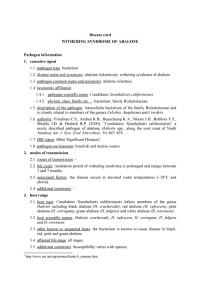
This disease card provides information on the causative agent, transmission, host range, distribution and diagnosis of abalone withering syndrome. The disease is caused by an intracellular bacterium Candidatus Xenohaliotis californiensis of the family Rickettsiaceae. Information on diagnosistic methods and references are provided.
The Manual of Procedures for the Implementation of the Asia Regional Technical Guidelines on Health Management for the Responsible Movement of Live Aquatic Animals provides background material and detailed technical procedures to assist countries and territories in the Asia Region in implementing the Asia Regional Technical Guidelines on Health Management for the Responsible Movement of Live Aquatic Animals. The Technical Guidelines were initiated due to increased recognition that disease emergence is often linked to live aquatic animal movements.