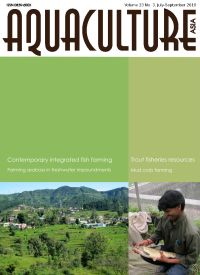
Farming of Asian seabass Lates calcarifer in freshwater impoundments in West Bengal, India; An integrated approach to contemporary fish farming practice incorporating traditional knowledge in mid hills in India: A success story; Mud crab farming: An alternative livelihood in the Indian Sundarban; Trout fisheries resources and potentialities in the Menchukha region of Arunachal Pradesh; NACA Newsletter.
25 June 2019 | Christina Lalramchhani, C.P. Balasubramanian, P.S. Shyne Anand, T.K. Ghoshal, Prem Kumar and K.K. Vijayan | 6840 Downloads | .pdf | 7.18 MB
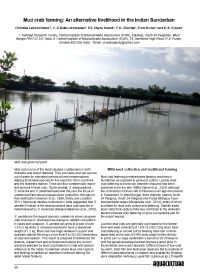
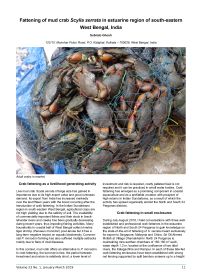
Mud crab is one of the most valuable crustaeceans in both domestic and export markets. They are hardy and can survive out of water for extended periods at lower temperatures, making them idea for live export. Mud crab fattening predominates farming practices in Sundarban as opposed to grow-out culture. This report describes current practces adopted by mud crab farmers in India with special reference to the Indian Sundarban, where mud crab capture and farming are an important livelihood for small holder farmers.
This report summarises the proceedings of the 17th meeting of the Advisory Group, held 13-14 November 2018 in Bangkok, Thailand. The group's role includes reviewing disease trends and emerging threats in the region, identifying developments in global aquatic disease issues and standards, evaluating the Quarterly Aquatic Animal Disease Reporting Programme and providing guidance on regional strategies to improve aquatic animal health management.
The 79th edition of the Quarterly Aquatic Animal Disease report contains information from eleven governments. The foreword discusses the outcomes of the 17th Meeting of the Asia Regional Advisory Group on Aquatic Animal Health, held in Bangkok, 13-14 November 2018.
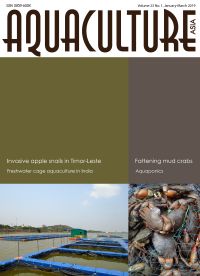
Current status of freshwater cage aquaculture in India; Fattening of mud crab Scylla serrata in estuarine region of south-eastern West Bengal; Aquaponics - sustainable farming method in the fight against hunger; aquatic invasive apple snails (Pomacea spp.) in Timore-Leste - current status, spread and management in rice fields; NACA Newsletter.
Live mud crab has a high export value and good overseas demand. Over the past fifteen years exports from India have increased, with the introduction of crab fattening practices. Wild-caught seed are held in pens constructed of bamboo screens for several weeks and fed to increase their body weight and hence value. Fattened crabs are onsold to traders exporters, who may air lift them to Singapore and other regional markets for the live restaurant trade.
The 78th edition of the Quarterly Aquatic Animal Disease Report contains information from twelve governments in the Asia-Pacific region. The foreword discusses three recent aquatic animal health consultations: The ASEAN Regional Technical Consultation on Aquatic Emergency Preparedness and Response Systems for Effective Management of Transboundary Disease Outbreaks in Southeast Asia; the Regional Consultation and Related Study on Antimicrobial Resistance Risk to Aquaculture in Asia; and the Preliminary Consultation on Monitoring of Antimicrobial Resistance in Bacterial Pathogens in Aquaculture.
The 77th edition of the Quarterly Aquatic Animal Disease Report contains information from nine governments. The foreword discusses an intensive seven-day training course on tilapia lake virus (TiLV) that was jointly organised by China's National Fisheries Extension Center, Sun Yat-Sen University and the Food and Agriculture Organization of the United Nations.
22 March 2018 | Network of Aquaculture Centres in Asia-Pacific | 3290 Downloads | .pdf | 3.45 MB
This report summarises the proceedings of the 16th meeting of the Advisory Group, held 26-27 August 2017 in Bali, Indonesia. The group's role includes reviewing disease trends and emerging threats in the region, identifying developments in global aquatic disease issues and standards, evaluating the Quarterly Aquatic Animal Disease Reporting Programme and providing guidance on regional strategies to improve aquatic animal health management. The meeting included discussion on Tilapia Lake Virus (TiLV) and developments in antimicrobial resistance.
The Asia Regional Advisory Group on Aquatic Animal Health meets annually to discuss regional health issues including emerging disease threats. This report includes a review of regional disease status circa 2016, global and regional disease reporting arrangements, global issues and standards, progress in implementation of the the Regional Technical Guidelines on Health management for the Responsible Movement of Live Aquatic Animals, identification and designation of regional aquatic animal health resources and regional and international cooperation.
The 15th meeting was held from 21-23 November 2016, in Bangkok, Thailand. A special session was held on addressing the use of anti-microbial substances in aquaculture and the development of anti-microbial resistance. This is an issue of global concern for both human and animal health, and it had been addressed by a resolution at FAO’s Thirty-ninth Conference in June 2015. The meeting reviewed in detail the status of aquatic animal disease in the region.
Anti-microbials and alternatives. Successful demonstration of new model for rural development in Myanmar. Optimisation of Nile tilapia (Oreochromis niloticus) production in ponds based on improved farm management practices in Rwanda. EUS infection in freshwater fishes of Andhra Pradesh. Development of pond-reared broodstock / spawners of green mud crab Scylla serrata. ASEAN Gender Network launched. A two-tube nested PCR detection method for AHPND bacteria. 9th Regional Grouper Hatchery Production Training Course.
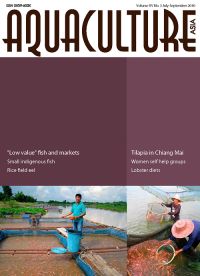
Shrimp farming in Andhra Pradesh, India. Small indigenous freshwater fish species in village community ponds to ensure nutritional security of rural poor. Postlarvae culture and technical status of whiteleg shrimp Penaeus vannamei hatcheries, Vietnam. Jatropha meal as a promising plant protein source for aquaculture feeds. Use of soybean meal in cobia diets. Capture based aquaculture of spiny lobster Panulirus polyphagus in open sea cages. Institutional linkage helping rural women gain employment.
International requirements on food safety, traceability, animal health and welfare and social responsibility are increasingly stringent. The burden of compliance and the cost of certification are particularly heavy for small scale farmers who are often excluded by the limited resources at their disposal. Working in groups can help small scale farmers attain economies of scale necessary to address compliance issues and participate in certification schemes, improving their competitive position.
Relative efficacies of lobsters Panulirus ornatus and P. homarus cultured using pellet feeds and trash fish, Vietnam. Tilapia in Chiang Mai, Thailand. Marketing low-value cultured fish in Bangladesh: An evaluation of value chain. Current practices of rice field eel Monopterus albus culture in Vietnam. Self-help group makes fisherwomen self-relian: A story of success. Small indigenous freshwater fish species of India: Significance, conservation and utilisation.
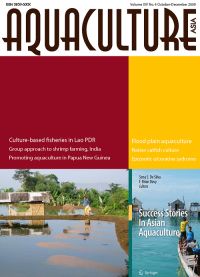
Mussel farming initiatives in North Kerala, India. Selective study on availability of indigenous fish with ornamental value in West Bengal. Aquaculture livelihoods centre in Aceh, Indonesia. e-Sagu Aqua - an innovative information and communication technology model for transfer of technology for aquaculture. Freshwater pearl crop: An emerging enterprise in the Indian subcontinent. Preliminary risk assessment of Pacific white shrimp (P. vannamei) introduced to Thailand for aquaculture. Black gill disease of lobster and more.
The Asia Regional Advisory Group on Aquatic Animal Health meets annually to discuss regional health issues including emerging disease threats. This report includes a review of regional disease status circa 2008, global and regional disease reporting arrangements, global issues and standards, progress in implementation of the the Regional Technical Guidelines on Health management for the Responsible Movement of Live Aquatic Animals, identification and designation of regional aquatic animal health resources and regional and international cooperation.
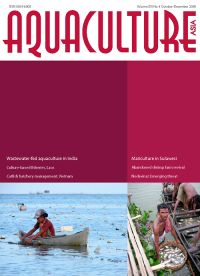
An increasingly secure future for wastewater-fed aquaculture in Kolkata, India? First culture-based fisheries growth cycle in Lao PDR is overhwelmingly encouraging. Revival of abandoned shrimp farms in Andhra Pradesh. Growth of industries linked with aquaculture in Kolleru Lake area, India. Applications of nutritional biotechnology in aquaculture. Technical and management aspects of catfish hatcheries in Vietnam. Asian seabass farming. Mariculture development opportunities in southeast Sulawesi, and much more.
Fish and fish products are crucial in the nutrition and livelihoods of the Myanmar people. However, little information is available on their patterns of consumption, inter-regional differences, availability and types of fish consumed. This report is the outcome of two concurrent missions, one to coastal areas and one to inland areas. The report includes the findings of the missions as well as conclusions and recommendations in support of the long-term sustainability of fishery resources in Myanmar.