Education and Training

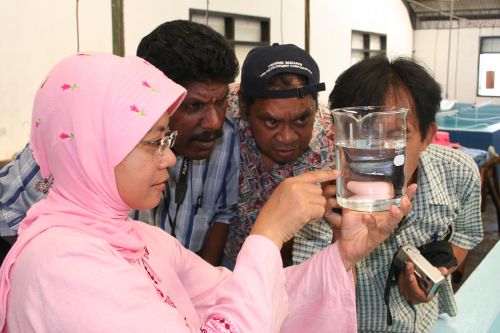
The Education and Training Programme assists capacity building among NACA members through the exchange and sharing of knowledge and skills between members. Activities may take the form of training courses, study visits and personnel exchange. The programme also supports the training components of the other thematic programmes and serves as an outreach arm of NACA. Regular training activities include three to four courses each year on various topics of regional priority in aquaculture development, such as:

  • Broodstock management in aquaculture.
  • Aquaculture business management.
  • Marine finfish seed production.
  • Aquaculture governance and planning.
  • Management for sustainable aquaculture development.

Key activities

Key activities of the programme include:

  • Identifying training needs for aquaculture development in NACA members.
  • Identifying and organising relevant expertise and capacities to meet the training needs.
  • Developing training modules and materials.
  • Facilitating routine education and training activities of NACA.
  • Facilitating and coordinating exchange programmes among members and with other regions.

Creative Commons Attribution.
Related

Subject tags

A collection of subject tags relating to technical matters.

In this collection

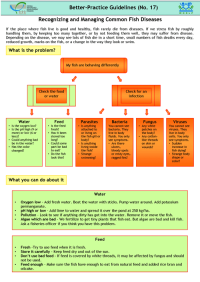
Better practice guidelines: Recognising and managing common fish diseases

If the place where fish live is good and healthy, fish rarely die from diseases. If we stress fish by roughly handling them, by keeping too many together, or by not feeding them well, they may suffer from disease. Depending on the disease, we may see lots of fish die in a short time, small numbers of fish deaths every day, reduced growth, marks on the fish, or a change in the way they look or swim.

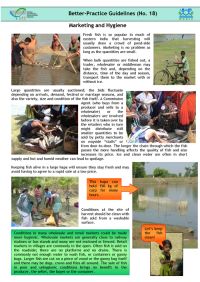
Better practice guidelines: Marketing and hygiene

Fresh fish is so popular in much of eastern India that harvesting will usually draw a crowd of pond side customers. Marketing is no problem so long as the quantities are small. When bulk quantities are fished out a trader, wholesaler or a middleman may take the fish and depending on the distance, time of the day and season, transport them to the market with or without ice.

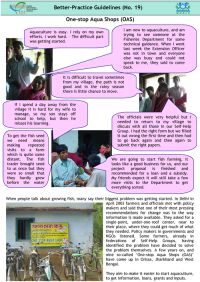
Better practice guidelines: One-stop aqua shops

When people talk about growing fish, many say their biggest problem was getting started. In Delhi in April 2003 farmers and officials met with policy makers and said that one of their most pressing recommendations for change was to the way information is made available. They asked for a single-point, under-one-roof center, near to their place, where they could get much of what they needed.

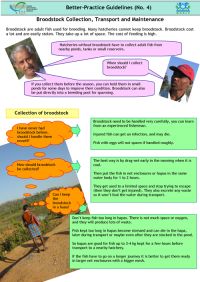
Better practice guidelines: Broodstock collection, transport and maintenance

These guidelines illustrate good practice for broodstock handling and management using practices that are suitable for small-scale operations. This document is also available in Oriya.

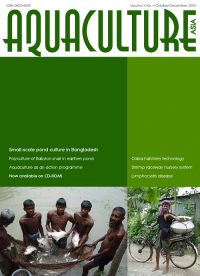
Aquaculture Asia Magazine, October-December 2005

In this issue:

Small-scale pond culture in Bangladesh. Issues and challenges in community-based aquaculture. Aquaculture as an action programme building confidence and self-worth. Transforming policy recommendations into pro-poor service provision. Grow out of spotted Babylon to marketable size in polyculture with seabass. Influence of economic conditions and global shocks on grouper markets. Status of cobia hatchery technology in Vietnam. Organic shrimp raceway system. Macrobrachium rosenbergii in Vembanad Lake. Management of monogenean parasites.

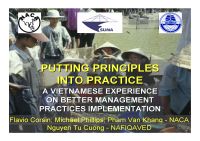
Putting principles into practice: A Vietnamese experience on better management practices implementation

This presentation provides an overview of Vietnamese experience on the implementation of better management Practices (BMPs) and good aquaculture practices (GAP) in shrimp aquaculture. Practices were implemented collectively by encouraging small-scale farmers to form groups that collaborate on issues such as screening seed for disease and improving water quality management. Improvements to crop outcomes were observed. The results presented include the profitability of BMP adopted ponds.

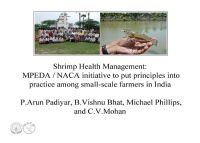
Shrimp health management: MPEDA/NACA initiative to put principles into practice among small-scale farmers in India

Presentation on a MPEDIA/NACA intiative to implement better management practices for shrimp farming amongst small-scale farmers in India via formation of farmer groups. The practices are based on the International Principles for Responsible Shrimp Farming. Adoption of improved farming practices reduces the incidence of disease and improves crop outcomes for small-scale farmers. This presentation was made at the World Aquaculture Society Conference in Bali, Indonesia, 2005.

Sổ tay thực hành: Kỹ thuật Nuôi tôm - rừng kết hợp: Tài liệu dành cho cán bộ khuyến ngư

Sổ tay nẩy với mục đích giúp đỡ cho cán bộ khuyến ngư hướng dẫn người nông dân kỹ thuật nuôi tôm nhằm mục đích đạt được sản lương và thu nhập ngày càng cao trong hệ thống nuôi kết hơp tôm - rừng ở Đồng bằng Sông Cửu Long. Với những kỹ thuật đơn giản, thông thường giúp cho ngư dân từng bước gia tăng sản lương mà ít bị rủi ro.

Mixed shrimp-mangrove farming practices: A manual for extension workers

This manual has been prepared to assist extension officers to advise farmers on techniques for improving yields and farm income in mixed shrimp farming-mangrove forestry farming systems in the Mekong Delta. It focuses mainly on simple, common sense techniques that will allow farmers to make step-by-step improvements to production without taking unnecessary risks. The manual is based on a 6-year collaborative research and development project between the Governments of Vietnam and Australia.

Mixed shrimp-mangrove farming practices: A manual for farmers

This manual has been prepared to assist farmers with techniques for improving yields and farm income in mixed shrimp farming-mangrove forestry farming systems in the Mekong Delta, Vietnam. It focuses mainly on simple, common sense techniques that will allow farmers to make step-by-step improvements to production without taking unnecessary risks. The techniques and recommendations covered in this manual are based on the experience of a 6-year collaborative research and development project between Vietnam and Australia.

Better practice guidelines: Livelihoods approaches - capacity building and analysis

This guide outlines a process for building capacity in participatory livelihoods approaches and carrying out livelihoods analysis. The process is about a way of working that enables development practitioners to better understand how people live and to learn how others understand their own livelihoods. This particular process emerged from experiences of working with government agencies and non-governmental organisations who themselves work with agricultural communities whose members have limited resources, in other words, poor rural fishers and farmers.

Report of the Grouper Hatchery Production Training Course 2005

This is the report of the 3rd Regional Grouper Hatchery Production Training Course, which was conducted at the Brackishwater Aquaculture Development Center, Situbondo, East Java, Indonesia from April 18-May 8, 2005. There were a total of 17 participants coming from Australia, Brunei Darussalam, Indonesia, Malaysia, Maldives, Marshall Islands, Singapore, and Vietnam. The training consisted of a  mixture of theory, practical and field trips for the participants.

NACA Newsletter Volume XX, No. 1, January-March 2005

In this issue:

Tsunami: The long road to recovery. Special Program in Response to the Tsunami. Rebuilding cage aquaculture and eco-tourism at Koh Yao Noi, Thailand. Cash for work, Aceh Indonesia. Assessment of tsunami impacts in Thailand and Indonesia. Consortium to Restore Shattered Livelihoods in Tsunami-devastated Nations. Regional Workshop on Rehabilitation of Fisheries and Aquaculture in Coastal Communities of tsunami affected countries in Asia. Outcomes of Governing Council 16. New grouper feed and marine finfish hatchery guides. Towards a framework for a pro-poor regional strategy for sustainable aquatic resources management in Asia-Pacific. Artificial propagation of indigenous fish species in Sarawak, Malaysia. Inauguration of the National Advisory Committee on Aquatic Animal Health of Viet Nam. Supporting Viet Nam to make an informed decision towards Penaeus vannamei farming. Health group calls for improved surveillance and reporting. Training and study tours in Q1 2005-05-25. TVR 'Ramu' Pillay (1921-2005).

Aquaculture Development Beyond 2000: The Bangkok Declaration and Strategy

The main output of the International Conference on Aquaculture in the Third Millennium. The Declaration summarises the key impediments and opportunities in aquaculture development that are likely to arise over the next 20 years and provides strategic policy guidance for sustainable aquaculture development. The Declaration was adopted by conference participants in a plenary session.

NACA Newsletter Volume XIX, No. 4, October-December 2004

In this issue:

Kasetsart University and NACA sign MOU on genetics. Village shrimp health management project in Andhra Pradesh. A committee to manage fish health in Viet Nam. China to promote healthy shrimp farming. Father of China's shrimp aquaculture. NACA collaboration can extend to west and central Asia, Iran mission suggests. STREAM conducts monitoring & evaluation workshop. STREAM to support aquaculture in western Orissa.

eNACA: A digital knowledge-sharing strategy for aquaculture

This paper provides a strategic overview of the development and implementation of a very low cost ICT-based communications network. We address issues relevant to the development of an online community in terms of strategy, services and infrastructure. Our objective is to develop an online community where participants can discuss issues and share information directly. It is based on internet communications and multimedia publishing technologies. At time of writing eNACA is distributing 12,000 free publications per month via download.

Management options for the shrimp fry fishery: A regional stakeholder workshop in Coxes Bazar

In February 2002 the shrimp fry collection ban was placed into abeyance pending further review of how biodiversity could be conserved at the same time as protecting the livelihoods of 400,000 fry collectors. A Shrimp Action Plan for the period April - September 2002 was drawn up to identify trends impacting on distribution and growth in the shrimp sector, and to explore alternative models for the management of fry resource and to assess their social, institutional and economic implications.

Proceedings of the Learning Workshop on Livelihoods Analysis, 19-20 November 2002, Long An, Vietnam

This Learning Workshop on Livelihoods Analysis was held in Long An Province, Vietnam from 19-20 November 2002. It was part of an ongoing series of activities that will inform the implementation of the Ministry of Fisheries Strategy on Sustainable Aquaculture for Poverty Alleviation under the Vietnamese Government’s Hunger Eradication and Poverty Reduction (HEPR) Program. The recruitment in October of Nguyen Song Ha, STREAM Vietnam Communications Hub Manager, improved preparations within the Vietnamese national context.

Report of the Expert Consultation on Aquaculture Education in the Asia-Pacific, Hanoi, Vietnam, 11-15 May 2000

The Expert Consultation on Aquaculture Education in the Asia-Pacific was held in, Vietnam, 2000. The consultation was the final activity of APEC project FWG/02/99 “Collaborative Aquaculture Education Program”. This report gives the findings and papers presented to the Expert Consultation, including the follow-up recommendations for establishing an Aquaculture Educational Consortium, in the form of a network, comprising academic and training institutions in the Asia and Oceania regions.

Aquaculture Asia Magazine, July-September 2003

In this issue:

Ornamental fish farming in India. Tilapia for Indian aquaculture? Peri-urban food production in southeast Asia. Socio-economic consequences of shrimp farming in Andhra Pradesh. Breeding techniques for golden arowana Scleropages formosus. Captive breeding of peacock eel Macrognathus aculeatus. Substrate-based aquaculture systems. Extension in shrimp health management - experiences from India. Treatment of disease in freshwater shrimps and crabs in China. Larval rearing techniques for humpback grouper Cromileptes altivelis.