NACA member governments are: Australia, Bangladesh, Cambodia, China, Hong Kong SAR, India, Indonesia, I.R. Iran, Kingdom of Saudi Arabia, Korea (DPR), Lao PDR, Malaysia, Maldives, Myanmar, Nepal, Pakistan, Philippines, Sri Lanka, Thailand and Vietnam.
26 May 2008 | Sena S. De Silva, Upali S. Amarasinghe and Thuy T. T. Nguyen (eds.) | 2403 Downloads | .pdf | 2.73 MB
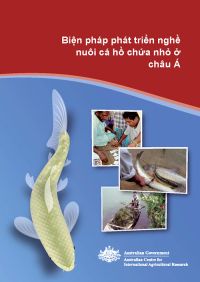
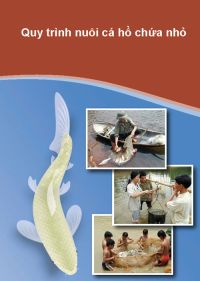
Chúng tôi xin trân trọng được giới thiệu với bạn đọc cuốn sách Biện pháp phát triển nghề nuôi cá hồ chứa nhỏ ở châu Á. Mục tiêu của cuốn sách không nhằm hướng dẫn thực hành như tài liệu khuyến ngư, mà thực sự là công trình tổng kết kinh nghiệm từ kết quả thực tế của nhiều địa phương, kết quả nghiên cứu khoa học, và những cơ sở lý thuyết liên quan đến lĩnh vực này.
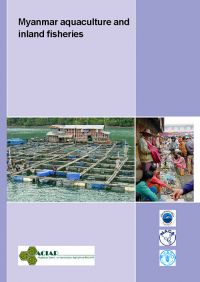
Fish and fish products are crucial in the nutrition and livelihoods of the Myanmar people. However, little information is available on their patterns of consumption, inter-regional differences, availability and types of fish consumed. This report is the outcome of two concurrent missions, one to coastal areas and one to inland areas. The report includes the findings of the missions as well as conclusions and recommendations in support of the long-term sustainability of fishery resources in Myanmar.
31 March 2008 | Sena S. De Silva, Upali S. Amarasinghe and Thuy T. T. Nguyen (eds.) | 1494 Downloads | .pdf | 2.04 MB
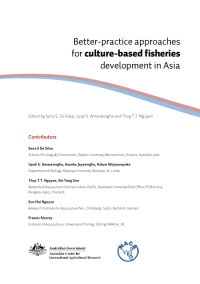
The primary objective of this manual is to provide guidelines for attaining better practices in culture-based fisheries, an emerging practice in rural areas in the Asian region. It deals will the principles of culture-based fishery practices, primarily based on relatively long-term experiences in Sri Lanka and Vietnam. It is not only targeted at researchers per se, but also at stakeholders at the grass root levels, as well as planners and policy developers.
This report, the 39th in the series, contains information about the aquatic animal health status of fifteen states in the Asia-Pacific region. The foreword discusses the 7th Symposium on Diseases in Asian Aquaculture.
This report, the 38th in the series, contains information about the aquatic animal health status of seventeen states in the Asia-Pacific region. The foreword discusses the OIE/NACA Regional Workshop on Aquatic Animal Health.
19 September 2007 | Sih Yang Sim | 2798 Downloads | .pdf | 2.19 MB
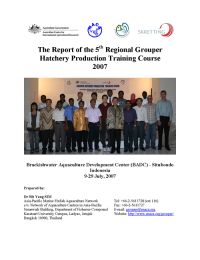
The 5th Regional Grouper Hatchery Training Course was another success with all participants is pleased with the overall training activities and field trips. A total of 17 participants from eight countries attended the training course which was hosted by the Brackishwater Aquaculture Development Centre, Situbondo, Indonesia. Participants were able to involve in the broodstock activities for giant grouper, in additional to the tiger and humpback groupers, and attended field trips to backyard hatcheries and export facilities.
This is the report of the project Application of PCR for improved shrimp health management in the Asian region. The training programme included two training workshops that were designed to provide a good understanding of PCR methodology, laboratory practices and trouble shooting in detection of both DNA and RNA viruses. The workshops were followed by by two rounds of an anonymous PCR inter-calibration or ring testing exercise to allow laboratories to gauge their own performance.
This report, the 37th in the series, contains information about the aquatic animal health status of fourteen states in the Asia-Pacific region. The foreword discusses emerging diseases in the region.
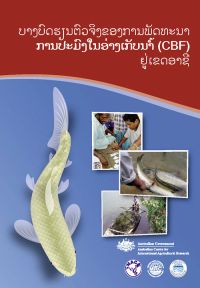
Mục tiêu của cuốn sách nhằm cung cấp những chỉ dẫn cơ bản của CBF, một hình thức nuôi cá hiệu quả, đang được quan tâm nhiều ở các vùng nông thôn miền núi châu.
This report, the 36th in the series, contains information about the aquatic animal health status of fifteen states in the Asia-Pacific region. The foreword discusses recent activities in support of aquatic animal health in the region.
30 January 2007 | Sih Yang Sim | 1855 Downloads | .pdf | 3.52 MB
This report describes a training course on grouper hatchery protocols that was held in Indonesia in 2006. A total of 20 participants from 13 countries attended the training course which was hosted by the Brackishwater Aquaculture Development Centre, Situbondo. Participants came from Australia, Hong Kong, Indonesia, India, Malaysia, Maldives, Myanmar, Philippines, Qatar, Saudi Arabia, Singapore, Thailand and Vietnam.
This report, the 35th in the series, contains information about the aquatic animal health status of fifteen states in the Asia-Pacific region. The foreword discusses mechanisms for recognition of emerging diseases in the Asia-Pacific region.
This report, the 34th in the series, contains information about the aquatic animal health status of fourteen states in the Asia-Pacific region. The foreword discusses efforts towards international harmonisation in aquatic animal health standards.
This report, the 33rd in the series, contains information about the aquatic animal health status of seventeen states in the Asia-Pacific region. The foreword discusses emerging diseases in the region.
This manual provides guidelines for attaining better practices in culture-based fisheries, an emerging practice in rural areas in the Asian region. It deals with the principles of culture-based fishery practices, primarily based on relatively long-term experiences in Sri Lanka and Vietnam. It deals with the gross factors that are applicable to improving fish yields and therefore revenue; and sustaining culture based fisheries as a development activity in the long-term.
This report, the 32nd in the series, contains information about the aquatic animal health status of fifteen states in the Asia-Pacific region. The foreword discusses regional cooperation for promotion of aquatic animal health management.
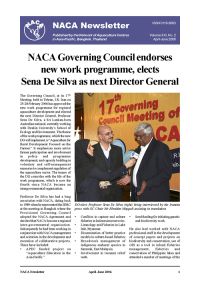
NACA Governing Council endorses new work programme, elects Sena De Silva as next Director General. RapiDot Kit - Farmer friendly kit for WSSV detection. Regional mariculture program strengthened. Economics and marketing analysis of the live reef fish food trade in the Asia-Pacific. Workshop on molecular techniques in aquaculture and seafood safety, Mangalore, India. Better-practice approaches for culture-based fisheries development in Asia. High-level Bahrain fisheries deletation visits Iran. First monthly meeting of fish farmers at One-stop Aqua Shop in Punjab Pakistan. Fish breeding training program for farmers of OAS, Kaipara. Provincial workshops on National Fisheries Policy and Strategy Framework held in Punjab and Sindh, Pakistan. Monitoring and evaluating the impacts of aquaculture on the agency and well-being of women. STREAM welcomes AYAD volunteer. Workshop to strengthen aquatic animal health capacity and biosecurity in ASEAN. Asian Federation for Information Technology in Agriculture (AFITA) 2006 in Bangalore. Aquaculture rehabilitation project launched by Indonesian Minister of Marine Affairs and Fisheries.
This is the proceedings of the workshop on Building capacity to combat impacts of aquatic invasive alien species and associated trans-boundary pathogens in ASEAN countries, held in Penang, Malaysia, on the 12th-16th July 2004. The workshop built on the recommendations from a 2002 workshop organised by the Global Invasive Species Program and a 2003 workshop of countries sharing the Mekong watershed, in promoting awareness, coordination mechanisms and information exchange systems and identifying management and risk mitigation measures.
This is the annual report (2003-2004) of the Reef Fish Aquaculture R&D Project, based at the Northern Fisheries Centre, Cairns. The project provides a core platform for a suite of R&D projects addressing the feasibility of aquaculture technologies for high-value marine finfish species. This report outlines progress on the three core components of the programme, namely broodstock management and spawning, live prey production, and larval rearing and grow-out.
This report, the 31st in the series, contains information about the aquatic animal health status of fourteen states in the Asia-Pacific region. The foreword discusses recent activities to strengthen aquatic animal health management in ASEAN.