NACA member governments are: Australia, Bangladesh, Cambodia, China, Hong Kong SAR, India, Indonesia, I.R. Iran, Kingdom of Saudi Arabia, Korea (DPR), Lao PDR, Malaysia, Maldives, Myanmar, Nepal, Pakistan, Philippines, Sri Lanka, Thailand and Vietnam.
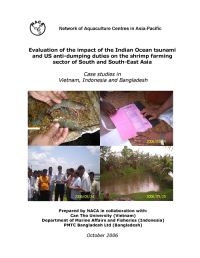
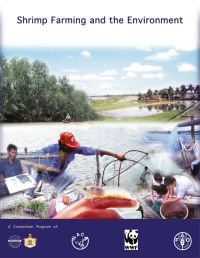
This report is the outcome of a study conducted by NACA to assess the impact of the 2004 Indian Ocean tsunami and of the introduction of US anti-dumping duties on the shrimp farming sectors of countries in the Asia-Pacific region, with special focus on the effect that these unusual events had on shrimp prices and stakeholders' livelihoods. The assessment was conducted by collecting data from a wide range of stakeholders involved with shrimp farming.
This report, the 34th in the series, contains information about the aquatic animal health status of fourteen states in the Asia-Pacific region. The foreword discusses efforts towards international harmonisation in aquatic animal health standards.
This report, the 33rd in the series, contains information about the aquatic animal health status of seventeen states in the Asia-Pacific region. The foreword discusses emerging diseases in the region.
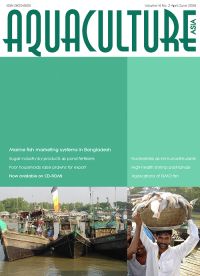
High-health postlarvae a prerequisite for sustainability of the Indian shrimp industry. Broodstock and all-female scampi grow out ponds in south India. Genetically modified fish and potential applications. Rainbow trout farming in hill terraces of Nepal. Sugar industry by-products as plankton boosters and yield enhancers in carp culture. Growth and production of Penaeus monodon in low saline culture systems. Poor households raise prawns for export. Marine fish marketing in Bangladesh.
This report, the 31st in the series, contains information about the aquatic animal health status of fourteen states in the Asia-Pacific region. The foreword discusses recent activities to strengthen aquatic animal health management in ASEAN.
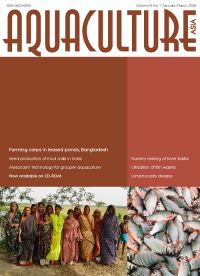
Nursery rearing of silver barb Puntius goniotus. Artemia enrichment and biomasss production for larviculture. Seed production of mud crab Scylla serrata in India. Macrobrachium on the southwest coast of India. Fish wastes in urban and suburban markets of Kolkata: Problems and solutions. Groups of poor women farming carps in leased ponds, Bangladesh. Lymphocystis disease and diagnostic methods in China. Mesocosm technology advances grouper aquaculture in northern Australia.
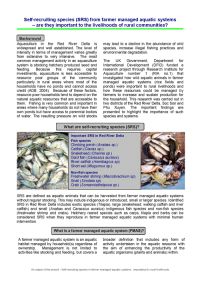
Self-recruiting species are defined as aquatic animals that can be harvested from farmer managed aquatic systems without regular stocking. This may include indigenous or introduced, small or larger species. Identified self-recruiting species in the Red River Delta includes exotic species (tilapia), large (snakehead, walking catfish and river catfish) and small (Anabas and Carassius auratus) indigenous fish species and non-fish species (freshwater shrimp and crabs).
This report, the 30th in the series, contains information about the aquatic animal health status of sixteen states in the Asia-Pacific region. The foreword discusses capacity building and harmonisation in aquatic animal health within ASEAN.
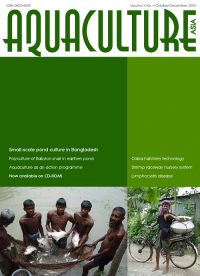
Small-scale pond culture in Bangladesh. Issues and challenges in community-based aquaculture. Aquaculture as an action programme building confidence and self-worth. Transforming policy recommendations into pro-poor service provision. Grow out of spotted Babylon to marketable size in polyculture with seabass. Influence of economic conditions and global shocks on grouper markets. Status of cobia hatchery technology in Vietnam. Organic shrimp raceway system. Macrobrachium rosenbergii in Vembanad Lake. Management of monogenean parasites.
This document is the technical proceedings of the Asia Regional Scoping Workshop on “Primary Aquatic Animal Health Care in Rural, Small-scale, Aquaculture Development,” held in Dhaka, Bangladesh from 27 - 30 September 1999. The objectives of the workshop were to review information on socio-economic impacts, risks of disease incursions and health management strategies in rural, small-scale aquaculture and enhanced fisheries programmes; and to identify potential interventions for their better health management and appropriate followup actions.
This case study is based on review of existing publications/reports and stakeholder consultations. It is divided into three main sections, namely: 1) Background review on shrimp aquaculture in Bangladesh. 2) Results from a case study of farm management practices, hatcheries and wild shrimp fry collection and 3) Results from a case study on the social aspects of shrimp aquaculture, based on detailed local level studies in the Khulna region.
This report, the 28th in the series, contains information about the aquatic animal health status of seventeen states in the Asia-Pacific region. The foreword discusses the need for improved surveillance and transparent reporting of aquatic animal disease.
In this issue: Young people taking bolder steps. Providing a venue for voices to be heard. Rehabilitation of a bundu pond - STREAM's initiative and DOF's action. Coastal resources utilisation and conservation issues in Cox's Bazar, Bangladesh. People, fish and reefs - a livelihoods learning curve. Understanding the marine ornamental trade and its impact on the livelihoods of poor stakeholders in the Philippines. About the STREAM Journal. About STREAM. This edition is also available in Ilonggo and Vietnamese.
Freshwater prawn culture in China and its market prospects. Demise of wastewater-fed duckweed-based aquaculture in Bangladesh. Freshwater finfish biodiversity - an Asian perspective. Her farm is destroyed, how can we help? Women oyster vendors in Eastern Thailand. Farm-level feeds and feeding practices for marine finfish. ACIAR grouper grow-out feeds and CSIRO research. Feed development and application for juvenile grouper. Grouper growout feeds. Silver pomfret culture technology.
Tsunami: The long road to recovery. Special Program in Response to the Tsunami. Rebuilding cage aquaculture and eco-tourism at Koh Yao Noi, Thailand. Cash for work, Aceh Indonesia. Assessment of tsunami impacts in Thailand and Indonesia. Consortium to Restore Shattered Livelihoods in Tsunami-devastated Nations. Regional Workshop on Rehabilitation of Fisheries and Aquaculture in Coastal Communities of tsunami affected countries in Asia. Outcomes of Governing Council 16. New grouper feed and marine finfish hatchery guides. Towards a framework for a pro-poor regional strategy for sustainable aquatic resources management in Asia-Pacific. Artificial propagation of indigenous fish species in Sarawak, Malaysia. Inauguration of the National Advisory Committee on Aquatic Animal Health of Viet Nam. Supporting Viet Nam to make an informed decision towards Penaeus vannamei farming. Health group calls for improved surveillance and reporting. Training and study tours in Q1 2005-05-25. TVR 'Ramu' Pillay (1921-2005).
This report, the 26th in the series, contains information about the aquatic animal health status of fifteen states in the Asia-Pacific region. The foreword discusses responsible movement of live aquatic animals in the context of health and quarantine issues.
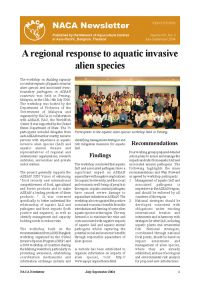
A regional response to aquatic invasive alien species. 6th Symposium on Diseases in Asian Aquaculture. Indonesia plan EC PREP seafood trade study. NACA Website: Guide to member services. Preparing and responding to health emergencies. New publication: Marine Finfish Aquaculture Magazine. STREAM Agreement with MOF Vietnam on Communications. STREAM Agreement with NAFEC Vietnam on Livelihoods Approaches. NACA-NACEE Cooperation. Training and study tours.
This report, the 24th in the series, contains information about the aquatic animal health status of seventeen states in the Asia-Pacific region. The foreword discusses capacity building to prevent, prepare for an respond to aquatic animal health emergencies.
In February 2002 the shrimp fry collection ban was placed into abeyance pending further review of how biodiversity could be conserved at the same time as protecting the livelihoods of 400,000 fry collectors. A Shrimp Action Plan for the period April - September 2002 was drawn up to identify trends impacting on distribution and growth in the shrimp sector, and to explore alternative models for the management of fry resource and to assess their social, institutional and economic implications.
This report, the 23rd in the series, contains information about the aquatic animal health status of twenty states in the Asia-Pacific region. The foreword discusses a project on Capacity and Awareness Building on Import Risk Analysis for Aquatic Animals, funded by the APEC Fisheries Working Group.