NACA member governments are: Australia, Bangladesh, Cambodia, China, Hong Kong SAR, India, Indonesia, I.R. Iran, Kingdom of Saudi Arabia, Korea (DPR), Lao PDR, Malaysia, Maldives, Myanmar, Nepal, Pakistan, Philippines, Sri Lanka, Thailand and Vietnam.
Asia has experienced rapid development of aquaculture in the past four decades. This has improved food security, livelihoods and economic development in many Asian countries. It has also become the main source of fish products in the region. Yet aquaculture as a new industry is poorly regulated in many countries. Its development has come with environmental problems, animal disease and food safety issues. These have resulted from both inadequate laws and poor enforcement.
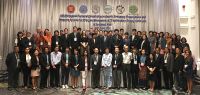
The ASEAN Regional Consultation on Aquatic Emergency Preparedness and Response Systems for Effective Management of Transboundary Disease Outbreaks in Southeast Asia was held in Bangkok, 20-22 August. The objective of the consultation was to bring together ASEAN member states and technical experts to discuss the current status of emergency animal disease preparedness and response systems, and to identify gaps and opportunities for regional cooperation in management of transboundary disease.
The EURASTiP Exchange Programme provides opportunities for industry, researchers and educators from Europe and south-east Asia to connect and gain new perspectives while sharing innvovative ideas to help develop long term partnerships. Bursaries of up to €3,000 per exchange are available (subject to eligibility criteria) to support international innovation and collaboration. The deadline for applications is 20 September 2018. For more information on how to apply please see the EURASTiP website.
This report summarises the proceedings of the 16th meeting of the Advisory Group, held 26-27 August 2017 in Bali, Indonesia. The group's role includes reviewing disease trends and emerging threats in the region, identifying developments in global aquatic disease issues and standards, evaluating the Quarterly Aquatic Animal Disease Reporting Programme and providing guidance on regional strategies to improve aquatic animal health management. The meeting included discussion on Tilapia Lake Virus (TiLV) and developments in antimicrobial resistance.
This collection contains video recordings of the lectures from the Regional Training Course on Culture-based Fisheries in Inland Waters, held at Nha Trang University, Vietnam. The objective of the course was to provide participants with the skills to assist local communities to plan and manage culture-based fisheries; a relatively simple and low cost technology that can deliver nutritional and economic benefits to rural communities with few livelihood options. The course was sponsored by the United Nations University Fisheries Training Programme.
The first ever Regional Training Course on Culture-based Fisheries in Inland Waters was held at Nha Trang University from 30 October to 8 November. The objective of the course was to provide participants with the skills to assist local communities to plan and manage culture-based fisheries. These practices are an example of a relatively simple and low cost technology that can deliver nutritional and economic benefits to rural communities, which often have few livelihood options.
IDRC and the National University of Singapore (NUS) are offering fellowships for Southeast Asian entrepreneurs, leaders in business, government, and civil society who want to better understand Southeast Asian value chains. The four-day program from 19-22 March 2018 will give participants a useful toolkit of ideas to take full advantage of a connected ASEAN Economic Community. Women leaders and participants from Cambodia, Indonesia, Laos, Malaysia, Myanmar, the Philippines, Thailand, Timor-Leste, and Vietnam are especially encouraged to apply.
A regional consultation on aquaculture feed production and use in Asia-Pacific was held from 7-9 March 2017. The consultation reviewed the current situation of aquaculture feed production and use, sourcing of ingredients, policy and research needs. This collection contains audio recordings of the technical presentations made by experts, international organisations, the private sector and governments in the region. The report of the consultation is in press and will be made available for download in due course.
Anti-microbial resistance in aquaculture; participatory market chain approaches to boost fish nurseries; traditional community fishing practices of rural Assam; practical significance of restricted feeding regimes in aquaculture; Bangana dero: A potential indigenous fish species for diversification of carp culture; shell colour variation in farmed Litopenaeus vannamei: Comparison of white- and brown-shelled shrimp; culture-based fisheries: A low-tech, greenhouse friendly approach to improving food and income for Cambodian families.
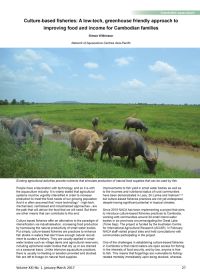
Improvements to fish yield in small water bodies as well as to the incomes and nutritional status of rural communities have been demonstrated. in Laos, Sri Lanka and Vietnam but culture-based fisheries practices are not yet widespread, despite having significant potential in tropical climates. A project to introduce culture-based fisheries to Cambodia is described. Participating communities reported improved catch per unit effort, an increase in the number of people engaged in fishing and lower food costs.
Cambodians are among the largest consumers of fish in the world with per capita consumption of 63 kg/person/year. At present 90% of production is from freshwater systems. Low value "trash" fish from both freshwater and marine resources are used as an important feed input to the sector. Both imported pellets and on-farm feeds are of mixed quality, storage protocols inadequate and feeding strategies often wasteful. There is much scope to improve the efficiency of feed use.
These are the proceedings of a consultation on the existence and effectiveness of environmental monitoring systems for fisheries and aquaculture in the Lower Mekong basin. The document provides a baseline assessment of environmental monitoring systems in Cambodia, Thailand and Vietnam and the report of a workshop to discuss the assessments findings and future steps towards an improved environmental monitoring and early warning system that will contribute to climate change adaptation in fisheries and aquaculture in the area.
The Asia Regional Advisory Group on Aquatic Animal Health meets annually to discuss regional health issues including emerging disease threats. This report includes a review of regional disease status circa 2015, global and regional disease reporting arrangements, global issues and standards, progress in implementation of the the Regional Technical Guidelines on Health management for the Responsible Movement of Live Aquatic Animals, identification and designation of regional aquatic animal health resources and regional and international cooperation.
This Code of Practice is prepared to promote or ensure compliance to World Trade Organisation-Sanitary and Phytosanitary measures for the movement of live aquatic organisms in the Lower Mekong Basin. The goals of the Code are to achieve environmental protection and management, biodiversity conservation as well as prevention of spread of disease epizootics. Most of the points listed in this Code are based on the inputs of MRC Member Countries.
A Regional Proficiency Testing Program for Aquatic Animal Disease Diagnostic Laboratories in Asia-Pacific was developed to strengthen diagnostic capability across Asia. This capability was identified as a requirement to facilitate the sanitary safety of trade in aquatic animal products. The program provided 41 laboratories across the Asia-Pacific with the opportunity to assess their diagnostic performance for 10 regionally significant aquatic animal pathogens, and to adapt or modify practices where necessary to improve.
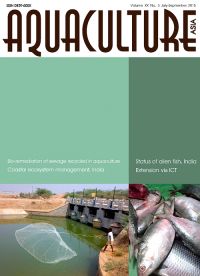
Changes to the magazine and website. Status of alien fish species farming and it's implications for Andhra Pradesh, India. Bridging the research-extension-farmer-input and market linkage gap in coastal aquaculture through application of ICT. Bio-remediation of domestic sewerage recycled in aquaculture: A Central Institute of Freshwater Aquaculture model. Role of family farming in marine and coastal ecosystem management in India. Conservation of fish genetic resources: An introduction to the state fishes of India.
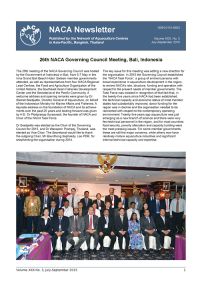
26th NACA Governing Council Meeting, Bali, Indonesia. Regional Workshop on the Status of Aquatic Genetic Resources. Developing an environmental monitoring system to strengthen fisheries and aquaculture in the Lower Mekong basin. Regional workshop documents sustainable intensification practices in aquaculture. Perspectives on culture-based fisheries developments in Asia. SUPERSEAS PhD opportunities.
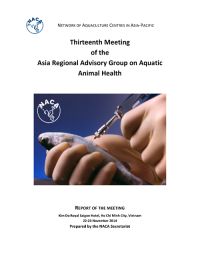
The Asia Regional Advisory Group on Aquatic Animal Health meets annually to discuss regional health issues including emerging disease threats. This report includes a review of regional disease status circa 2014, global and regional disease reporting arrangements, global issues and standards, progress in implementation of the the Regional Technical Guidelines on Health management for the Responsible Movement of Live Aquatic Animals, identification and designation of regional aquatic animal health resources and regional and international cooperation.
The application of culture-based fisheries in Cambodian waters commenced with a project in sixteen small reservoirs located in four provinces. Initial consultations with the village communities responsible for the water regime management were held and their agreement obtained for monitoring and cooperating through the trial period. One common feature in all the reservoirs selected is the provision of a “conservation zone”, generally in the deeper areas of the water body, where fishing is prohibited.