Cambodia

Cambodia's involvement in NACA.

Creative Commons Attribution.

Related

NACA member governments

NACA member governments are: Australia, Bangladesh, Cambodia, China, Hong Kong SAR, India, Indonesia, I.R. Iran, Kingdom of Saudi Arabia, Korea (DPR), Lao PDR, Malaysia, Maldives, Myanmar, Nepal, Pakistan, Philippines, Sri Lanka, Thailand and Vietnam.

In this collection

Quarterly Aquatic Animal Disease Report, April-June 2006

This report, the 32nd in the series, contains information about the aquatic animal health status of fifteen states in the Asia-Pacific region. The foreword discusses regional cooperation for promotion of aquatic animal health management.

Building capacity to combat impacts of aquatic invasive alien species and associated trans-boundary pathogens in ASEAN countries

This is the proceedings of the workshop on Building capacity to combat impacts of aquatic invasive alien species and associated trans-boundary pathogens in ASEAN countries, held in Penang, Malaysia, on the 12th-16th July 2004. The workshop built on the recommendations from a 2002 workshop organised by the Global Invasive Species Program and a 2003 workshop of countries sharing the Mekong watershed, in promoting awareness, coordination mechanisms and information exchange systems and identifying management and risk mitigation measures.


STREAM Journal Volume 5, No. 1, January-March 2006

In this issue: Policy development as a theme and policy briefs as a genre. Decriminalising Cambodian family-scale fishers through a livelihoods approach to law reform. Longer pond leases in Orissa. One-stop Aqua Shop - a "one-window delivery" service center for aqua-farmers and fishers. Fisheries and aquaculture policy formulation process in Pakistan. Improving the international marine ornamental fish trade to sustain and improve the livelihoods of poor people involved in the trade. About the STREAM Journal. About STREAM.

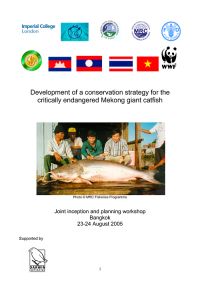
Development of a conservation strategy for the critically endangered Mekong giant catfish: Joint inception and planning workshop

This is the report of an inception workshop for the Mekong Giant Catfish Working Group. The Mekong giant catfish Pangasianodon gigas is listed as critically endangered in the 2003 IUCN Red List. The purpose of the workshop was to exchange information on the current state of the Mekong giant catfish and the relevant conservation and research activities of key organisations, and to establish a joint planning process aimed at developing an overarching conservation strategy for the Mekong giant catfish.

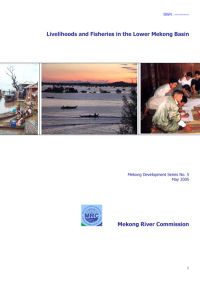
Livelihoods and fisheries in the lower Mekong basin

People who manage fisheries in the lower Mekong are beginning to think of themselves as a community within a common river basin. This is a different way of thinking; managing fisheries is no longer seen as an isolated activity but as a part of the life of people who live along the river. Previously, fisheries managers might have thought of their job as safeguarding or increasing fish production, but now they must share in the effort to alleviate poverty.

Quarterly Aquatic Animal Disease Report, January-March 2005

This report, the 27th in the series, contains information about the aquatic animal health status of fifteen states in the Asia-Pacific region. The foreword discusses identification of regional expertise in aquatic animal health, in terms of experts, resource centres and reference laboratories.

Quarterly Aquatic Animal Disease Report, April-June 2004

This report, the 24th in the series, contains information about the aquatic animal health status of seventeen states in the Asia-Pacific region. The foreword discusses capacity building to prevent, prepare for an respond to aquatic animal health emergencies.

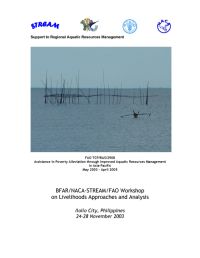
Workshop on Livelihood Approaches and Analysis, 24-28 November 2003, Philippines

This is the report of the “BFAR/NACA-STREAM/FAO Workshop on Livelihoods Approaches and Analysis” held in Iloilo City, Philippines from 24-28 November 2003. The main purpose of the workshop was to develop and document mechanisms for training in livelihoods approaches and analysis, and to build national capacity to conduct livelihoods analysis. The workshop in Iloilo was the first in a series which will take place in other countries in the region.

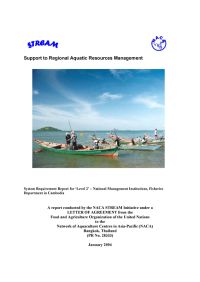
System requirements report for 'level 2' - national management institutions, Fisheries Department in Cambodia

This report describes the national-level requirements for data collection and sharing mechanisms for fisheries co-management in Cambodia. It presents the findings from a thorough literature review and workshops, group and individual interviews. Community fisheries in Cambodia are at a very early stage of development, and the exact management responsibilities are still poorly understood by many stakeholders. This report relates the information needs voiced by participants in this study.

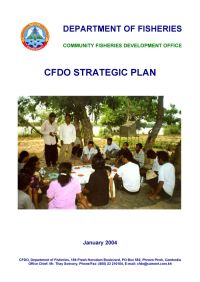
Community Fisheries Development Office Strategic Plan

In October 2000 the government of Cambodia announced a major change in fisheries management policy. The core elements of the new policy are the reduction of fishing lot concession areas by 56%, the broader participation of fishing communities in the management of fisheries and a focus on the efficient, sustainable and equitable use of the living aquatic resources. This document details the Strategic Plan for the CFDO in the Department of Fisheries (DoF) based on its mandate.

STREAM Journal Volume 3, No. 1, January-March 2004

In this issue: Creating understanding and ownership of collaborative research results through 'learning by doing'. Fish culture, farming, markets and promotion - an integrated, sustainable approach to aquaculture and rural development. Fisheries policy reform impact assessment in Cambodia - understanding policy and poor people. "Shrimp hero" Phan The Phuong. Coral farming in Vietnam. The global fisheries market - can rural poor people benefit? Issues raised by STREAM Media Monitoring reports. About the STREAM Journal. About STREAM. This edition is also available in Ilonggo.

Quarterly Aquatic Animal Disease Report, January-March 2004

This report, the 23rd in the series, contains information about the aquatic animal health status of twenty states in the Asia-Pacific region. The foreword discusses a project on Capacity and Awareness Building on Import Risk Analysis for Aquatic Animals, funded by the APEC Fisheries Working Group.

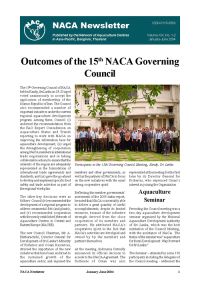
NACA Newsletter Volume XIX, No. 1-2, January-June 2004

In this issue:

Outcomes of the 15th Governing Council. Aquaculture seminar. Council Chair for 2004-2005. Shrimp disease and coastal management - four years. New Import Risk Analysis publications. Reducing the risk of shrimp disease outbreaks in Vietnam. Network of Aquaculture Centres in Central and Eastern Europe. OASIS: The One Stop Aqua Shop Information Service. Other recent STREAM activities. New faces at NACA.

Report of the Expert Consultation on Aquaculture Education in the Asia-Pacific, Hanoi, Vietnam, 11-15 May 2000

The Expert Consultation on Aquaculture Education in the Asia-Pacific was held in, Vietnam, 2000. The consultation was the final activity of APEC project FWG/02/99 “Collaborative Aquaculture Education Program”. This report gives the findings and papers presented to the Expert Consultation, including the follow-up recommendations for establishing an Aquaculture Educational Consortium, in the form of a network, comprising academic and training institutions in the Asia and Oceania regions.

Quarterly Aquatic Animal Disease Report, October-December 2003

This report, the 22nd in the series, contains information about the aquatic animal health status of seventeen states in the Asia-Pacific region. The foreword discusses the role of disease surveillance programmes and issues realted to the OIE Aquatic Animal Health Standards Commission.

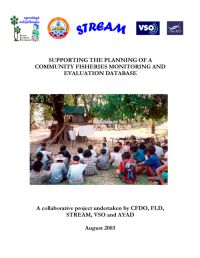
Supporting the planning of a community fisheries monitoring and evaluation database

Knowledge of community fisheries and their capacity is a pre-requisite for co-management. This report illustrates the development of a pilot data collection, sharing and interrogation mechanisms for key information in support of co-management, identifying information requirements and procedures for the transmission and sharing of information between relevant stakeholders. A combination of focus group interviews with the community committee and village leaders, and participatory rural appraisal was used as a means of information compilation.

STREAM Journal Volume 2, No. 3, July-September 2003

In this issue: Livelihood improvements through fisheries in the Pode community in Pokhara, Nepal. Women's participation in coastal resources management and livelihoods in Khanh Hoa Province, Vietnam. Supporting people's efforts and interactions in coastal resources management in Indonesia. Planning for a community fisheries M&E system. Identifying needs and recommendations for efficient stakeholder communications through an information access survey. IEC Seminar-Workshop in Support of Fisheries Ordinance Implementation in Roxas City, Philippines. About the STREAM Journal. About STREAM.

Quarterly Aquatic Animal Disease Report, July-September 2003

This report, the 21st in the series, contains information about the aquatic animal health status of sixteen states in the Asia-Pacific region. The foreword discusses the outcomes of the second meeting of the Asia Regional Advisory Group on Aquatic Animal Health.

Report of the Second STREAM Regional Conference, Tagaytay City, the Philippines, 8-10 June 2003

The Second STREAM Regional Conference was held in Tagaytay City, Philippines, from 8-10 June 2003 with the participation of 23 people from Australia, Cambodia, India, Nepal, Philippines, Thailand, Vietnam and Yunnan Province of China. Following a regional overview of STREAM’s themes, country partners, donors and funding, and activities, participants visited four “stations” on the themes of livelihoods, institutions, policy development, and communications, working in groups representing National Coordinators, Communications Hub Managers, and Partners. STREAM operations were discussed.

Quarterly Aquatic Animal Disease Report, April-June 2003

This report, the twentieth in the series, contains information about the aquatic animal health status of nineteen states in the Asia-Pacific region. The editorial discusses health risks associated with trans-boundary movement of live aquatic animals and the role of risk analyses.