Cambodia

Cambodia's involvement in NACA.

Creative Commons Attribution.

Related

NACA member governments

NACA member governments are: Australia, Bangladesh, Cambodia, China, Hong Kong SAR, India, Indonesia, I.R. Iran, Kingdom of Saudi Arabia, Korea (DPR), Lao PDR, Malaysia, Maldives, Myanmar, Nepal, Pakistan, Philippines, Sri Lanka, Thailand and Vietnam.

In this collection

STREAM Journal Volume 3, No. 1, January-March 2004

In this issue: Creating understanding and ownership of collaborative research results through 'learning by doing'. Fish culture, farming, markets and promotion - an integrated, sustainable approach to aquaculture and rural development. Fisheries policy reform impact assessment in Cambodia - understanding policy and poor people. "Shrimp hero" Phan The Phuong. Coral farming in Vietnam. The global fisheries market - can rural poor people benefit? Issues raised by STREAM Media Monitoring reports. About the STREAM Journal. About STREAM. This edition is also available in Ilonggo.

Quarterly Aquatic Animal Disease Report, January-March 2004

This report, the 23rd in the series, contains information about the aquatic animal health status of twenty states in the Asia-Pacific region. The foreword discusses a project on Capacity and Awareness Building on Import Risk Analysis for Aquatic Animals, funded by the APEC Fisheries Working Group.

NACA Newsletter Volume XIX, No. 1-2, January-June 2004

In this issue:

Outcomes of the 15th Governing Council. Aquaculture seminar. Council Chair for 2004-2005. Shrimp disease and coastal management - four years. New Import Risk Analysis publications. Reducing the risk of shrimp disease outbreaks in Vietnam. Network of Aquaculture Centres in Central and Eastern Europe. OASIS: The One Stop Aqua Shop Information Service. Other recent STREAM activities. New faces at NACA.

Report of the Expert Consultation on Aquaculture Education in the Asia-Pacific, Hanoi, Vietnam, 11-15 May 2000

The Expert Consultation on Aquaculture Education in the Asia-Pacific was held in, Vietnam, 2000. The consultation was the final activity of APEC project FWG/02/99 “Collaborative Aquaculture Education Program”. This report gives the findings and papers presented to the Expert Consultation, including the follow-up recommendations for establishing an Aquaculture Educational Consortium, in the form of a network, comprising academic and training institutions in the Asia and Oceania regions.

Quarterly Aquatic Animal Disease Report, October-December 2003

This report, the 22nd in the series, contains information about the aquatic animal health status of seventeen states in the Asia-Pacific region. The foreword discusses the role of disease surveillance programmes and issues realted to the OIE Aquatic Animal Health Standards Commission.

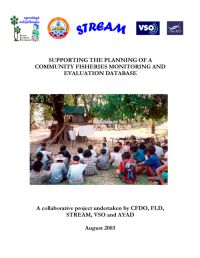
Supporting the planning of a community fisheries monitoring and evaluation database

Knowledge of community fisheries and their capacity is a pre-requisite for co-management. This report illustrates the development of a pilot data collection, sharing and interrogation mechanisms for key information in support of co-management, identifying information requirements and procedures for the transmission and sharing of information between relevant stakeholders. A combination of focus group interviews with the community committee and village leaders, and participatory rural appraisal was used as a means of information compilation.

STREAM Journal Volume 2, No. 3, July-September 2003

In this issue: Livelihood improvements through fisheries in the Pode community in Pokhara, Nepal. Women's participation in coastal resources management and livelihoods in Khanh Hoa Province, Vietnam. Supporting people's efforts and interactions in coastal resources management in Indonesia. Planning for a community fisheries M&E system. Identifying needs and recommendations for efficient stakeholder communications through an information access survey. IEC Seminar-Workshop in Support of Fisheries Ordinance Implementation in Roxas City, Philippines. About the STREAM Journal. About STREAM.

Quarterly Aquatic Animal Disease Report, July-September 2003

This report, the 21st in the series, contains information about the aquatic animal health status of sixteen states in the Asia-Pacific region. The foreword discusses the outcomes of the second meeting of the Asia Regional Advisory Group on Aquatic Animal Health.

Report of the Second STREAM Regional Conference, Tagaytay City, the Philippines, 8-10 June 2003

The Second STREAM Regional Conference was held in Tagaytay City, Philippines, from 8-10 June 2003 with the participation of 23 people from Australia, Cambodia, India, Nepal, Philippines, Thailand, Vietnam and Yunnan Province of China. Following a regional overview of STREAM’s themes, country partners, donors and funding, and activities, participants visited four “stations” on the themes of livelihoods, institutions, policy development, and communications, working in groups representing National Coordinators, Communications Hub Managers, and Partners. STREAM operations were discussed.

Quarterly Aquatic Animal Disease Report, April-June 2003

This report, the twentieth in the series, contains information about the aquatic animal health status of nineteen states in the Asia-Pacific region. The editorial discusses health risks associated with trans-boundary movement of live aquatic animals and the role of risk analyses.

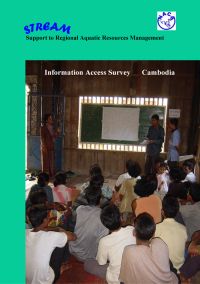
Cambodia information access survey

The aim of this report is to identify and recommend methods of communication that are appropriate to aquatic resources management stakeholders, focusing in particular on poor rural communities in Cambodia. As the Cambodian government begins to work more closely with local aquatic resources managers from poor rural communities, increased attention is being paid to the use of communication strategies and tools, in particular by the newly established Community Fisheries Development Office of the Department of Fisheries.

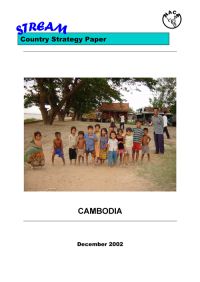
Cambodia country strategy paper

Cambodia is one of the poorest countries in the world; much of its population live in rural areas and many live below the local poverty line. The management of common property aquatic resources is of over-riding importance to food security and sustainable rural development in Cambodia. The key groups of poor people who use aquatic resources as part of their diverse livelihoods portfolios are subsistence fishers, small-scale aquaculture practitioners and aquatic resources collectors.

Report on sustainable livelihoods study of farmers and fishers in Kaoh Chbar Village, Kratie Province, Cambodia

This study of the livelihood of farmers and fishermen is based on the information provided by the villagers representing 142 households in the village. There had been some changes that impacted on the livelihood of villagers, especially in natural resources. The population is constantly growing which leads to an increase in natural resource utilisation and ultimately their degradation. The villagers usually suffer from diseases such as malaria, fever and dengue fever.

A livelihoods study of farmers and fishers in Saob Leu Village, Kratie Province, Cambodia

This is the report of a livelihoods study team working together with villagers from Saob Leu Village in Kratie Province, Cambodia from 10-15 July 2002. The team worked with 1530 villagers who volunteered to participate and represented the 177 households in the village. The villagers rely mainly on farming, with dry season rice being the most important crop. Most villagers are involved in small-scale fishing, with some having other skills.

A livelihoods study of farmers and fishers in Trorbek Pork Village, Kandal Province, Cambodia

This is the report of a livelihoods study team working together with villagers from Trorbek Pork in Kandal Province, Cambodia. In Trorbek Pork Village there are 140 families and a total population of 700 persons. The primary occupation of villagers was farming dry season rice on 47 ha, and in addition cultivating vegetables such as corn, mung bean, wax gourd, chilli and sesame on 15 ha. Secondary occupations included fishing, garment making, singing, laboring and repairing machines.

Report on sustainable livelihoods study of farmers and fishers in Dong Kom Village, Kandal Province, Cambodia

This study was based on the population census (1998) and key informant interviews (10 to 50 villagers voluntarily represented the 253 families of Dong Kom Village). There were 253 families with a total population of 1,192 persons. The primary occupation of villagers was farming, growing dry season rice on 1,900 ha, besides that they grow other vegetables such as corn, pumpkin and other vegetables on 200 ha. Secondary occupations were fisher, teachers, traditional medical practitioner, barber and other services.

A livelihoods study of farmers and fishers in Dang Tong Village, Kampong Chhnang Province, Cambodia

This is the report of a livelihoods study team working together with villagers from Dang Tong Village in Kampong Chhnang Province, Cambodia. In general, villagers are skilled in farming and mat weaving, but some villagers also have individual skills such as carpentry, boat making, hairdressing and fixing machines. Although this village is in the Tonle Sap (Great Lake) area, which has the most plentiful supply of fresh fish in the country, the villagers are subsistence fishers.

Report on sustainable livelihoods study of farmers and fishers in Koh Reusey Village, Kampong Chhnang Province, Cambodia

The main objective of the study is to understand the villagers’ standard of living, hardship, external impact, present and future demand. The team interviewed with 15 to 60 villagers including men, women, young and old villagers, represented 135 families in the village. The main occupations of the villagers are farmers cultivating rice on 299 hectares of seasonal rice and 61.8 hectares dry season rice and fishers. Beside that, they have other occupations such as repairers, making thatch.

STREAM Journal Volume 1, No. 3, July-September 2002

In this issue: From resource user to resource manager: A significant change story. Significant change with Cambodian provincial livelihoods study teams. The Community Fisheries Development Office: One year on. CFDO open for business! Stakeholders and institutional involvement in aquaculture management and development. Fish seed production for aquaculture in Southeast Cambodia: Decentralisation - the way to go? About the STREAM Journal. About STREAM. This edition is also available in Ilonggo, Khmer, Nepali and Vietnamese.

Report of the workshop on process monitoring and significant change, 26-28 June 2002

The aim of this workshop was to formulate an approach which would enable participants to start detailed work on a process monitoring system, building on current activities and using already existing skills in Cambodia, Nepal, Philippines, Thailand and Vietnam. Objectives were to familiarise participants with recent developments in process monitoring and significant change, and to develop an action plan for each country and a set of guiding principles for a monitoring system to underpin work in all countries.