NACA member governments are: Australia, Bangladesh, Cambodia, China, Hong Kong SAR, India, Indonesia, I.R. Iran, Kingdom of Saudi Arabia, Korea (DPR), Lao PDR, Malaysia, Maldives, Myanmar, Nepal, Pakistan, Philippines, Sri Lanka, Thailand and Vietnam.
The recordings in this collection are the annual progress reports of NACA's regional lead centres in Thailand, China and the Philippines. The presentations were made at the 23rd NACA Governing Council Meeting, which was held in Siem Reap, 27-29 May 2011, hosted by the Government of Cambodia. The Governing Council is NACA's peak policy body, which meets annually to review the organisation's activities and set priorities for the year ahead.
The Colombo Declaration is a commitment to regional cooperation in aquaculture development for food security, nutrition and economic development in Asia. It was developed and agreed on by delegations from 18 states at a ministerial-level meeting held in Colombo, Sri Lanka, 28-29 July 2011.
The recordings in this collection are the annual progress reports of NACA’s regional lead centres in India, Thailand, China and the Philippines, plus a summary of NACA’s progress over the past five years and a special address by Professor E.G. Silas. The presentations were made at the 22nd NACA Governing Council Meeting in Cochi, Kerala, from 9-11 May 2011, India.
The Asia Regional Advisory Group on Aquatic Animal Health meets annually to discuss regional health issues including emerging disease threats. This report includes a review of regional disease status circa 2010, global and regional disease reporting arrangements, global issues and standards, progress in implementation of the the Regional Technical Guidelines on Health management for the Responsible Movement of Live Aquatic Animals, identification and designation of regional aquatic animal health resources and regional and international cooperation.
4 February 2011 | Miao Weimin, Sena De Silva and Brian Davy (eds.) | 6185 Downloads | .pdf | 1.16 MB
This regional review study is an effort to promote improved inland fisheries management under the Code of Conduct for Responsible Fisheries. It covers ten Asian countries with significant inland capture fisheries, namely Bangladesh, China, India, Indonesia, the Republic of Korea, Myanmar, Nepal, Sri Lanka, Thailand and Viet Nam. The papers were presented and discussed at a regional workshop held from 8-11 February 2010 in Pattaya, Thailand. Audio recordings of the presentations are also available for download.
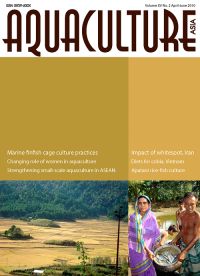
The Dedanaw Project, Myanmar. The changing face of women for small-scale aquaculture in Bangladesh. Strengthening capacity of small holders in ASEAN. Carp seed production in Orissa, India. Sustainable mountain paddy-fish farming of the Apatani tribes. The economic impacts of whitespot virus on shrimp production in Iran. Current practices of marine finfish cage culture in China, Indonesia, Thailand and Vietnam. Effects of trash fish on growth and body composition of cobia.
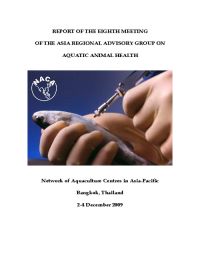
The Asia Regional Advisory Group on Aquatic Animal Health meets annually to discuss regional health issues including emerging disease threats. This report includes a review of regional disease status circa 2009, global and regional disease reporting arrangements, global issues and standards, progress in implementation of the the Regional Technical Guidelines on Health management for the Responsible Movement of Live Aquatic Animals, identification and designation of regional aquatic animal health resources and regional and international cooperation.
Inland aquatic ecosystems in China have been largely influenced by the large-scale economic activities and over-exploitation of aquatic resources. A wide range of fisheries resource enhancement and conservation activities have been carried out throughout China. This presentation reviews the history and practices and analyses the problems and insufficient in inland fisheries resource enhancement and conservation in China, and finally recommends some suggestions on technology and operation in order to sustain inland fisheries resources.
25 September 2009 | Jianshou Liu, Zhongjie Li, Songguang Xie, Weimin Miao, Wangbao Gong and Lang Wu | 1504 Downloads | .pdf | 299.39 KB
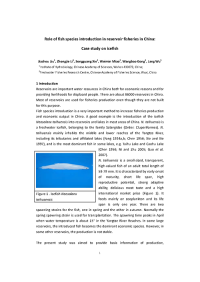
Fish species introduction has been a very important method of increasing fisheries production and economic output in China. A good example is the introduction of the icefish Neosalanx taihuensis into reservoirs and lakes in most areas of China. The present study aims to provide basic information on production, management strategies and biological characteristics in target reservoirs and lakes in China and guide introduction and management practices of the fish.
7 June 2009 | Sena De Silva and Upali Amarasinghe (eds.) | 2401 Downloads | .pdf | 1.1 MB
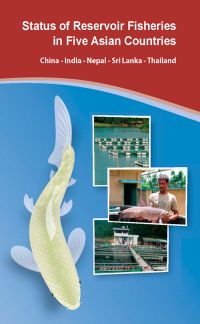
Reservoir fish fauna, fisheries production and management methods, amongst others factors, differ widely. The differences in fish yield between reservoirs and/or between countries cannot be easily understood and are unlikely to be determined by individual parameters or characteristics. This volume takes stock of the current management practices with a view to utilising this knowledge to develop and or evolve appropriate national and or regional strategies for sustained development of reservoirs fisheries.
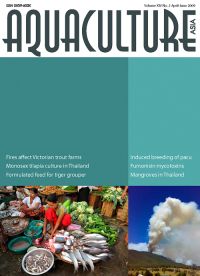
GLOBALGAP standard in Thai shrimp farms: Mission (im)possible? The Victorian trout industry and the bushfires. Small-scale aquaculture in the Ayeyarwady Delta, Myanmar. The history, status and future prospects of monosex tilapia culture in Thailand. Mangroves of Nakhon Si Thammaarat Province in Souther Thailand. Induced breeding of pacu Piaractus brachypomus in captivity. Fumosins - mycotoxins of increasing importance in fish. Microsatellite DNA markers, a fisheries perspective. Formulated feed for tiger grouper grow out.
NORAD funded project on climate change initiated. Sign up for our free email newsletter service! Market chains and biosecurity of 'low value' aquaculture commodities. Global conference on aquaculture 2010. Extending information and technical services to aquaculture farmer groups in Aceh. Giant Prawn 2011, Quindao, China. Alien species in aquaculture and biodiversity: A paradox in food production. Aquatic ecosystems and development: Comparative Asian perspectives. Macrobrachium: The culture of freshwater prawns.
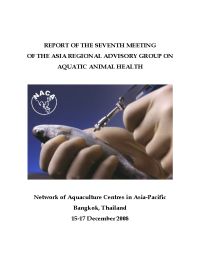
The Asia Regional Advisory Group on Aquatic Animal Health meets annually to discuss regional health issues including emerging disease threats. This report includes a review of regional disease status circa 2008, global and regional disease reporting arrangements, global issues and standards, progress in implementation of the the Regional Technical Guidelines on Health management for the Responsible Movement of Live Aquatic Animals, identification and designation of regional aquatic animal health resources and regional and international cooperation.
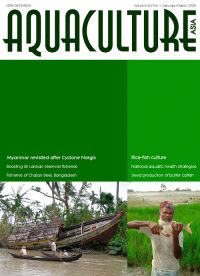
Myanmar revisited. Harvesting, traditional preservation and marketing of fishes of Chalan Beel, Bangladesh. Role of community in production and supply of larger, quality fingerlings. Can rice-fish farming provide food security in Bangladesh? Nutritional and food security for rural poor through multi-commodity production from a lake of eastern Uttar Pradesh. Emerging boost in Sri Lankan reservoir fish production. Farming the freshwater prawn Macrobrachium malcolmnsonii. Breeding and seed production of catfish Ompok pabda.
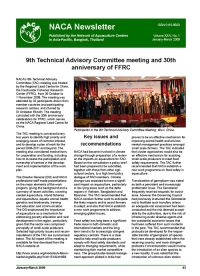
9th Technical Advisory Committee meeting and 30th anniversary of FFRC. Training Workshop on the Use of Molecular Genetics in Conservation held at USM, Malaysia. Japan International Award for NACA Staff. Consortium on freshwater finfish genetics and breeding. Shrimp Farming eNews. Seventh Meeting of the Asia Regional Advisory Group on Aquatic Animal Health. Sri Lankans learn pisciculture at CIFA. India's Central Institute for Freshwater Aquaculture observes 33rd Foundation day.
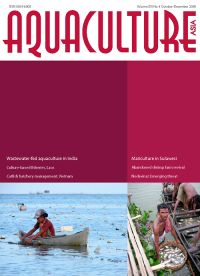
An increasingly secure future for wastewater-fed aquaculture in Kolkata, India? First culture-based fisheries growth cycle in Lao PDR is overhwelmingly encouraging. Revival of abandoned shrimp farms in Andhra Pradesh. Growth of industries linked with aquaculture in Kolleru Lake area, India. Applications of nutritional biotechnology in aquaculture. Technical and management aspects of catfish hatcheries in Vietnam. Asian seabass farming. Mariculture development opportunities in southeast Sulawesi, and much more.
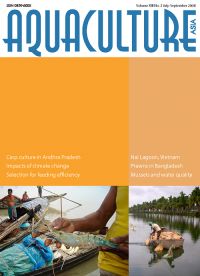
Possible improvements to carp culture in Andhra Pradesh. Aquaculture and environmental issues in the region of Nai Lagoon, Vietnam. Selection potential for feed efficiency in farmed salmonids. Freshwater prawn broodstock concern in Bangladhesh hatcheries. Production of Cirrhinus molitorella and Labeo chrysophekadion for culture-based fisheries in Lao PDR: Nursery and grow-out. Mussel farming: Alternate water monitoring practice. Use of poultry by-product meals in pelleted feed for humpback grouper Cromileptes altivelis.
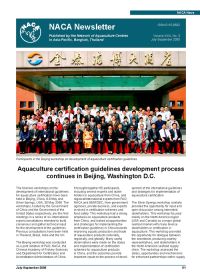
Aquaculture certification guidelines development process continues in Beijing, Washington D.C. Development of BMPs for catfish farming in Vietnam - survey of management practices. NACA extends cooperation with ADB for tsunami rehabilitation in Indonesia. International hands-on training programme on molecular biology techniques. Cage aquaculture carrying capacity tool now available. 6th Regional Grouper Hatchery Production Training Course completed. 2008 Forum on Fisheries Science and Technology, 25-27 September 2008, Shanghai, China. Aquaculture success stories 'write shop'. Bookshelf: New publications for free download.
This workshop was the fifth in a series of consultations to prepare the international guidelines for aquaculture certification. The workshop had a strong emphasis on aquaculture products from China, and explored opportunities and challenges for implementing the certification guidelines in China towards improving overall aquatic production and trade of aquaculture products. The workshop considered that international guidelines for aquaculture certification would provide a useful basis for development of standards for certification of aquaculture products in China.